
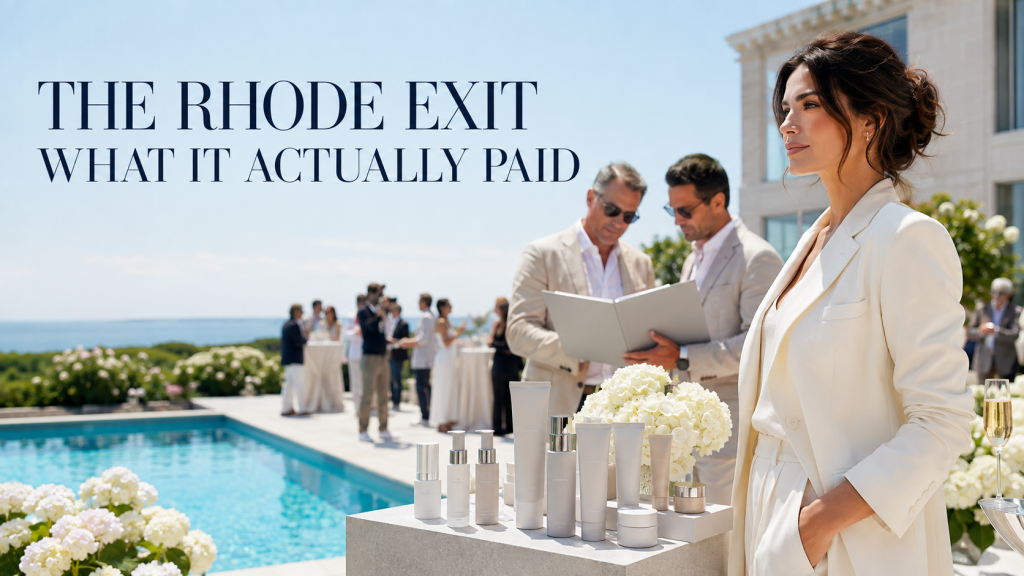
In May 2025, e.l.f. agreed to pay up to $1 billion for Rhode, a skincare company that was barely three years old. Hailey Bieber owned most of it. Since the close, the Hailey Bieber net worth estimate has jumped to roughly $300 million. That is a tenfold rewrite of her old model-money math. The glazed donut turned out to be a liquidity event.
This refresh replaces our earlier profile, because the old numbers no longer survive contact with the filings. For the machinery behind conversions like this one, start with our field guide to celebrity wealth.
The Numbers at a Glance
Current Hailey Bieber net worth: roughly $300 million. Deal value: up to $1 billion, with $800 million paid at close. Trailing sales at the sale: $212 million. Multiple: 3.8 times revenue. Earnout remaining: up to $200 million through 2028.
Titles kept: Founder, Chief Creative Officer, Head of Innovation, plus the advisor seat. Age at close: 28. Time from launch to billion-dollar exit: three years.
The Number: How $20 Million Became $300 Million
Celebrity Net Worth now pegs her at $300 million, held separately from Justin’s $200 million. Before Rhode, the estimate hovered near $20 million, which was respectable runway money. The difference is one deal.
The math runs like this. Rhode sold for $800 million at closing, split between $600 million in cash and roughly 2.6 million e.l.f. shares. Analysts who model her stake between 50 and 70 percent land on a post-tax range of $309 million to $433 million. California takes its cut, so the public estimate settles near the bottom of that band.
Estimates diverge because methodologies do. Forbes discounts private stakes harder, while Celebrity Net Worth prices the cash at the wire. Both agree on the direction, and the direction is straight up. The honest range runs from $250 million to something north of $400 million.
Two details matter more than the headline. First, she took stock as well as cash, so the fortune still moves with the acquirer’s chart. Second, the earnout clock is running, and it is running fast. Every Hailey Bieber net worth estimate is downstream of one ownership decision made in 2022.
Before Rhode: Ford Models and the Baldwin Ledger
The pre-founder resume was solid rather than spectacular. She signed with Ford Models in 2014, then worked campaigns for Tommy Hilfiger, Ralph Lauren, and Versace. Vogue covers followed in due course, together with the runway seasons that establish a face without enriching it. Model fees at that tier buy a nice apartment, not a compound.
The name helped and complicated things at once. Stephen Baldwin is her father, Alec is her uncle, and the tabloids kept the surname warm for two decades before she monetized it. Marrying Justin Bieber in 2018 added an arena-sized audience to the balance sheet.
The overlooked chapter is the content play. Her YouTube kitchen-and-bathroom series was produced with OBB, the studio Michael D. Ratner built. Those episodes look like fluff in hindsight, yet they were the audition for a business partnership. She was testing founders before she became one.
Attention, though, is not income. Until 2022 she was famous the way most models are famous, visible everywhere and liquid nowhere. The next chapter fixed that.
Three Products and a Waiting List
Rhode launched in June 2022 with three products and a waitlist that never really cleared. Her co-founders were Michael D. Ratner and Lauren Ratner, with Nick Vlahos, formerly of The Honest Company, running the business as CEO. The bench mattered, because famous founders fail without operators.
Discipline was the strategy. While rivals shipped fifty SKUs, Rhode held its line to a handful and let the sellouts do the advertising. The peptide lip treatment and the glazed aesthetic became intellectual property. By March 2025 the brand was doing $212 million in trailing annual sales.
The launch cadence stayed almost insultingly patient. One or two products a year arrived, each teased for weeks from her own feed. Legacy houses spend nine figures on marketing for less attention than a single Rhode drop generated.
Distribution stayed deliberately scarce until the end. Rhode sold direct from its own site for three years, then announced the Sephora expansion around the time the deal landed. Scarcity built the demand, and the acquirer bought the release valve.
That figure is the one to memorize. At the sale price, e.l.f. paid roughly 3.8 times sales, a multiple usually reserved for brands with decades of equity. Earned media value explains the premium, since Rhode ranked first in its category in 2024.
The Deal: What e.l.f. Actually Paid
The structure rewards close reading. According to the acquisition announcement, e.l.f. paid $800 million at closing, with up to $200 million more tied to three years of growth targets. The stock component came to about 2.6 million shares.
Then the earnout started paying early. In 2026, e.l.f. booked a $57.6 million charge because Rhode kept beating the targets the bankers had modeled. Buyers rarely celebrate writing bigger checks, although this one did.
Compare that to the celebrity deals that aged badly. Coty bought its Kylie stake at the top, then watched the value fall, a story we told in the Kylie Jenner lip kit breakdown. Rhode inverted that pattern, and the acquirer’s shareholders cheered.
The Earnout Math: The $200 Million Still in Play
The earnout deserves its own ledger, because it is where the next $100 million lives. The contract ties up to $200 million to Rhode’s growth over three years from the close. Miss the targets and the money evaporates. Beat them and e.l.f. pays for the privilege.
So far the beating is one-sided. The $57.6 million charge in 2026 exists because accounting rules force the buyer to book expected earnout payments as Rhode outruns the model. In plain English, the brand is growing faster than the people who paid a billion dollars thought possible.
Her e.l.f. shares tell the same story from another angle. The stock jumped double digits on the announcement, so the $200 million paper component started appreciating before the ink dried. Founders who sell for all cash never get that second ride. Analysts covering e.l.f. now cite Rhode as the growth engine in their buy notes, which was not the consensus at announcement.
What She Kept
The exit did not end her involvement, and the titles prove it. She stays Founder, adds Chief Creative Officer and Head of Innovation, and advises the combined company on strategy. The face remains under contract to the brand it built.
This is the modern founder template. Sell the equity while the heat is real, then keep the creative chair so the story continues. Our celebrity beauty brand net worth rankings track who ran this play and who waited too long.
The stock component does quiet work too. Roughly $200 million in e.l.f. shares means she profits twice, once from the sale and again from the growth she keeps creating. Few endorsement contracts have ever paid like that.
The Peer Table: Where She Ranks Now
The beauty founder leaderboard now reads in tiers. Rihanna’s Fenty fortune sits at $1.4 billion, while Selena Gomez’s Rare Beauty run holds near $1.3 billion. Both kept their equity rather than selling.
Hailey chose the opposite trade and banked certainty. At $300 million she ranks below the billionaires, yet she is the only one holding nine figures of cash from an actual close. Paper fortunes and wired fortunes are different species.
The adjacent comparison is instructive too. Kim Kardashian’s money story runs through SKIMS toward an IPO that keeps not arriving. Meanwhile Kendall’s $90 million tequila empire shows what happens when the famous face takes a smaller slice. Liquidity, not valuation, is the score that settles arguments.
The Bieber Household Balance Sheet
The household math deserves its own line item. Justin’s $200 million sits separately, anchored by the roughly $200 million sale of his music catalog in early 2023. Between them, the Biebers cleared half a billion before either turned thirty. For context, that combined figure rivals the exits of most venture-backed founders twice their age.
Their son Jack Blues arrived in August 2024, which reframed the empire as generational. Estate lawyers call this a planning event. Publicists call it a rebrand.
Notably, the two fortunes come from different industries. One rides streaming catalogs, while the other rides skincare margins, so the household is diversified in a way most celebrity marriages never manage.
The Next Act
The playbook she ran has a known sequel. Nick Vlahos, her CEO, previously scaled The Honest Company, whose founder story we covered in the Jessica Alba breakdown. Operators like that do not retire after one exit, and neither do founders holding nine figures of dry powder.
Watch the advisor seat. Strategic advisor to the combined companies sounds ceremonial, yet it gives her a view of every category e.l.f. wants to enter next. Fragrance is the obvious white space, since the glazed aesthetic has never been bottled.
The second brand, whenever it comes, will launch with the one asset money cannot buy back. Proof. Nobody argues with a founder whose first company sold for a billion dollars.
The Glazed Economy Comes East
The aesthetic she branded has a geography, and the geography is here. Glazed skin is the house look from Southampton to Montauk, maintained at price points Rhode never charged. The Hamptons longevity clinic boom sells the professional version of her drugstore promise.
Peptides are the connective tissue. The ingredient that anchored her lip treatment now anchors entire treatment menus, mapped in our peptide therapy provider guide. A $30 brand taught a generation to request the same chemistry at medspa prices.
That is the sponsor lesson hiding in this profile. The woman who sold skincare to teenagers moved the beauty standard for the women who summer out here. Brands that understand the chain from TikTok to treatment room are the ones filling July calendars.
The Status Read
There is a cultural mechanic underneath the math. She entered as a Baldwin, married into bigger fame, and spent years cast as the plus-one in someone else’s story. The nepo baby discourse priced her as inherited attention.
Rhode converted that scrutiny into margin. Every debate about her face drove traffic to a checkout page she owned. We map that conversion in our study of how beauty becomes a balance sheet and the broader physics in how fame becomes fortune.
The result reads like a status verdict. The woman priced as an accessory now out-earns most of the people who did the pricing. Out East, that arc is the whole genre. So the Hailey Bieber net worth story reads less like gossip and more like a case study.
Where The Conversation Continues
The full leaderboard lives in our 2026 celebrity net worth rankings, refreshed as the deals close. Rhode will not be the last billion-dollar face trade, although it set the current benchmark. Expect the Hailey Bieber net worth line to move again when the earnout settles in 2028.
For beauty and medspa brands, the readers of this page are the customers you keep missing. The July issue seats a finite table. So does the tent in Bridgehampton.
Author

Written by
Recent Posts

The First Decision After a Collision Can Be the Most Important One
Two Weeks in Rome and Beyond: Turkish Airlines Itineraries from Boston, Chicago and Onward to India
Top 10 Hair Transplant Clinics in Turkey 2026

Artist Alley to Online Store: How Convention Artists Can Keep Selling After the Event
When an 18-Wheeler Crash Leaves Lasting Consequences
Categories
- Art
- Articles
- Business of Luxury
- Celebrities
- Culture
- Entertainment
- Events
- Faces of Summer 2026
- Fashion
- Fashion & Style
- Featured
- Finance
- Food, Spirits, Wine
- Hamptons
- Hamptons Celebrities
- Health
- Health & Beauty
- Lifestyle
- Luxury Lifestyle
- Press
- Profiles
- Real Estate
- Technology
- The Chronicles
- Travel
- Uncategorized
- Weddings