
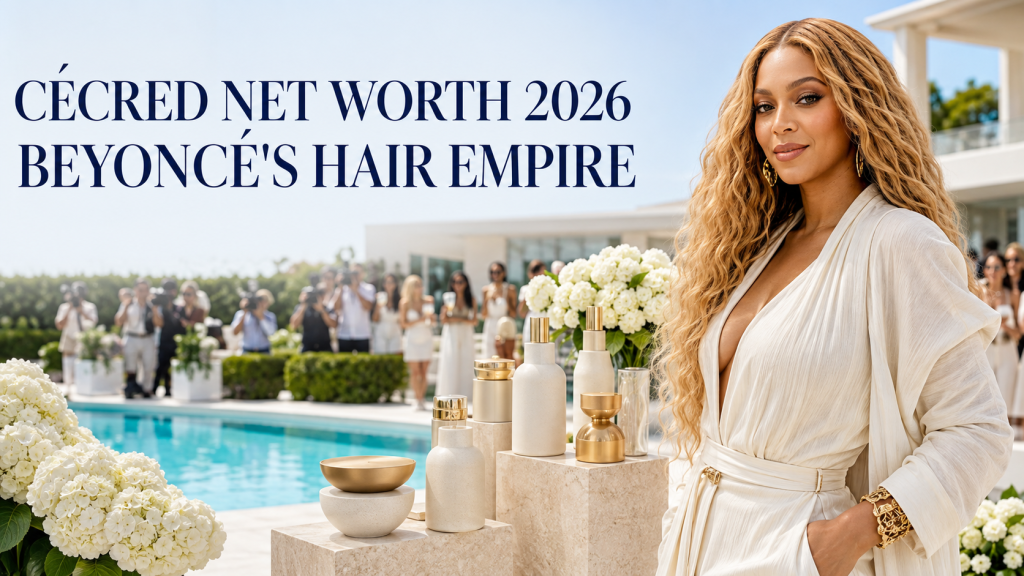
Beyoncé launched a haircare line in February 2024, and the industry prepared its polite applause. Soon the numbers arrived. Cécred net worth math starts with an estimated $200 million in first-year revenue, two million customers in six months, and one bottle of Edge Drops selling every 16 seconds. Above all, she owns 100 percent of it. Nobody else in this cluster can say that at this scale.
The parent fortune, together with the touring money, sits in Beyoncé’s billion-dollar audit. This piece isolates the hair money, because the hair money just changed the whole leaderboard.
The Ledger Nobody Saw Coming
Run the first-year tape. Revenue: an estimated $200 million or more, per the case-study coverage. Customers: two million inside six months. Products: 19 across three collections, priced $18 to $56, so the money came from volume rather than vanity pricing.
One product deserves its own line. Edge Drops moves a unit every 16 seconds, projecting past $100 million a year for a single SKU. By comparison, most celebrity brands never see that number across an entire line. Notably, the mid-market pricing did the work luxury pricing could not, filling two million baskets fast.
Zero Investors, Full Stack
The capital structure is the real headline. She self-funded the entire operation, took no venture money, and kept every point of equity. Compare the three structures this cluster has documented so far.
The Rhode sale converted ownership into a nine-figure exit. Bella’s Series A fragrance play traded a slice for speed. Beyoncé chose the third door, which is also the hardest one: write the checks yourself, keep the whole company, answer to nobody.
Certainly, only a founder with catalog money can play it that way. The tours and the masters funded the patience, so the brand never needed a stranger’s timeline. Wealth bought her the same luxury it bought Scarlett Johansson, time, except at ten times the scale.
The Salon Inheritance
The origin is generational, not promotional. Tina Knowles spent four decades as a licensed cosmetologist and salon owner before becoming vice chairwoman, and her daughter spent childhood sweeping that salon floor. Six years of development and 14 pending patents came out of that inheritance.
This is the founder-hours test passed before the company existed. The failures in the shakeout files rented faces for launch day. Cécred was built by a family that did hair professionally before it did fame.
The patents matter for the valuation story too. Proprietary formulas and packaging turn a celebrity line into defensible intellectual property, which is what acquirers and bankers actually price. Authenticity is the marketing. The patent wall is the asset.
The Living Proof Hire
The operator pattern holds here as well. CEO Grace Ray ran Living Proof, the science-first haircare company, before taking this chair. Every winner in this cluster pairs a famous founder with a category professional, and the hair version is no exception.
Notice the sourcing shift, though. Rhode and Haus Labs drew executives from The Honest Company, whereas Beyoncé recruited from inside haircare itself. Category depth over celebrity-brand experience is a tell about ambition. She is not building a merch line. She is building a Living Proof with better distribution.
The Ulta Detonation
Distribution stayed direct-to-consumer for a full year, then went vertical. The April 2025 Ulta launch put the line in more than 1,400 stores at once, the largest haircare launch in the retailer’s history. Weekly projections doubled within 24 hours.
The sequencing echoes the Rhode strategy at larger scale. Prove demand on your own site first, then arrive at retail as a certainty rather than an experiment. Retailers pay better terms for certainties, and shelf position follows the receipts.
The international act is loading next, although the company has said little publicly. Watch the markets where the tours sell out fastest, because the shipping map usually follows the setlist map.
The Album Cycle Engine
The launch timing was orchestral. Cécred arrived in February 2024, one month before Cowboy Carter, so the biggest album cycle of her career doubled as the brand’s introduction campaign. The stadium tour that followed put the products backstage at every date.
This is the same cultural-calendar physics that powers the Haus Labs run, except she owns all of the beneficiary. When the founder is the biggest live act on earth, customer acquisition is a rounding error. The marketing budget is the career.
The Textured Hair Gold Rush
Cécred is the biggest story in a bigger shift. Textured haircare is a $31 billion market that legacy beauty ignored for decades, and Tracee Ellis Ross’s Pattern Beauty spent six years proving the demand. Mary Dillon, formerly Ulta’s chief executive, helped launch it.
The mother-daughter echo is hard to miss. Tracee built Pattern while her mother’s fortune, mapped in Diana Ross’s $250 million Motown architecture, proved Black entertainment wealth could compound for generations. Tina and Beyoncé run the same relay in reverse, with the mother holding the craft and the daughter holding the capital.
Even the Amyris wreckage left a hair survivor, since JVN found a buyer while its sibling brands folded. Hair, it turns out, is where celebrity beauty keeps proving durable. Routine categories reward the brands that earn a permanent spot in the shower.
The Fenty Hair Standoff
The category now hosts a heavyweight rivalry. Rihanna launched Fenty Hair in June 2024, four months after Cécred, which means the two biggest names in music are competing on the same aisle. Fenty’s beauty billions give her the bigger machine, although LVMH holds half of it.
The ownership split decides the scoring. Rihanna’s empire is larger, yet every Fenty dollar is shared, while every Cécred dollar is not. At comparable hair revenue, Beyoncé’s position would be worth roughly double per dollar sold.
Music already ranks the two of them constantly, as the who’s-richest-in-music board shows. Beauty just gave the rivalry a second scoreboard.
Where Cécred Ranks Now
Place the revenue beside the cluster. An estimated $200 million beats The Outset’s $150 million quiet machine, beats the Haus Labs run rate, and roughly matches what Rhode was doing when e.l.f. paid a billion for it. Cécred did that in year one.
Now apply any reasonable multiple to a fully owned, patent-backed, $200 million brand. The implied Cécred net worth lands in the high hundreds of millions, all of it hers. Among musicians who built brands, only the Fenty complex is bigger, and nobody’s position is cleaner.
The Status Read
Hair is the most intimate category in beauty, because it carries heritage the way skincare never has. A washday ritual is inherited, taught, and defended. Selling into that ritual requires standing inside it, which is precisely the credential the salon childhood provides.
That is why this brand skipped the skepticism every other celebrity launch eats. The customer did not ask whether Beyoncé was serious about hair. The question answered itself two generations ago. Equally, the category resists trend cycles, since ritual repurchases outlive every algorithm shift.
Where The Conversation Continues
The standings live in the 2026 net worth rankings and the beauty empire standings, where the Cécred net worth line now forces a rewrite. Watch for international retail next, because the DTC-then-detonate sequence has one more act.
Out East, the lesson lands on every sponsor deck. Heritage plus patience beats reach plus haste, in haircare and in July calendars alike. The brands built to last book the long table.
Author

Written by
Recent Posts

The First Decision After a Collision Can Be the Most Important One
Two Weeks in Rome and Beyond: Turkish Airlines Itineraries from Boston, Chicago and Onward to India

Top 10 Hair Transplant Clinics in Turkey 2026

Artist Alley to Online Store: How Convention Artists Can Keep Selling After the Event
When an 18-Wheeler Crash Leaves Lasting Consequences
Categories
- Art
- Articles
- Business of Luxury
- Celebrities
- Culture
- Entertainment
- Events
- Faces of Summer 2026
- Fashion
- Fashion & Style
- Featured
- Finance
- Food, Spirits, Wine
- Hamptons
- Hamptons Celebrities
- Health
- Health & Beauty
- Lifestyle
- Luxury Lifestyle
- Press
- Profiles
- Real Estate
- Technology
- The Chronicles
- Travel
- Uncategorized
- Weddings