
The Farmhouse That Changed Everything
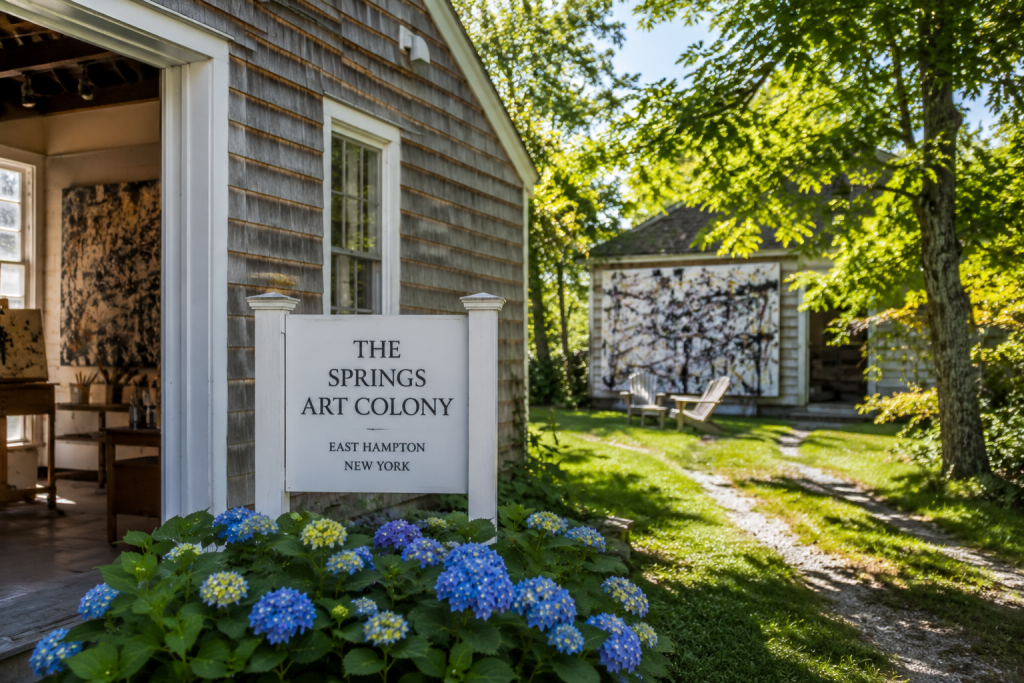
The Springs art colony East Hampton story begins with a $5,000 farmhouse. In November 1945, Jackson Pollock and Lee Krasner moved from Manhattan to a wood-frame house on 1.56 acres at 830 Springs-Fireplace Road, overlooking Accabonac Creek in the hamlet of Springs, within the Town of East Hampton. The house had been built in 1879 as a fisherman’s homestead. Also, a storage barn sat nearby. Both artists needed a break from the city, from the downtown gallery scene, from the cramped quarters of Manhattan’s art world. Indeed, what they found in Springs was not merely space. It was a new relationship between the artist and the landscape, and that relationship would produce the most consequential body of American art in the twentieth century.
Then, Pollock converted the barn into a studio. He pinned enormous canvases to the floor. He began dripping, pouring, and flinging house paint in rhythmic arcs, developing the technique that Clement Greenberg and Harold Rosenberg would champion and the world would eventually recognize as the signature gesture of Abstract Expressionism. Meanwhile, Krasner worked in the upstairs bedroom of the house, producing paintings that would take decades to receive their proper critical recognition. Certainly, the studio floor itself became a palimpsest of color: layers upon layers of dripped paint that visitors can still see today, preserved under padded slippers that the museum provides. For a Chelsea gallery owner (the Manhattan kind, not the London kind) who summers in Springs because the address carries curatorial credibility, this floor is not a relic. It is a pilgrimage site.
The Pollock-Krasner House: A National Historic Landmark
Lee Krasner continued working in the barn studio after Pollock’s death in a car accident in August 1956 (he died one mile from the house, on Springs-Fireplace Road, at the age of 44). Subsequently, Krasner used the studio from 1957 until her own death in 1984, and the walls are covered in colors and gestures from her major works, including “Gaea,” “Memory of Love,” and “Portrait in Green.” Under the terms of Krasner’s will, the property was deeded to the Stony Brook Foundation in 1987, and the Pollock-Krasner House and Study Center opened to the public in 1988. It was designated a National Historic Landmark in 1994.
Visiting the Museum
Today, the museum operates by reservation from May through October, Thursday through Sunday. Guided tours ($20 adults, $10 children) run at noon and 2 PM. Self-guided tours with audio guides are $15. SUNY and CUNY students and faculty receive free admission. Visitors see the house, the barn studio with its famous painted floor, and rotating exhibitions that contextualize Pollock’s and Krasner’s work within the broader East End art colony. Notably, the barn studio documents masterpieces including “Autumn Rhythm,” “Convergence,” and “Blue Poles,” all of which were created on this floor. Also, their tools and materials are displayed as they were during the artists’ lifetimes. The ground floor is wheelchair accessible; the studio is not, though alternative experiences are available.
She puts on the padded slippers and steps onto the studio floor.
Paint is everywhere. Layers upon layers. Sixty years of color dried into concrete.
Her gallery on 24th Street represents three artists who cite Pollock as a primary influence.
None of them have stood on this floor.
She photographs it with her phone. She will not post it.
Some things are for private confirmation, not public display.
The floor does not care about her gallery. It does not care about her artists.
It just holds what was poured onto it and waits.
Before Pollock: The Art Colony That Was Already There
The Springs art colony did not begin with Pollock and Krasner. It began decades earlier. Thomas Moran, the landscape painter known for his monumental canvases of Yellowstone and the Grand Canyon, established himself in East Hampton in the 1880s. Notably, his studio on Main Street still stands (it was designated a National Historic Landmark in 1965, making it the first artist studio so recognized in East Hampton). Childe Hassam, the American Impressionist, painted East Hampton’s light and architecture. William Merritt Chase ran a summer art school in Shinnecock, a few miles west, that influenced a generation of plein air painters.
In 1877, the Tile Club (a group of New York artists and writers) traveled east, fell in love with the landscape, and published their impressions in Scribner’s Magazine. Consequently, East Hampton acquired a reputation as an artist’s destination before it was a socialite’s destination. That summer colony (the Maidstone Club, estate-building on Lily Pond Lane, the transformation documented in East Hampton’s history) grew on top of this artistic foundation. The artists were here first. The money followed. Understanding that sequence is essential to understanding why the East End art market exists where it does.
Willem de Kooning and the Springs Migration
Willem de Kooning built his studio in Springs in 1963, seventeen years after Pollock and Krasner arrived. Specifically, his compound on Woodbine Drive (designed by his friend, architect John Hejduk, though de Kooning modified the plans extensively) became one of the most significant artist studios in American art history. Indeed, de Kooning lived and worked there until his death in 1997. The property is not open to the public but remains a reference point in art world geography: when dealers, curators, and collectors discuss the Springs art colony, de Kooning’s studio anchors the eastern end of the conversation while the Pollock-Krasner House anchors the western end.
Similarly, Elaine de Kooning, Alfonso Ossorio, Conrad Marca-Relli, James Brooks, and Charlotte Park all lived and worked in Springs during the Abstract Expressionist era. The hamlet functioned as a residential annex for the New York School: close enough to the city for gallery openings and studio visits, far enough away for uninterrupted work. For the artists, Springs offered cheap land, beautiful light, and a community of peers. In contrast to the village of East Hampton proper (with its Guild Hall openings and Newtown Lane boutiques), Springs maintained a working-class character that the artists valued. They were not summering. They were living, and the distinction still defines Springs today.
The Art Market Today: What Springs Built
The legacy of the Springs art colony radiates outward through the entire East End gallery scene. Contemporary dealers position themselves in proximity to the same landscape that produced Pollock’s “Number 1A” and de Kooning’s “Woman” series. Bridgehampton’s gallery corridor draws collectors who make the connection between historical significance and current market value. The Parrish Art Museum in Water Mill (housed in a Herzog and de Meuron building that opened in 2012) holds a permanent collection anchored by East End art. Guild Hall’s 2,400-work collection documents the community’s cultural life from the 1870s forward.
In the summer months, gallery openings on the East End function as social events that overlap with the dining scene, the beach scene, and the real estate market. Collectors who buy art on the East End are often the same people who buy houses on the East End, and the two markets reinforce each other. Indeed, a Pollock sold at auction in 2006 for $140 million (at the time, the highest price ever paid for a painting). The farmhouse where he made it cost $5,000. Essentially, that ratio tells you everything about what Springs created: a place where a barn floor became the birthplace of a market worth billions.
Springs in 2026: The Hamlet That Still Works
Springs remains, in many ways, the East End’s most authentic hamlet. Notably, Ashawagh Hall on Springs-Fireplace Road hosts community events, art shows, and the kind of local gatherings that the village of East Hampton has largely outgrown. The Fireplace Project, a nonprofit exhibition and project space, continues the tradition of artist-run alternatives that the Abstract Expressionists would recognize. Also, Springs General Store still operates. Still, the real estate market has reached Springs: homes that once housed fishermen and artists now sell for prices that reflect proximity to the Pollock-Krasner House and the de Kooning legacy.
For an art advisor from the Upper East Side (the kind who manages a $50 million private collection and considers Springs the only address on the East End with genuine cultural credibility), the hamlet offers something that Lily Pond Lane and Georgica Pond cannot: provenance. Not real estate provenance (the deed chain, the architectural lineage), but cultural provenance, the knowledge that the same light falling across Accabonac Creek fell across Pollock’s canvas in 1949. Ultimately, you cannot buy that. You can only live inside it and hope the proximity does its work.
Where the Conversation Continues
Social Life Magazine has covered the East End art scene for 23 years, five summer issues per season, 25,000 copies each, distributed at the galleries, museums, and cultural venues where collectors gather.
If your brand serves the art world audience (fine art, luxury publishing, private banking, insurance, philanthropy, bespoke framing, estate planning), a paid feature in Social Life Magazine places you in front of the 60,000 people who visit Guild Hall each year and the collectors who drive the East End market. Submit a paid feature here.
Polo Hamptons 2026 returns to 900 Lumber Lane in Bridgehampton on July 18 and 25. BMW North America is the title sponsor. Christie Brinkley hosts. Sponsorship at polohamptons.com.
Subscribe to Social Life Magazine for year-round coverage of the art, galleries, and cultural life of the East End.
Jackson Pollock bought a farmhouse for $5,000 in 1945. He converted the barn into a studio. He poured paint onto a floor. The floor is still there. Paint is still there. Today, the house is a National Historic Landmark. And the art world that grew from that barn floor is worth more than every estate on Lily Pond Lane combined. Springs does not compete with East Hampton Village. It does something harder. It reminds the village what art looked like before it became an asset class.
Author

Written by
Recent Posts

Sculpting Chic

Inside the Year-Round Hot Yoga Spot Quietly Becoming the Hamptons’ Real Club

How to Choose Useful Tech Gifts for Employees and Clients in 2026
The Garage Question: Which Car Goes South for the Season?
VandS Clinic Review Treatment: How Seoul Injectable and Laser Options Compare for US Patients
Categories
- Art
- Articles
- Business of Luxury
- Celebrities
- Culture
- Entertainment
- Events
- Faces of Summer 2026
- Fashion
- Fashion & Style
- Featured
- Finance
- Food, Spirits, Wine
- Hamptons
- Hamptons Celebrities
- Health
- Health & Beauty
- Lifestyle
- Luxury Lifestyle
- Press
- Profiles
- Real Estate
- Technology
- The Chronicles
- Travel
- Uncategorized
- Weddings