
The Street That Reads You Before You Read the Address
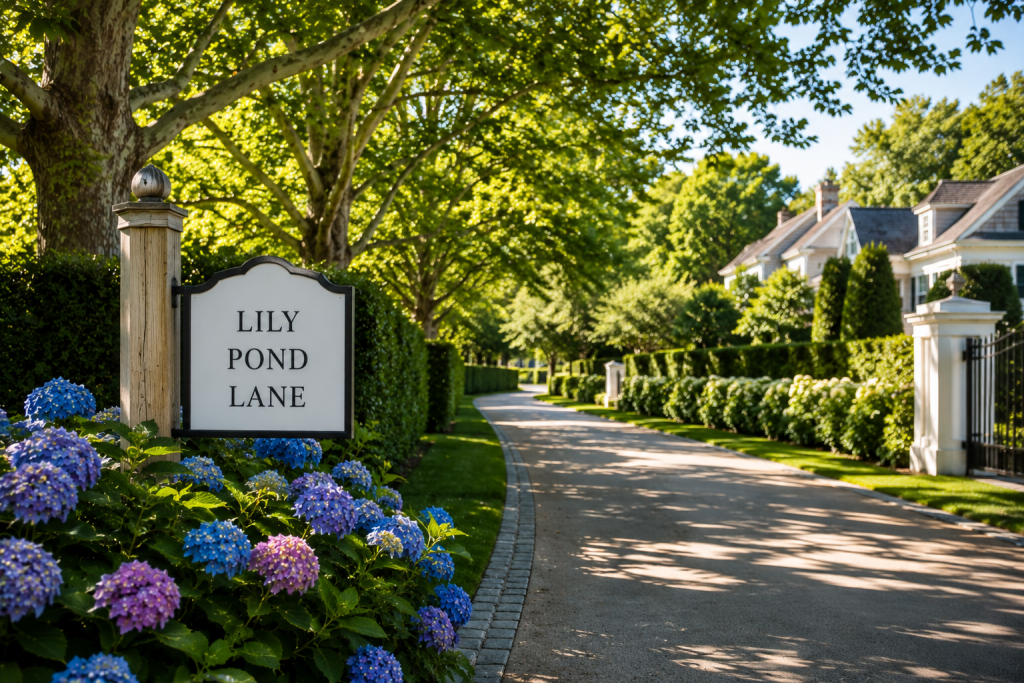
Lily Pond Lane runs east from Ocean Avenue toward Georgica Beach, approximately one mile of oceanfront and pond-front estates that have defined East Hampton’s identity for over a century. The street is known for its stately width, its rows of majestic beech trees, its towering London plane trees, and the kind of architectural pedigree that newer construction cannot replicate. Martha Stewart once described her initial attraction to Lily Pond Lane as its “quiet, serene appearance,” noting that while most houses were tucked behind privet hedges, some gardens were fully exposed and “breathtaking.” Indeed, this tension between concealment and display is the street’s operating principle. Every hedge hides something. Every gap in the hedge reveals something else. Both gestures are intentional.
Current pricing runs between $25 million and $70 million, depending on ocean frontage, lot size, and which side of the street you occupy. The 2025 sale of 33 Lily Pond Lane closed at $39 million with 171 feet of ocean frontage. David Geffen’s compound anchors the top of the range at $70 million (purchased 2016). Certainly, these numbers place Lily Pond Lane in the same tier as Meadow Lane in Southampton and Further Lane in terms of raw dollar volume. However, what Lily Pond Lane offers that its competitors cannot is history. The street’s oldest home dates to 1874, making it older than the Maidstone Club, older than Guild Hall, older than the railroad.
The Architects Who Built the Street’s DNA
J. Greenleaf Thorp is the architect who defined East Hampton’s resort aesthetic. He designed multiple homes along Lily Pond Lane in the early 1900s, establishing the shingled, Colonial Revival vocabulary that still governs how the street looks and feels. Thorp also designed Grey Gardens on West End Road and the home Alec Baldwin owns in Amagansett. His work at the Maidstone Club shaped the club’s physical identity. Essentially, if a building in East Hampton carries historical weight, there is a reasonable chance Thorp had a hand in it.
E. Clifford Potter and his brother Frederick G. Potter were real estate developers who built some of the first modern apartment buildings on Park Avenue, as well as the Winter Garden Theater in Manhattan. They were among the Summer Colony residents in East Hampton since the 1880s, and they hired Thorp to design their own summer cottages along Ocean Avenue and Lily Pond Lane. E. Clifford Potter was also one of the founders of the Devon Yacht Club. Consequently, the homes the Potters built on Lily Pond Lane carry both architectural distinction and social provenance: the developers who shaped Park Avenue also shaped this street. For a collector from the Upper East Side (the kind who buys pre-war apartments precisely because the developer’s name matters), this lineage is not trivia. It is the asset.
Martha Stewart: The Wreck of Lily Pond Lane
Martha Stewart found the house after a day of looking at five properties with her daughter Alexis in the mid-1990s. Four of the five were dismissed without leaving the car. This one, the last, prompted Alexis to say: “This is it.” The property comprised one acre and a house dating to 1874, originally belonging to Reverend DeWitt Talmage, a famous Brooklyn preacher. The site was once called “Divinity Hill” for the many ministers from New York and Brooklyn who stayed at its boarding houses. When Stewart bought it, the house was known locally as “the wreck of Lily Pond Lane.” She hired Ben Krupinski, the legendary East Hampton builder, who had polished the floors of that same house as a high school student decades earlier.
The Renovation and the Legacy
Stewart threw her 50th birthday party in the house while it was still being renovated. “No one imagined it was my house,” she later recalled. “All white walls, barely any furniture.” The renovation was characteristically thorough: cracked plaster ceilings replaced with beadboard, the landscape divided into outdoor rooms separated by arbors and hedgerows. Indeed, the house became enormously influential in Stewart’s product empire, inspiring paint lines, furniture collections, and magazine spreads. She lived there until 2021, when she sold to Kenneth Lerer (co-founder of HuffPost) for $16.5 million. Stewart still laments not buying more property at the time of her original purchase. After all, one acre on Lily Pond Lane in the 1990s is the kind of opportunity that does not repeat.
She found the house on the last appointment of the day.
Her daughter said two words. That was enough.
The builder she hired had polished its floors as a teenager.
She threw her birthday party before the walls were painted.
Twenty-six years later, she sold it for $16.5 million.
The buyer co-founded a media empire.
The house changed hands between two people who understood the same thing.
Some addresses are not bought. They are inherited forward.
Jon Bon Jovi: The Rock Star Who Chose to Integrate
Jon Bon Jovi purchased the E.C. Potter House on Lily Pond Lane in 2004 for $7.6 million. The 11-bedroom estate was designed by Thorp in 1905 and built by E. Clifford Potter, the Park Avenue developer who also founded the Devon Yacht Club. The home sits on the ocean side of the street, with views of Hook Pond. Bon Jovi has called it “my favorite place on earth to be.” Notably, that statement means something different coming from a man who also owns an 18,000-square-foot chateau in New Jersey and a $43 million mansion in Palm Beach.
What distinguishes Bon Jovi from most celebrity residents on the East End is engagement. During COVID, he launched a food bank serving local families facing food insecurity. His son Jesse created Hampton Water rose, naming the brand after decades of family summers on this street. He performs at local benefits. He shows up at community events. In comparison to Georgica Pond’s entertainment royalty (who value privacy above all) and Meadow Lane’s finance billionaires (who value invisibility), Bon Jovi represents something rare on Lily Pond Lane: wealth that chose to integrate rather than isolate. The Bongiovi family is not summering here. They are living here, and the distinction matters.
David Geffen: The Compound at the Top of the Range
David Geffen’s $70 million oceanfront compound, purchased in 2016, represents the ceiling of Lily Pond Lane pricing. The entertainment mogul (DreamWorks, Asylum Records, Geffen Records) has assembled a position that combines ocean frontage, scale, and the kind of privacy that only compound-level acreage can provide. Certainly, Geffen’s purchase reshaped the street’s valuation framework. Before the $70 million transaction, Lily Pond Lane was expensive. After it, the street became a benchmark. Every subsequent listing on the lane prices itself in relation to Geffen’s compound, whether the seller acknowledges this or not.
The compound operates at a level of privacy that most Lily Pond Lane residents do not require or pursue. Geffen is not visible at local benefits. He does not perform at community events. His presence on the street is felt through absence: the compound exists, the hedges are maintained, the security is present, and the owner is elsewhere. Still, the compound’s value to Lily Pond Lane extends beyond its price tag. It establishes a ceiling that protects every other property on the street. When the most expensive property on your lane sold for $70 million, your $25 million listing looks like a bargain. For the East Hampton real estate market, Geffen’s compound functions as an anchor, and anchors work in both directions.
The 2025 Sale: 33 Lily Pond Lane and the New Benchmark
In 2025, 33 Lily Pond Lane sold at $39 million, representing one of the year’s most significant East End transactions. This property offers 171 feet of ocean frontage and sits high on a double dune, providing unobstructed ocean views while remaining protected from storm surge. Its lit tennis and basketball court is one of the last approved before East Hampton Village changed its lighting regulations, making it a grandfathered amenity that adds value beyond its recreational function. Also, the heated gunite pool and the property’s elevated position combine to create the kind of turnkey oceanfront compound that rarely comes to market.
The $39 million price point sits precisely in the middle of Lily Pond Lane’s current range, above the Bon Jovi acquisition ($7.6 million in 2004, which would price significantly higher today) and the Stewart/Lerer transaction ($16.5 million in 2021) but well below Geffen’s $70 million ceiling. For a media executive from Tribeca (the kind who just negotiated a $200 million content deal and wants an address that signals permanence rather than aspiration), 33 Lily Pond Lane represents the sweet spot: oceanfront, historic street, walking distance to East Hampton Village, and a price point that says you belong without saying you are trying.
What Lily Pond Lane Is Not: The Critical Distinctions
Lily Pond Lane is not Meadow Lane. Meadow Lane in Southampton concentrates finance billionaires behind fortress-like hedgerows where the architecture actively prevents encounters. The social dynamic is vertical: money arranged in parallel lines, never intersecting. Lily Pond Lane’s social dynamic is more porous. Residents walk to Georgica Beach and encounter each other. They shop on Newtown Lane. They eat at Nick and Toni’s on Friday nights. Proximity creates contact that Meadow Lane’s design philosophy actively avoids.
Lily Pond Lane is not Further Lane. Further Lane offers isolation, acreage, and the $147 million Rosenstein compound. However, Further Lane lacks village proximity. It straddles East Hampton and Amagansett, and its residents accept a trade-off: more land, less social infrastructure. Lily Pond Lane is not Georgica Pond, either. Georgica attracts entertainment industry principals, the people who greenlight movies. Lily Pond Lane attracts the celebrities who star in them, the media moguls who distribute them, and the cultural figures who review them. Essentially, Georgica is power. Lily Pond Lane is fame. The two overlap, but they are not identical.
The Street as Time Capsule
Lily Pond Lane’s ultimate value is not oceanfront footage or celebrity proximity. It is continuity. Notably, the 1874 house (now Lerer’s) predates the Maidstone Club by seventeen years. Thorp’s cottages from the 1900s predate Guild Hall by three decades. Potter brothers’ development activity predates the LIRR’s arrival in East Hampton. In other words, Lily Pond Lane was a destination before the village had the institutions that made it a destination. The street wrote the first draft of what East Hampton would become, and every subsequent chapter has been a revision of that original text.
For a buyer considering Lily Pond Lane today, the question is not “can I afford it?” At $25 million to $70 million, the answer is binary: yes or no. Ultimately, the real question is “do I understand what I am buying?” A house on Lily Pond Lane is not a property. It is a position in a 150-year narrative that includes Reverend Talmage’s boarding houses, the Potter brothers’ developer ambitions, Martha Stewart’s birthday party in an empty room, Jon Bon Jovi’s food bank, and David Geffen’s $70 million hedge. Buying on Lily Pond Lane means accepting that the street was here before you and will be here after you. Your contribution is temporary. The address is permanent.
Where the Conversation Continues
Social Life Magazine has covered Lily Pond Lane and the East End real estate market for 23 years, five summer issues per season, 25,000 copies each. The magazine is distributed in the restaurants, hotels, and beach clubs where Lily Pond Lane residents actually gather.
If your brand serves the Lily Pond Lane audience (luxury furnishings, architecture, landscape design, private banking, fine art, bespoke travel, insurance, estate planning), a paid feature in Social Life Magazine places you in the conversation that matters. Submit a paid feature here.
Polo Hamptons 2026 returns to 900 Lumber Lane in Bridgehampton on July 18 and 25, with BMW North America as title sponsor and Christie Brinkley as host. Sponsorship at polohamptons.com.
Subscribe to Social Life Magazine for year-round coverage of the addresses, transactions, and stories that shape the East End.
Lily Pond Lane was a destination before the village had a name for what it was becoming. It still is. Beech trees still arch overhead. Hedges still hide what they hide. Only the price of admission has changed. The street itself remains exactly what it has always been: proof that in East Hampton, history is the most expensive amenity of all.
Author

Written by
Recent Posts

Sculpting Chic

Inside the Year-Round Hot Yoga Spot Quietly Becoming the Hamptons’ Real Club

How to Choose Useful Tech Gifts for Employees and Clients in 2026
The Garage Question: Which Car Goes South for the Season?
VandS Clinic Review Treatment: How Seoul Injectable and Laser Options Compare for US Patients
Categories
- Art
- Articles
- Business of Luxury
- Celebrities
- Culture
- Entertainment
- Events
- Faces of Summer 2026
- Fashion
- Fashion & Style
- Featured
- Finance
- Food, Spirits, Wine
- Hamptons
- Hamptons Celebrities
- Health
- Health & Beauty
- Lifestyle
- Luxury Lifestyle
- Press
- Profiles
- Real Estate
- Technology
- The Chronicles
- Travel
- Uncategorized
- Weddings