
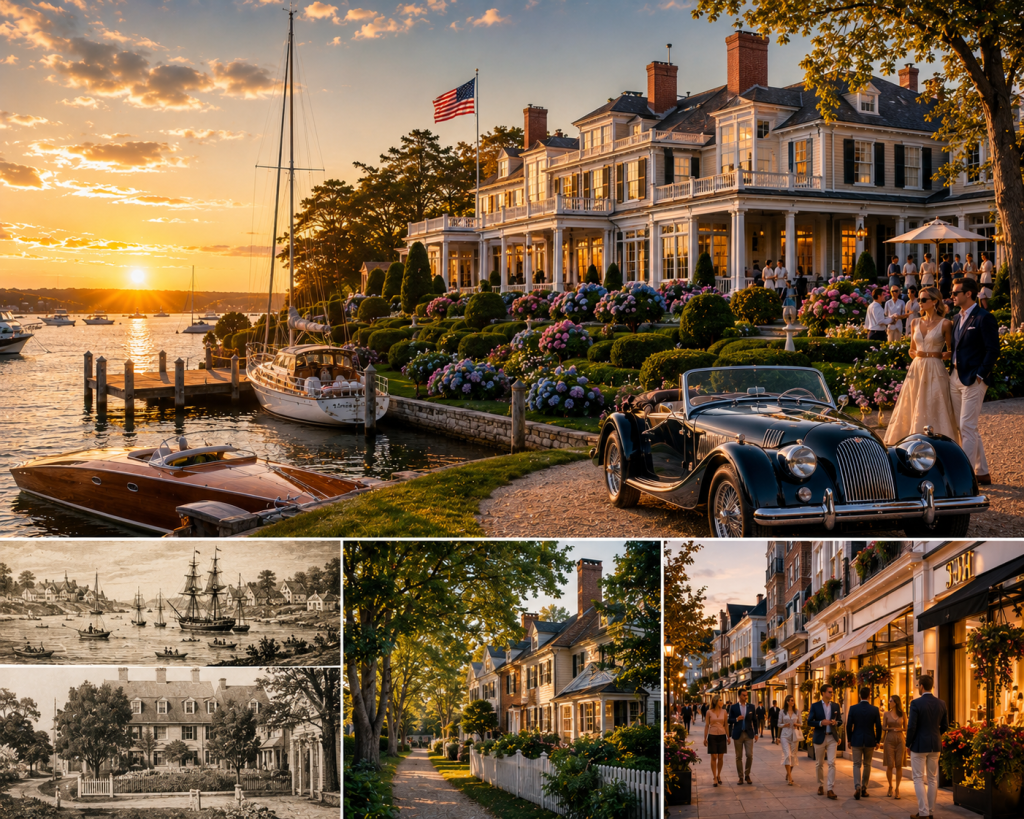
Before the English
The history of Southampton begins thousands of years before any European set foot on the South Fork. Specifically, the Shinnecock Nation inhabited the land between the Atlantic Ocean and Peconic Bay for millennia. Their supremacy in wampum production made them both prosperous and vulnerable. Consequently, they became subjects of periodic raids by the Pequot and other New England tribes.
When the first English settlers arrived in 1640, the Shinnecock numbered approximately 2,000. In particular, they were master whalers who built canoes large enough to hold a hundred people. They spear-fished for eel, harvested shellfish from the bays, and hunted whales from those canoes in open water. Their language was a dialect of Algonquian, and their relationship to the land operated on principles of habitation and stewardship that did not map neatly onto the European concept of ownership.
This distinction, between inhabiting and owning, would define the next four centuries of Southampton history. To this day, it has not been resolved.
1640: Conscience Point and the Eight Miles Square
On June 12, 1640, a small group of English Puritans from Lynn, Massachusetts, landed at a spot on the north shore of the South Fork that would later be called Conscience Point. They were seeking religious freedom and a new place to build. In fact, the settlers included eight men, one woman, and a boy. Among them: Thomas Halsey, Edward Howell, Edmond Farrington, Allen Bread, Edmund Needham, Abraham Pierson the Elder, Thomas Sayre, Josiah Stanborough, and George Welbe. Their names have been preserved in town records that Southampton has maintained, without interruption, since 1640.
They carried a grant from James Farret, agent for William Alexander, the Earl of Stirling. Essentially, the grant authorized them “to sit down upon Long Island and to possess, improve, and enjoy eight miles square of land.” By July 7, they had determined the boundaries of what they called the Southampton plantation.
They land on a June afternoon. Eight men, one woman, one boy. The harbor is calm. The land is flat, then rolling, then flat again toward an ocean they will not reach until tomorrow. The Shinnecock meet them and do not kill them. This is the first miracle. The Shinnecock teach them to plant corn and fertilize with fish. This is the second. The settlers build their first homes at the head of Old Town Pond and begin the project that will last 386 years: turning someone else’s land into something they call theirs.
The Land Conveyances
The Shinnecock sold additional land to the settlers through a series of conveyances (1640, 1659, 1662, 1666, 1703), expanding the colonial footprint across the South Fork. The original Indian deed, dated December 13, 1640, is preserved in the Southampton town records. In exchange for land, the settlers offered protection from the Pequot raids that had troubled the Shinnecock for generations. The extent to which the Shinnecock understood these transactions as permanent transfers of ownership, rather than agreements to share occupancy, remains a subject of scholarly debate and legal contest.
Southampton became the first permanent English settlement in what is now New York State. It was named after the English port city of Southampton in Hampshire, which was itself named for the Earls of Southampton. The village predates New York City’s English period by twenty-four years.
The Colonial Village: 1640 to 1776
Building for Centuries
The earliest settlers established their plantation at the head of Old Town Pond and began constructing the infrastructure of a village designed to last. Their first meeting house stood on a hill that is now the site of Southampton Hospital. Thomas Halsey built the house at 249 Main Street around 1648, a saltbox structure that survives as the oldest English frame house in New York State and one of the oldest in America. The Halsey Homestead is now a museum operated by the Southampton Historical Museum.
The settlers processed drift whales they found on shore, observed the Shinnecock hunting techniques, improved on their weapons and boats, and went out to ocean hunting. Whaling began as a shore-based enterprise in the late seventeenth century and grew into a major industry. Agriculture (particularly Long Island potatoes and sweet corn) and duck-raising were the other economic pillars.
The Pelletreau Silver Shop
In 1686, a dry goods store was built on Main Street that would become the oldest continuously operating shop in the Western Hemisphere. Originally, Francis Pelletreau purchased it in 1717 after immigrating from New York City. His grandson Elias Pelletreau occupied the building from 1750 to 1810, transforming it into a silversmith’s workshop where he crafted jewelry, shoe buckles, tankards, and silverware for clients from Connecticut to New Jersey.
Elias Pelletreau also served as a Captain of the Suffolk County Militia during the American Revolution. He combined artisanship with patriotism in a way that captures the character of colonial Southampton: practical, skilled, and willing to fight.
Revolution and Recovery
The Revolutionary War brought British occupation to Long Island. Southampton was slow to recover after the withdrawal of British forces in 1783. Eventually, long-distance whaling in the nineteenth century restored the village’s economic vitality.
Notably, the First Presbyterian Church, whose congregation traces to 1640, is the oldest Presbyterian body in America. Its current building, constructed in 1843 with wooden Gothic features and a clock tower enlarged in 1895, anchors the village’s spiritual life.
The Railroad Changes Everything: 1872 to 1900
The Arrival That Created the Hamptons
In 1872, the Long Island Rail Road extended its tracks through Southampton to Sag Harbor. That single infrastructure decision transformed the South Fork from a remote agricultural and whaling community into a summer destination for wealthy New Yorkers seeking escape from the city’s heat, noise, and disease.
Indeed, the phenomenon these New Yorkers participated in had no established name yet. The concept of the “summer vacation” was a new national invention. Long Island’s South Fork offered what the city could not: clean air, ocean swimming, pristine farmland, and a train ride that took half a day. Boarding houses and small hotels appeared. Then larger ones. Then estates.
Naturally, the building boom that followed between 1880 and 1920 created the estate section that defines Southampton today. Large Shingle Style and Colonial Revival houses rose along Gin Lane, Meadow Lane, and roads south of what would become Montauk Highway. These were not cottages (though their owners called them that, in the tradition of Newport). Rather, they were statements of arrival.
William Merritt Chase and the Invention of the Art Colony
The railroad did not bring only bankers. In 1891, Janet Ralston Chase Hoyt invited William Merritt Chase to direct a new plein air painting school in the Shinnecock Hills. Hoyt was a New York philanthropist and the daughter of Lincoln’s Secretary of the Treasury, Salmon Chase.
Chase was among the leading painters in America. Notably, his students over twelve consecutive summers at Shinnecock (1891 to 1902) would include George Bellows, Rockwell Kent, Edward Hopper, Joseph Stella, and Georgia O’Keeffe. That roster reads like a syllabus for twentieth-century American art. Each summer, 100 to 150 students attended, boarding at the Art Club, local farmhouses, and cottages in the Art Village compound.
The Social Overlap
Stanford White designed Chase’s summer house at Shinnecock, complete with an integral studio. Supporters of the school included Mrs. Astor, Mrs. August Belmont, Mrs. Andrew Carnegie, Mrs. W. K. Vanderbilt, and Mrs. Whitney. The social overlap between the art world and the estate world was not accidental. It was the foundation of Southampton’s dual identity: a village that was simultaneously a colony of wealth and a colony of art, and that understood these two things as compatible rather than contradictory.
He paints on Monday and Tuesday. The rest of the week is for his family and the light. His wife and children walk along Shinnecock Bay in pale summer dresses while he sets up his easel in the dunes. “I carry a comfortable stool that can be closed up in a small space, and I never use an umbrella,” he tells a student. “I want all the light I can get.” In 1893, his fourth daughter is born at Shinnecock. They name her Hazel Neamaug Chase. Neamaug is a Shinnecock word. It means “between the waters.” The painter from Greenwich Village has given his child a name from the people whose land he paints on. This is either tribute or appropriation or both. The light does not answer the question.
Chase’s Shinnecock paintings are now in the collections of the Metropolitan Museum of Art, the Parrish Art Museum, the Cincinnati Art Museum, and the Wadsworth Atheneum. Every gallery opening on the East End, every studio tour, every collectors’ dinner traces its lineage to those twelve summers when Chase stood in the dunes with a portable stool and no umbrella.
The Twentieth Century: Clubs, Culture, and Concealment
The Social Infrastructure
Between 1890 and 1930, Southampton built the institutional infrastructure that still governs its social life. First, Shinnecock Hills Golf Club was incorporated in 1891 with a Stanford White clubhouse. The Bathing Corporation was founded on Gin Lane in 1923. The Meadow Club established tennis and social programming for the younger generation of summer residents.
These institutions were not amenities. They were sorting mechanisms. Membership in the Bathing Corporation, passed through families like silverware, distinguished those who had always been here from those who had merely arrived. The clubs codified what the hedgerows expressed architecturally: that Southampton’s social order was designed to be inherited, not purchased.
Of course, the Parrish Art Museum, founded in 1898 and housed in a Grosvenor Atterbury building on Jobs Lane, anchored the village’s cultural identity. Samuel Parrish’s collection provided the institutional foundation. But it was Chase’s legacy that filled the galleries, along with the work of artists who followed him: Fairfield Porter, Willem de Kooning, and Jackson Pollock in nearby Springs.
The Hedgerow as Architecture
Sometime in the early twentieth century, Southampton homeowners began planting privet hedges along their property lines. Gradually, the practice spread until it became definitive. By mid-century, the twelve-foot hedgerow was as much a signature of the estate section as the Shingle Style house or the gunite pool.
The hedgerow is simultaneously practical (it blocks wind, provides privacy, absorbs sound) and symbolic (it communicates that what happens behind it is not your business). In a village where restraint is the highest form of self-expression, the hedgerow is the ultimate statement: I am here. You cannot see me. This is the arrangement we both prefer.
For the VC or business owner evaluating Southampton real estate, the hedgerow matters practically and socially. It is the first line item in the maintenance budget ($5,000 to $15,000 annually) and the first lesson in the village’s social grammar.
The Shinnecock Through the Centuries
No history of Southampton is honest without accounting for what happened to the people who were here first.
The Shinnecock Nation’s land base was progressively reduced through a series of conveyances, legislative actions, and contested agreements. In 1703, a 1,000-year lease established the Shinnecock Indian Reservation. Then, in 1859, the New York State Legislature approved a sale of approximately 3,500 acres of tribal land. The Shinnecock have contested this decision for over 160 years, alleging a fraudulent petition submitted by powerful New York investors.
By 1875, disease had reduced the reservation’s population to approximately 200. The following year, ten Shinnecock men died helping to recover a freighter that had run aground offshore. News accounts described the loss as the end of the tribe. It was not.
Nevertheless, the Shinnecock Nation persisted. In 2010, the Bureau of Indian Affairs granted federal recognition after a decades-long application process. The reservation sits adjacent to Shinnecock Hills Golf Club, on land the tribe considers sacred and claims as burial grounds. In 2005, the Shinnecock filed a lawsuit seeking the return of 3,500 acres, including the golf course itself.
In June 2026, when the U.S. Open brings 150,000 spectators to Shinnecock Hills, BLADE helicopters will land on the Shinnecock Nation Powwow Grounds. Premier parking passes will be sold on reservation land. The relationship between the golf club and the nation is complicated in the way that 386 years of shared geography and unequal power tend to be. It is part of the Southampton history that the hedgerows were not designed to tell.
Modern Southampton: 1950 to Present
The Postwar Transformation
The second half of the twentieth century brought two parallel shifts to Southampton. The first was demographic: the summer population expanded beyond a small society of interrelated families. It grew to include Wall Street’s ascendant class: hedge fund managers, private equity founders, and investment bankers. The second shift was architectural.
Meadow Lane became “Billionaires Row” as finance titans including Ken Griffin, Leon Black, Robert Kraft, and Henry Kravis assembled oceanfront compounds. Gin Lane maintained its status as the most prestigious address, with auction prices reaching $88.48 million in 2024. Meanwhile, the median home price crossed $2 million in 2025 for the first time.
The Cultural Continuity
In 2012, the Parrish Art Museum moved from Jobs Lane to a Herzog and de Meuron building in Water Mill. The move tripled its exhibition space and affirmed the East End’s position as a serious art community. Meanwhile, the Southampton Arts Center occupied the former Parrish building, maintaining cultural programming on Jobs Lane.
Similarly, the dining scene evolved from country clubs and boarding house meals to a landscape that includes Sant Ambroeus, FENIKS, 75 Main, and a restaurant ecosystem rivaling any resort community in America.
Since 2003, Social Life Magazine has covered the East End, documenting the social, cultural, and real estate dynamics across every village from Westhampton to Montauk.
The 2026 Moment
Southampton enters summer 2026 with two defining events: the U.S. Open at Shinnecock Hills (June 18 to 21) and Polo Hamptons (July 18 and 25). The golf championship returns to the course where John Shippen, a sixteen-year-old of African American and Shinnecock descent, competed in 1896 as the first American-born professional golfer. The polo returns to Bridgehampton with BMW North America and Christie Brinkley. Between those two events, the village that was founded when Shakespeare had been dead for only twenty-four years will do what it has always done: maintain what it has built and keep the hedgerows trimmed.
The Timeline
Pre-1640: Shinnecock Nation inhabits the South Fork for thousands of years.
1640: English Puritans from Lynn, Massachusetts land at Conscience Point. First permanent English settlement in New York.
1648: Thomas Halsey builds the house at 249 Main Street, now the oldest English saltbox in the state.
1686: The Pelletreau shop opens on Main Street. Oldest continuously operating shop in the Western Hemisphere.
1703: Shinnecock Indian Reservation established via 1,000-year lease.
1783: British forces withdraw after the Revolution. Southampton begins slow recovery.
1872: Long Island Rail Road extends tracks through Southampton. Summer vacation era begins.
1891: William Merritt Chase opens Shinnecock Hills Summer School of Art. Shinnecock Hills Golf Club incorporated. Stanford White designs the clubhouse.
1894: Shinnecock Hills becomes a founding member of the USGA. Village of Southampton incorporated.
1896: Shinnecock hosts the second U.S. Open. John Shippen competes as the first American-born professional golfer.
1898: Parrish Art Museum founded on Jobs Lane.
1923: Bathing Corporation founded on Gin Lane.
1986: U.S. Open returns to Shinnecock Hills. Raymond Floyd wins.
2010: Shinnecock Nation receives federal recognition from the Bureau of Indian Affairs.
2012: Parrish Art Museum opens Herzog and de Meuron building in Water Mill.
2025: Cooper’s Beach named number one beach in America by Dr. Beach. Median home price crosses $2 million.
2026: Shinnecock Hills hosts its sixth U.S. Open (June 18 to 21). Polo Hamptons runs July 18 and 25.
Where the Conversation Continues
Social Life Magazine has covered the East End for twenty-three years, long enough to understand that Southampton history is not a story about the past. In reality, it is a story about the present performing the past. Private clubs replicate the social structures of the 1920s. Hedgerows replicate the privacy of the estate era. Meanwhile, the restaurants replicate the hospitality of the boarding houses, at considerably higher prices. The Southampton Village Dossier is the definitive guide to the village as it lives today.
If your brand, practice, or institution serves the audience that values this kind of depth, Social Life Magazine’s paid feature program is the vehicle. It places your story in front of 25,000 copies per issue, distributed across the restaurants, hotels, and beach clubs where the village’s history is still being written.
Polo Hamptons 2026 (July 18 and 25, 900 Lumber Lane, Bridgehampton) is the event where Southampton’s past and present sit at the same table. BMW North America sponsors. Christie Brinkley hosts. The cabana is where you meet the neighbors whose families have been here since the hedgerows were saplings.
To receive Social Life Magazine delivered to your door, visit our subscription page.
Southampton was founded in 1640 by people who built things that lasted. To this day, the Halsey house is still standing. Town records are still continuous. The Shinnecock are still here. And the ocean is still the same distance from Main Street. Ultimately, the only thing that has changed is the price of everything between them.
Author

Written by
Recent Posts

How to Choose Useful Tech Gifts for Employees and Clients in 2026
The Garage Question: Which Car Goes South for the Season?
VandS Clinic Review Treatment: How Seoul Injectable and Laser Options Compare for US Patients
Before Buying a View Home: What a Sloped Lot Means for the Purchase

Powerful Strategies to Stay Ahead in a Fast-Moving Real Estate Market
Categories
- Art
- Articles
- Business of Luxury
- Celebrities
- Culture
- Entertainment
- Events
- Faces of Summer 2026
- Fashion
- Fashion & Style
- Featured
- Finance
- Food, Spirits, Wine
- Hamptons
- Hamptons Celebrities
- Health
- Health & Beauty
- Lifestyle
- Luxury Lifestyle
- Press
- Profiles
- Real Estate
- Technology
- The Chronicles
- Travel
- Uncategorized
- Weddings