
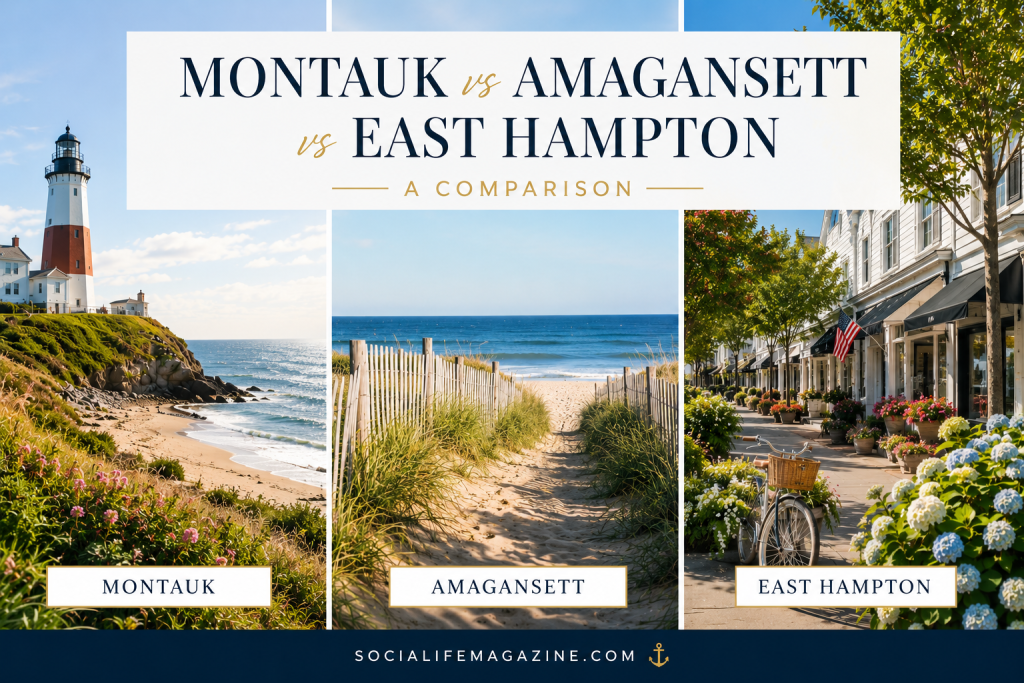
Montauk vs Amagansett vs East Hampton is not a competition. It is a continuum. Route 27 runs east from East Hampton Village through Amagansett, across the Napeague sand bridge, and into Montauk. In theory, the drive takes 25 minutes without traffic (a condition that exists only in theory between Memorial Day and Labor Day). Meanwhile, the Hamptons slowly dissolve. First, hedgerows give way to farmland. Then farmland gives way to dunes. Finally, dunes give way to the Atlantic. As a result, by the time you reach the lighthouse, you have traveled not just geographically but culturally, from a village that wrote the rules to a hamlet that ignores them to a place where the rules simply do not apply.
This comparison closes the Montauk Village Dossier and, with it, the fifth and final chapter of The Modern Culture Hamptons Bible. Sag Harbor was Chapter 1. Southampton was Chapter 2. Bridgehampton was Chapter 3. Amagansett was Chapter 4. And Montauk is Chapter 5. The End.
The Geographic Truth: 25 Minutes, Three Worlds
At thirty-seven, she runs strategy for a private equity firm in Midtown. She owns a two-bedroom in Cobble Hill that she bought for $1.4 million in 2019. She is looking for a weekend house on the East End. So her broker has shown her properties in all three locations. After those four weekends, she has learned the following: East Hampton makes her feel like she needs better shoes. Amagansett makes her feel like she needs better opinions. Montauk makes her feel like she can wear whatever she already owns. Ultimately, she is choosing Montauk. She does not know why. But she knows exactly why.
East Hampton Village is the westernmost of the three, settled in 1648 by Puritan farmers who established one of the oldest colonial communities in the United States. The village center on Main Street retains its historic character: Town Pond, Village Green, Guild Hall for theater and art, and Newtown Lane for shopping. Above all, the Maidstone Club anchors the social architecture. Lily Pond Lane has hosted Martha Stewart, Jon Bon Jovi, and David Geffen. Altogether, East Hampton is the traditional Hamptons, the one that appears in movies and magazine spreads, the one your parents warned you about or aspired to.
The Sand Bridge and Beyond
Just five minutes east of East Hampton Village. The name comes from the Montaukett language, meaning “place of good water.” The hamlet’s identity is built on contradictions that it refuses to resolve. Farm stands operate within a mile of Further Lane, where the highest residential transfer in Hamptons history (a $115 million oceanfront estate) closed in recent years. What is more, Jerry Seinfeld’s $32 million compound sits in the same zip code as Amber Waves Farm, where children pick tomatoes on Saturday mornings. Remarkably, Amagansett does not explain these contradictions. It simply contains them.
Then comes Napeague, the sand bridge. For roughly two miles, Long Island narrows to a sandbar with dunes on both sides and the Clam Bar serving lobster rolls at the border. Subsequently, the vegetation shifts from manicured to wild, and you enter Montauk. Gone are the hedgerows. Gone are the farm stands. Instead, there is a lighthouse, a fishing fleet, a surf break, a seawater spa, and a food truck selling $4 burritos on the sand. The road ends here. So does every pretension the Hamptons carried for the first 45 minutes of the drive.
Real Estate: What the Money Buys
Of course, the three markets operate on different currencies, and understanding the differences requires understanding what each location actually sells.
East Hampton Village sells proximity to institutions. The median home value sits around $1.77 million (Zillow), although this number dramatically understates the top end. Properties on Lily Pond Lane and in the estate section south of the highway regularly trade above $20 million. Seven transactions exceeded $20 million in recent years. What the buyer actually purchases is not square footage. It is adjacency to the Maidstone Club, Guild Hall, and a social calendar that has been running since before their grandparents were born.
The Hamlet and the End
Amagansett sells contradiction. The median listing price is approximately $2.34 million (Movoto, May 2026), with the Zillow Home Value Index at $3.27 million. But these medians conceal an enormous range. A cottage in the Springs section lists for $1.2 million. The Blavatnik oceanfront parcel sold for $115 million. Remarkably, both transactions occurred in the same hamlet. In essence, the Amagansett proposition for buyers is this: you are purchasing a place where a farm stand and a $115 million mansion coexist without irony, and where neither side feels the need to acknowledge the absurdity.
Montauk sells water. The median sold price hovers near $1.9 million, lower than both East Hampton and Amagansett. But the range is equally wide. Montauk Manor condos start below $500,000. DeForest Road oceanfront in Ditch Plains recently set a $17 million record. However, what distinguishes Montauk’s market from its neighbors is the sorting variable. East Hampton price maps to social proximity. In Amagansett, price maps to land and lane name. Out in Montauk, price maps to water: which body, which angle, which distance. Beyond that, nothing else matters. Notably, nobody in Montauk has ever paid a premium for club adjacency, because there are no clubs.
Dining: Three Philosophies of Dinner
Certainly, the way a village eats reveals its values more reliably than anything its residents say about themselves.
East Hampton dines with intention. Nick & Toni’s on North Main Street is the institution where media executives, real estate developers, and actors perform the casual friendship that defines Hamptons social life. Likewise, the Palm at the Huntting Inn serves the steakhouse crowd. East Hampton Grill handles the overflow. Naturally, reservations are essential, dress codes are implicit, and the act of being seen at the right table is part of the value proposition. Dining in East Hampton is a social instrument.
Amagansett dines with studied casualness. The Hampton Chutney on Montauk Highway serves South Indian dosas to families in board shorts. The Roundtree hotel restaurant provides the elevated option. Amber Waves Farm operates a farm stand where the produce comes from the field you can see from the parking lot. The dining philosophy in Amagansett is: we could dress up, but we choose not to. Of course, the choice is itself a performance, although Amagansett would disagree.
Montauk dines without philosophy. Duryea’s serves a $98 lobster cobb salad to walk-ins only. Navy Beach puts tables on the sand and lets yachts dinghy ashore. Shagwong Tavern seats a fisherman next to a hedge fund manager and neither asks the other’s name. The Ditch Witch sells $4 burritos from a truck on the beach. Still, the Surf Lodge books Snoop Dogg and serves dinner alongside the concert. In Montauk, the sunset is the dress code and the ocean is the reservation system. In other words, there is nothing to perform because the environment does the performing for you.
Beaches: Sand as Identity
East Hampton’s beaches (Main Beach, Two Mile Hollow, Georgica) are wide, manicured, and governed by a parking permit system that functions as a soft economic filter. Sand is excellent. The surf is moderate. And the crowd is attractive in the way that wealth and fitness produce attractiveness: deliberately. As a result, these beaches appear in fashion editorials because they look like fashion editorials already.
Amagansett’s beaches (Indian Wells, Atlantic Avenue) are wider, wilder, and populated by a crowd that believes it discovered them. Meanwhile, the parking is easier. The vibe is family-oriented. Yet the proximity to Further Lane means that a $115 million estate sits within walking distance of a public beach where children build sandcastles. Still, the juxtaposition is not discussed. It does not need to be.
Montauk’s beaches operate on a different principle entirely. Ditch Plains surfs. Hither Hills camps. Shadmoor’s bluffs crumble into the Atlantic with WWII bunkers visible in the landscape. Also, Kirk Park is the village beach, accessible by foot from Main Street. On the bay side, Gin Beach faces Block Island Sound and barely produces a ripple. Indeed, no other Hamptons village offers surfing, camping, bluff hiking, and calm bayside swimming within a ten-minute drive. In Montauk, the beach is not a backdrop. It is the reason.
Cultural Identity: What Each Place Believes About Itself
He is forty-five, a documentary producer who splits his time between a brownstone in Park Slope and whatever the East End offers on any given weekend. Over the past decade, he has rented in all three locations. His assessment, however, delivered at a dinner party in February, is this: “East Hampton is the Hamptons. Amagansett is the Hamptons pretending it isn’t. Montauk, on the other hand, is something else entirely.” Without hesitation, his friends nod. None of them disagree. So he books Montauk for July.
East Hampton believes in tradition. The village’s institutional architecture (Guild Hall, the Maidstone, the Ladies Village Improvement Society, which has been maintaining the village’s aesthetics since 1895) communicates continuity and standards. After all, Jackson Pollock painted here. The galleries on Newtown Lane carry that legacy. East Hampton does not need to explain itself. Its explanation is its existence, which has been continuous for nearly 400 years.
Amagansett believes in contradiction. Consider the contrasts: a farm stand beside a mansion, a yoga studio beside a surf shop, and the $115 million estate beside the $8 breakfast sandwich. Amagansett’s thesis, articulated in the Amagansett Village Dossier, is that unresolved tension is a feature and not a bug. Rather, the hamlet does not choose between rural and wealthy, creative and commercial, casual and exclusive. Instead, it holds all of them simultaneously, and the refusal to choose is itself the choice.
Montauk: Geography as Belief
Montauk does not believe in anything except geography. The lighthouse was commissioned by George Washington. The fishing fleet has operated continuously for a century. Andy Warhol hosted the Rolling Stones at Eothen. Camp Hero inspired Stranger Things. Gurney’s turns 100 this year. The Surf Lodge books Snoop Dogg on Saturday nights. Yet none of these facts compose a belief system. They compose a geography, and the geography’s thesis is: the road ends here. What you do when it ends is entirely your problem.
The Persona Sort: Who Goes Where
Obviously, each location attracts its own constituency, and the sorting is reliable enough to function as anthropology.
East Hampton draws the person who wants the conversation to have already started. Media, finance, art world. Typically, the buyer here knows the social calendar, owns appropriate dinner clothes, and understands that a Maidstone membership is worth more than any individual property feature. Typical household income: $500,000 and up. Average age: 45 to 65. Defining behavior: the reservation made three weeks in advance.
Amagansett draws the person who wants to feel undiscovered while being very much discovered. Creative directors, tech founders, writers with book deals. Similarly, the buyer here shops at the farm stand, wears Japanese denim, and considers East Hampton “too much.” Typical household income: $400,000 and up. Average age: 35 to 50. Defining behavior: the studied casual wave to a neighbor whose net worth is $200 million.
Montauk draws the person who has stopped sorting. Surfers, fishermen, Williamsburg creatives, FiDi quants who charter boats at dawn, Tribeca filmmakers who say they need to “get away from the scene” without realizing they are quoting the Warhol playbook. Specifically, typical household income ranges from $80,000 (the Ditch Plains surfer who drives a Subaru) to $8 million (the DeForest Road buyer). Average age: 25 to 55. Defining behavior: the absence of any behavior designed to be observed.
The Final Verdict: There Is No Verdict
Comparing these three places is ultimately an exercise in understanding what you want the Hamptons to do for you. Want the Hamptons to confirm your position in a hierarchy? Go to East Hampton. If you want the Hamptons to let you pretend hierarchies do not exist while benefiting from one, go to Amagansett. If you want the Hamptons to stop being the Hamptons, go to Montauk.
All three are beautiful, all three are expensive. And all three sit on the same Atlantic coastline. But of course, only one is the End. And at the End, the hierarchy dissolves, the performance stops, and the lighthouse blinks every five seconds the way it has since 1796, indifferent to the $115 million estate ten miles west and the $4 burrito three blocks south. Specifically, the road that started in Sag Harbor (Chapter 1), passed through Southampton (Chapter 2), crossed Bridgehampton (Chapter 3), paused in Amagansett (Chapter 4), and arrived at Montauk (Chapter 5) ends here. In total, five chapters. Five villages. Just one coastline.
Where the Conversation Continues
Social Life Magazine has covered the East End for 23 years, from Westhampton to the lighthouse. The Modern Culture Hamptons Bible is the definitive record of the villages that quietly run New York’s summer. If your brand belongs anywhere in these five chapters, this is the publication that writes the story.
For brands and tastemakers: explore our paid features program.
Polo Hamptons 2026 returns July 18 and 25 at 900 Lumber Lane in Bridgehampton, equidistant from East Hampton and Montauk, with BMW North America as title sponsor and Christie Brinkley as host. Details at polohamptons.com.
Subscribe: sociallifemagazine.com/subscription.
At the lighthouse, the road ends. This light does not care where you started. The fish were here before the money, and they will be here after the money leaves. This is the last line of the last chapter. The End.
Author

Written by
Recent Posts
5 Best At-Home Teeth Whitening Kits for a Brighter Smile in 2026
From Spa Retreats to Aesthetic Care, the Luxury Travel Itinerary Is Changing
The Rich-Girl Guide to Pearls: How to Signal Luxury Without a Logo
Best Fair Trade Coffee Brand in 2026: Leading Choices for Ethical, High-Quality Coffee
A Night of Fashion and Film: My Night at the Hamptons Film Festival Closing Celebration at Baker House 1650
Categories
- Art
- Articles
- Business of Luxury
- Celebrities
- Culture
- Entertainment
- Events
- Faces of Summer 2026
- Fashion
- Fashion & Style
- Featured
- Finance
- Food, Spirits, Wine
- Hamptons
- Hamptons Celebrities
- Health
- Health & Beauty
- Lifestyle
- Luxury Lifestyle
- Press
- Profiles
- Real Estate
- Technology
- The Chronicles
- Travel
- Uncategorized
- Weddings