
Less Than a Mile from Dynasty to Decline
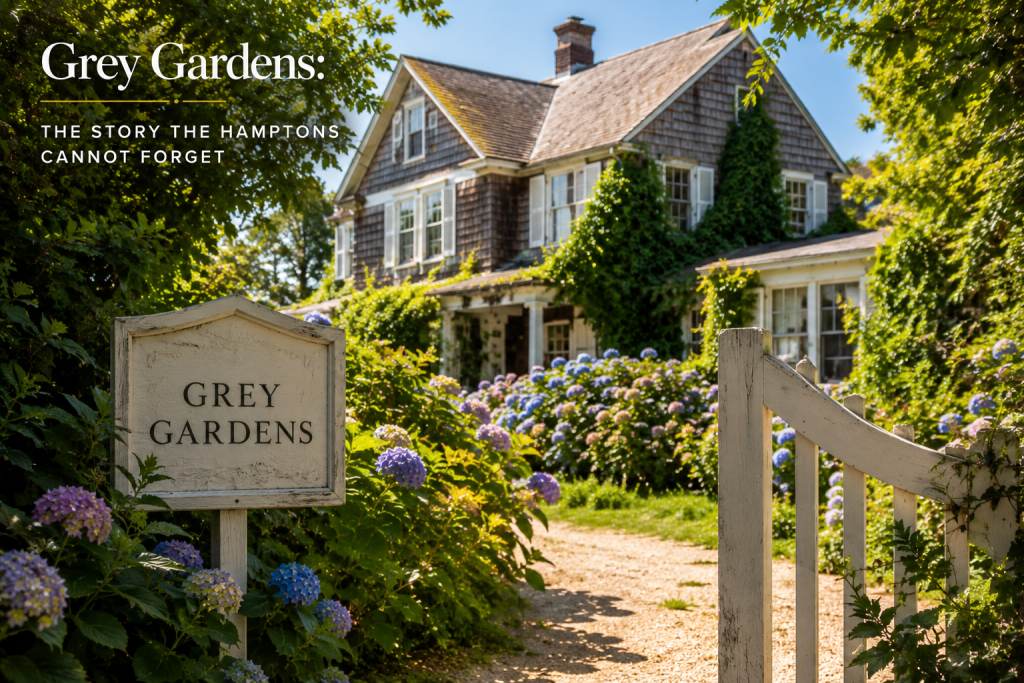
Grey Gardens East Hampton sits at 3 West End Road, on the corner of Lily Pond Lane, in the Georgica Pond neighborhood of East Hampton. Joseph Greenleaf Thorp designed the shingle-style house in 1897 (the same architect who shaped Lily Pond Lane’s aesthetic, the Maidstone Club, and Jon Bon Jovi’s E.C. Potter House). Notably, the property spans 1.7 acres, close enough to the Atlantic that you can hear it from the garden. Indeed, Grey Gardens is architecturally a sibling of the most prestigious addresses on the East End, designed by the same hand that built the neighborhood’s mythology. What makes it different is not the house. It is what happened inside.
The distance between Grey Gardens and the David Geffen compound on Lily Pond Lane is less than a mile. Between the two addresses lies the entire range of what the Hamptons can do to a family: elevation and erasure, aspiration and abandonment, a $70 million compound and a house that was once overrun with 52 feral cats. Certainly, every other power address in East Hampton exists as an aspiration. Grey Gardens exists as a warning. The warning has been sounding since 1975, and the Hamptons have never stopped listening.
The Beales: American Aristocracy Behind Closed Doors
Phelan Beale, a Wall Street lawyer and law partner of John Vernou Bouvier Jr. (grandfather of Jacqueline Kennedy Onassis), acquired Grey Gardens for his wife Edith Ewing Bouvier Beale (“Big Edie”) in 1924. Naturally, during the 1920s and 1930s, the house hosted elegant parties where American aristocracy gathered on the lawn. Big Edie sang. Also, Little Edie debuted in New York society (the New York Times covered her debut in 1936). The Bouvier family owned “Lasata” on Georgica Pond, three miles north on Further Lane, where young Jackie Bouvier spent her summers. Indeed, everything was connected. Everyone was family.
Then, around 1946, Phelan Beale notified Big Edie of their divorce by telegram from Mexico. The money stopped. The social invitations followed. By the 1950s, Big Edie and Little Edie were living together in Grey Gardens, increasingly isolated from the community that had once embraced them. By then, Little Edie had returned from a failed attempt at a career in New York. Big Edie refused to leave the house. Consequently, two women of extraordinary pedigree began a decades-long retreat from the world, and the house retreated with them. Slowly, plaster cracked. Gardens grew wild. Cats multiplied. Raccoons moved in. Running water eventually failed. The neighbors noticed. For a while, they said nothing.
1972: When the County Came Calling
In 1972, the Suffolk County Health Department conducted a series of inspections (which the Beales called “raids”) and issued an eviction notice. Specifically, inspectors reported finding structural decay, animal waste throughout the rooms, raccoons in the walls, and conditions that violated every village code on the books. Naturally, National Enquirer ran the story. New York Magazine put it on the cover. Suddenly, for the first time, the outside world saw what the neighbors had been whispering about: two Bouvier women, relatives of the most famous family in American politics, living in squalor in one of the most expensive zip codes in the country.
Jacqueline Kennedy Onassis and her sister Lee Radziwill intervened, providing the funds necessary to stabilize the house and bring it into compliance with village codes. However, the intervention was structural, not transformative. The house stopped deteriorating enough to satisfy the inspectors, but the Beales’ way of life did not change. Big Edie continued singing in the upstairs rooms. Little Edie continued wearing her signature headscarves and improvised outfits. The cats remained. Essentially, the Kennedys saved the house from demolition, but they could not save the women from the lives they had chosen. Or perhaps it was the life that had chosen them.
She stands in what was once the living room.
Ceiling is new. Floor is new. Windows catch light they never caught before.
Everything that was falling has been caught.
But she can still feel it: the weight of two women who stayed too long.
A real estate agent says “completely renovated.”
The house says something else.
Some rooms remember what happened in them.
This one remembers everything.
The 1975 Documentary: How a Film Made a House Immortal
Albert and David Maysles originally came to East Hampton to make a film about Lee Radziwill and the Bouvier family’s summer visits. That project was canceled. Instead, the brothers turned their cameras on Big Edie and Little Edie, and the result was the 1975 documentary Grey Gardens, shot in the direct cinema style that let the two women tell their own stories. Notably, the film screened at the 1976 Cannes Film Festival. It became an instant landmark of American cinema: a portrait of decline so intimate and so specific that it transcended its subject and became a metaphor for everything the Hamptons both celebrate and fear.
Big Edie, defiant and operatic, sang in rooms where raccoons lived in the walls. Little Edie, stylish and wounded, performed for the cameras with a charisma that made her an unlikely fashion icon decades later. Notably, the documentary achieved something that no real estate listing or society column ever could: it made the interior life of the American upper class visible. Not the interiors of the houses (though those were visible too, in all their decay), but the interior emotional terrain of two women who had been abandoned by the system that was supposed to sustain them. Rufus Wainwright called himself a “Grey Gardens fanatic” and claimed to have seen the film at least a dozen times. He was not alone.
The Afterlife: Broadway, HBO, and the Myth That Would Not Stop
After the documentary, Big Edie died in 1977. Little Edie remained at Grey Gardens until 1979, when she sold the house. Still, in the decades that followed, the story refused to stay buried. Specifically, a Tony-nominated Broadway musical opened in 2006. HBO produced a film in 2009 starring Drew Barrymore as Little Edie and Jessica Lange as Big Edie (Lange won an Emmy for the role). In 2017, the original 1972 footage of Lee Radziwill visiting the Beales was released as a separate documentary titled “That Summer.” Also, a Netflix mockumentary appeared in 2015. Indeed, each adaptation added another layer to the mythology, and each layer made the house more famous.
The cultural fascination with Grey Gardens runs deeper than celebrity rubbernecking. The story asks a question that every person with inherited privilege fears: what happens when the machinery stops? When the money runs out, when the invitations dry up, when the house that once hosted elegant parties becomes the house the neighbors avoid? For a family office advisor from the Upper East Side (the kind who structures multigenerational trusts specifically to prevent this scenario), Grey Gardens is not entertainment. It is a case study in what happens when estate planning fails and denial takes its place.
Bradlee and Quinn: The First Restoration
In 1979, Little Edie sold Grey Gardens to Ben Bradlee, the legendary executive editor of the Washington Post (who had overseen the paper’s Watergate coverage), and his wife Sally Quinn, the journalist, author, and Washington socialite. Remarkably, the price was $220,000. Little Edie’s condition of sale: do not tear the house down. “All it needs is a coat of paint,” she reportedly told them. That was an understatement. Quinn later claimed to have found the waste of 52 feral cats inside. Bradlee and Quinn spent approximately $600,000 restoring the home while maintaining the original gray shingle exterior.
Under their ownership, Grey Gardens became a center for Hamptons social life again. Notably, their best friend and neighbor was Nora Ephron. The house was featured in architectural and home décor magazines. Indeed, Bradlee wrote in a thatched cottage on the property. Quinn raised their son. For 35 years, Bradlee and Quinn demonstrated that Grey Gardens could hold joy as well as sorrow, that the house’s story did not have to end where the documentary left it. However, Bradlee died in 2014 at the age of 93. After his death, Quinn found it painful to spend time at the house. She began renting it for approximately $175,000 per month. Eventually, she listed it for $19.995 million in February 2017.
Liz Lange: The Current Chapter
Fashion designer Liz Lange (founder of the Figue clothing line and niece of the financier Saul Steinberg) had rented Grey Gardens for a summer before buying it. “If I had $20 million, and another $10 million to restore it, I would kill to own it,” she told reporters during her rental stay in 2015. On December 20, 2017, she purchased the house for $15.5 million. Also, Quinn held an estate sale that included original furnishings from the Beales that she had found in the attic decades earlier. Indeed, buyers at the sale were purchasing artifacts from the most famous case of American aristocratic decline, priced and tagged like antiques at a country auction.
Subsequently, Lange undertook a complete renovation, raising the house to build a full-size basement, updating every system, and hiring decorators Mark Sikes and Jonathan Adler. The property now features seven bedrooms, a heated pool, and gardens that Grey Gardens’ name finally deserves. Still, Lange understood what she was buying. She did not purchase a house. She purchased a story, and the story’s value exceeds any appraisal. For the current owner, Grey Gardens is not a cautionary tale. It is a rescue narrative, a proof that even the most famous ruin in the Hamptons can be rebuilt. Whether the ghosts agree is another question.
What Grey Gardens Means to the Hamptons
Every Hamptons address exists on a spectrum between aspiration and warning. Lily Pond Lane is aspiration. Georgica Pond is aspiration. Meadow Lane is aspiration. Grey Gardens is the warning that makes the aspiration urgent. Certainly, without Grey Gardens, the power addresses would have no shadow. Without the shadow, the light would mean less. Essentially, the Hamptons need Grey Gardens to be Grey Gardens, because the story of decline is what makes the story of ascent worth telling.
The house sits on the corner of Lily Pond Lane and West End Road. J. Greenleaf Thorp designed it in 1897, the same year he was defining the resort architecture of the most prestigious street in East Hampton. Ultimately, Grey Gardens was born as a sibling of the power addresses that surround it. Rather, what separated it was not architecture or geography. It was circumstance: a divorce telegram from Mexico, a mother who refused to leave, a daughter who could not. The distance between Grey Gardens and the Geffen compound remains less than a mile. In the Hamptons real estate hierarchy, a mile can span the distance between dynasty and decline. Grey Gardens proves it.
Where the Conversation Continues
Social Life Magazine has covered East Hampton’s cultural history for 23 years, five summer issues per season, 25,000 copies each. Grey Gardens is part of that history, and the magazine delivers it to the same audience that lives in the same neighborhood.
If your brand serves an audience that values narrative, heritage, and the kind of provenance that cannot be manufactured (luxury goods, fine art, estate planning, architecture, private banking), a paid feature in Social Life Magazine positions you inside the story. Submit a paid feature here.
Polo Hamptons 2026 returns to 900 Lumber Lane in Bridgehampton on July 18 and 25. BMW North America is the title sponsor. Christie Brinkley hosts. Sponsorship at polohamptons.com.
Subscribe to Social Life Magazine for year-round coverage of the addresses, stories, and power dynamics that shape the East End.
Grey Gardens was built in 1897. It fell apart slowly, then all at once. It was rescued, sold, renovated, and rescued again. Cats are gone. Raccoons are gone. Gardens are beautiful again. But the story is still there, in the walls, in the shingles, in the fog that rolls in from the ocean. Some houses outlive their owners. This one outlived its mythology. It is still standing. It is still asking the question every Hamptons homeowner would rather not answer: what happens when no one comes to the party?
Author

Written by
Recent Posts
Is Business Class Worth It on a Short-Haul Flight?
Failure to Disclose Finances in Divorce
Columbus Car Accident Attorney: Protecting Your Rights After a Georgia Crash
Does Workers’ Comp Cover Lost Wages? A Guide for Oregon Workers
Understanding Social Security Disability Benefits in Oklahoma
Categories
- Art
- Articles
- Business of Luxury
- Celebrities
- Culture
- Entertainment
- Events
- Faces of Summer 2026
- Fashion
- Fashion & Style
- Featured
- Finance
- Food, Spirits, Wine
- Hamptons
- Hamptons Celebrities
- Health
- Health & Beauty
- Lifestyle
- Luxury Lifestyle
- Press
- Profiles
- Real Estate
- Technology
- The Chronicles
- Travel
- Uncategorized
- Weddings