
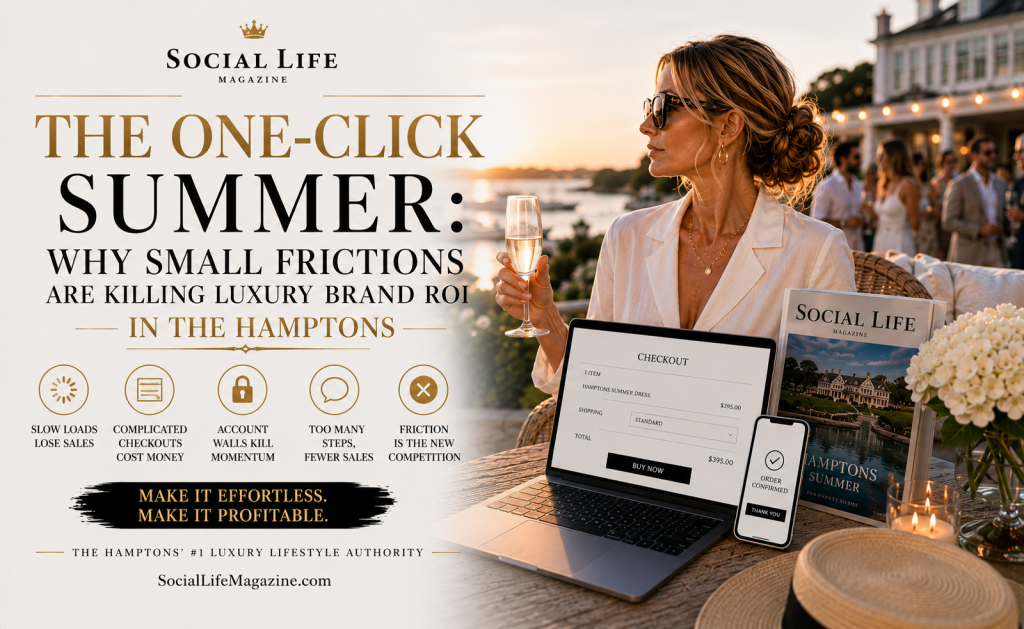
In 2012, a user experience researcher at Best Buy identified a single field in the company’s online checkout flow that was costing the company money. Not a broken feature. Not a confusing interface. A single optional field asking customers to create an account before completing a purchase.
The field was not mandatory. It could be skipped. But its presence created a moment of friction: a pause, a decision, a small additional cognitive load. A measurable percentage of customers abandoned their purchase entirely because of it.
Best Buy removed the field. Monthly revenue increased by $15 million.
One field. Fifteen million dollars a month. Sutherland uses this example in Alchemy to make a point that most organizations find genuinely difficult to accept: large effects are not always produced by large inputs. Sometimes the most valuable change is the smallest one. Remove a single step, a single decision, one moment of unnecessary friction from the path between intent and action.
Luxury brand sponsorship friction in the Hamptons is not primarily a price problem. The brands that fail to close Hamptons partnerships in time to activate in the current season are almost never failing because the numbers do not work. They are failing because the path between “this looks interesting” and “yes, we are doing this” contains more steps than the decision can survive. And every unnecessary step is a Best Buy checkout field that is silently costing the deal.
What Friction Actually Looks Like in Luxury Sponsorship
The friction in luxury sponsorship decisions is rarely visible as friction. It presents as diligence. Due process is what it looks like. It feels like the right way to handle a significant brand commitment.
A marketing director receives a pitch for a Polo Hamptons sponsorship. She finds it compelling. She forwards it to her events team for input. The events team has questions about logistics. The logistics questions go back to Social Life Magazine. Answers come back in three days because someone was traveling. By then, the events team has moved to a different priority. The marketing director follows up. A call is scheduled two weeks out. By the time the call happens, the calendar has moved to a place where the activation timeline is uncomfortably tight. The marketing director decides to wait for next year.
A good pitch. Right product. The brand belonged in that event. The deal died of friction.
This is not a hypothetical. It is the most common failure mode in Hamptons luxury sponsorship sales, and it has almost nothing to do with the quality of the pitch or the fit of the opportunity. It has to do with the number of steps between the initial interest and the executable decision.
Because the friction accumulates invisibly, the seller rarely identifies it as the cause of the loss. The deal looks like it died because of timing, or because the brand was not ready, or because a competitor offered better terms. In reality, it died because the path to yes was three weeks long and the decision could only survive about four days.
The Cognitive Load Problem
Behavioral economists measure friction not in steps but in cognitive load — the mental energy required to navigate a decision process. A decision that requires gathering information from multiple sources, coordinating multiple stakeholders, evaluating options against multiple criteria, and projecting outcomes across multiple time periods is a high-cognitive-load decision. High-cognitive-load decisions are expensive. They compete with every other high-cognitive-load decision in the decision-maker’s queue.
Luxury brand marketers at the level who are evaluating Hamptons sponsorships are among the highest-cognitive-load individuals in their organizations. Their decision queues are full. A sponsorship opportunity that lands in that queue with a high cognitive load attached to it will wait. It will wait for the right moment, the right headspace, the right week. The right moment frequently does not arrive before the season closes.
A better pitch is not the solution. The solution is a lower cognitive load attached to the yes. Specifically, this means: one place to learn everything necessary to make the decision, one price point to evaluate, one action to take, one timeline to understand.
Social Life Magazine’s paid feature submission page exists at a single URL. It answers the primary decision questions on a single page: what is the product, what does it cost, what does the brand receive, how long does it take. One action is required. The cognitive load attached to a yes is minimal. The decision that looked like it required three weeks of back-and-forth can be made in fifteen minutes.
That is not an accident of web design. It is an application of the Best Buy principle: remove the field that is causing abandonment. In the case of luxury sponsorship, the field being removed is every unnecessary question, every additional call, every step between the decision and the action.
The Speed Asymmetry
There is a second friction effect in Hamptons luxury sponsorship that operates independently of cognitive load: the speed asymmetry between brand decision timelines and event calendars.
Brand marketing decisions at luxury companies move on quarterly planning cycles, approval chains that can span three organizational levels, and budget processes that lock allocations months in advance. Polo Hamptons happens on specific dates in specific months. The two timelines are structurally mismatched. That mismatch always resolves the same way: the brand that moves fast gets the position. The brand moving at its normal institutional pace gets the next-year conversation.
Because of this asymmetry, the brands that consistently participate in premium Hamptons events are not always the ones that most logically belong there. They are the ones that have built the internal infrastructure to say yes quickly when the right opportunity arrives. They have a dedicated events or sponsorship budget that does not require a new approval cycle for each commitment. A decision-maker with sufficient authority to move before the committee meeting is essential.
The practical advice for brands evaluating Polo Hamptons 2026 is specific: if the opportunity is right, the time to decide is now, not after the next budget review. Two positions remain. The event is on July 18 and July 25. The activation planning timeline for a meaningful brand presence starts no later than six weeks before the event. That clock is already running.
For brands that are not yet structured to move this quickly, the paid editorial feature is the lower-friction entry point. One submission form, one editorial brief, one publication cycle. The brand is in the Hamptons summer before the institutional machinery has finished processing the larger sponsorship decision.
Submit at sociallifemagazine.com/submit-a-paid-feature. The summer does not wait for the approval chain.
Where The Conversation Continues
The friction principle is one of six frameworks separating brands that build Hamptons equity from brands that talk about building it. The full analysis: Why Luxury Brands That Ignore Psychology Lose the Hamptons Every Summer.
Earlier hubs cover The Perception Economy, The Signal Economy, The Outlier Buyer, and The Counterintuitive Hamptons.
The three spokes in this hub:
– Why Your Hamptons Sponsorship Package Isn’t Closing (FUTURE) – The Thank-You Card That Closes More Deals Than a Deck (FUTURE) – What Happens When You Make It Effortless to Say Yes (FUTURE)
Author

Written by
Recent Posts
The Skincare Habits That Make a Real Difference Over Time
Hamptons-Ready Beauty: Polished Makeup for Long Summer Days
Is Now a Good Time to Sell a Home in NJ?

The Hidden Work Behind a Seamless Hotel Weekend
Choosing Scratching Furniture for a British Shorthair
Categories
- Art
- Articles
- Business of Luxury
- Celebrities
- Culture
- Entertainment
- Events
- Faces of Summer 2026
- Fashion
- Fashion & Style
- Featured
- Finance
- Food, Spirits, Wine
- Hamptons
- Hamptons Celebrities
- Health
- Health & Beauty
- Lifestyle
- Luxury Lifestyle
- Press
- Profiles
- Real Estate
- Technology
- The Chronicles
- Travel
- Uncategorized
- Weddings