
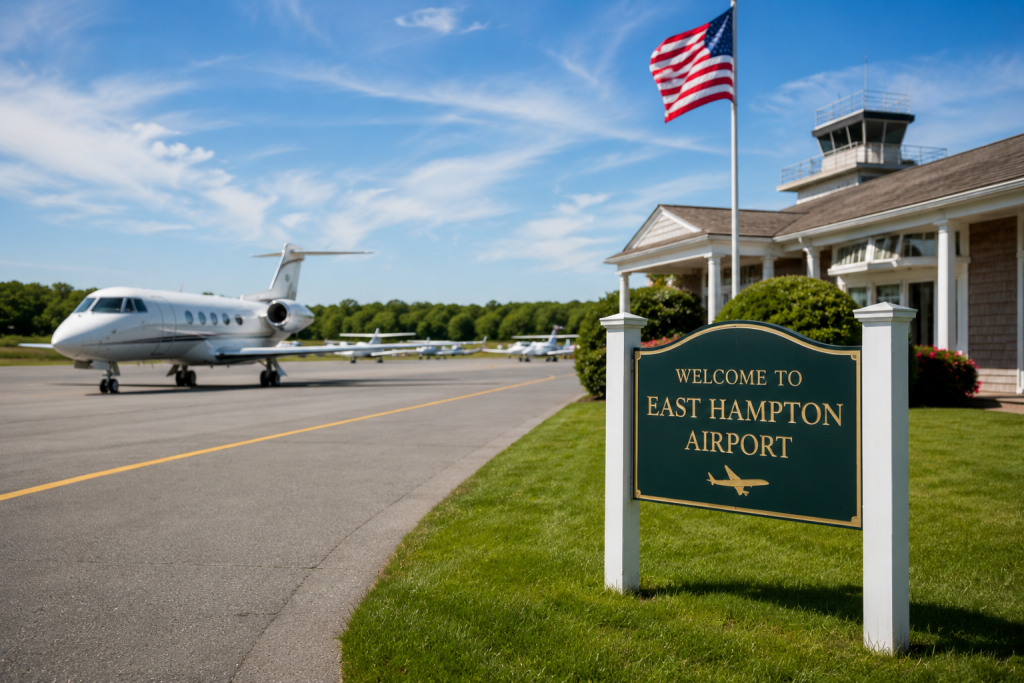
Forty Minutes or Four Hours: The Question That Splits the Village
The East Hampton Airport sits on Wainscott Road, approximately two miles west of East Hampton Village, and it has functioned as the most divisive piece of infrastructure on the East End for decades. At peak summer operation, the airport processes over 30,000 flights per year. Helicopters, seaplanes, private jets, and turboprops land and depart on a single 4,255-foot runway, ferrying passengers from Manhattan in approximately forty minutes. Indeed, that forty-minute flight compresses the same journey that takes four hours by car on a Friday afternoon in July. For the people who fly in, HTO is efficiency. For the people who live underneath the flight path, it is an invasion that no amount of property value can justify.
A private equity partner from Midtown (the kind who manages a $4 billion fund and holds a helicopter share at $250,000 per season) considers the flight a business expense. He departs the East 34th Street heliport at 2 PM, arrives at HTO by 2:40, and is seated at Nick and Toni’s by 3:15. Certainly, the time he saves has a calculable dollar value, and at his billing rate, the helicopter pays for itself in a single Friday afternoon. His neighbor on Springs-Fireplace Road, a novelist who has lived in the area for thirty years, hears every departure and considers each one a violation of the silence she moved here to find. They are both right. The airport does not resolve this contradiction. It amplifies it.
A Brief History of the Runway
East Hampton Airport opened in the 1930s, originally as a grass strip serving the growing summer colony. The Town of East Hampton has operated it as a public-use facility for most of its existence, accepting federal grant assurances that required maintaining public access in exchange for FAA funding. Those grant assurances expired in September 2021, which triggered the most significant regulatory battle in the airport’s history. In February 2022, the town board voted unanimously to “deactivate” the airport, close it permanently on February 28, and reopen it on March 4 as a new, private-use, prior-permission-required facility with a different FAA identifier (JPX instead of HTO).
The Legal Battle
However, the aviation industry fought back immediately. Friends of East Hampton Airport, the National Business Aviation Association (NBAA), and the Helicopter Association International filed lawsuits. A court injunction blocked the privatization. Consequently, the town was found in contempt of the court’s order in May 2023. In April 2024, the New York State Supreme Court’s Appellate Division upheld the injunction, ruling that the airport must remain open as a public-use facility and that any restrictions must go through the federal Airport Noise and Capacity Act (ANCA) process. The town had proposed limiting aircraft to one takeoff and one landing per day, setting hours of 8 AM to 8 PM on weekdays and 9 AM to 7 PM on weekends, and banning noisy aircraft above 91 EPNdB on approach. None of these restrictions have been implemented.
She hears the helicopter at 6:47 PM on a Thursday.
It passes over her garden at 800 feet.
She has lived in Springs for twenty-two years.
The helicopter has been landing here for most of them.
Her property is worth $4 million more than when she bought it.
She would trade every dollar of appreciation for silence.
The helicopter carries a man who considers silence a luxury he can buy.
He just bought forty minutes of it. She lost the same forty minutes.
The North Shore Helicopter Route: The Detour Nobody Wanted
In an effort to reduce helicopter noise over the South Shore communities between Manhattan and the Hamptons, the FAA established the North Shore Helicopter Route, requiring Hamptons-bound helicopters to fly over Long Island Sound and the North Shore before crossing Long Island at East Hampton. The intention was to shift noise away from densely populated South Shore communities. Essentially, the route moved the problem rather than solving it. Helicopters that previously flew over Jones Beach and the Hamptons Highway now crossed the island directly over East Hampton, concentrating noise in the very community where the airport is located.
The FAA extended the route through July 29, 2026, citing unresolved questions about the future of the airport and potential alternative destinations for Hamptons-bound aircraft. Voluntary noise abatement programs (including a “Fly Neighborly” initiative and a “Pilot Pledge” program developed with NBAA) encourage operators to follow noise-reduction procedures. Still, the word “voluntary” does the heavy lifting in that sentence. For residents of Springs, Wainscott, and the airport’s immediate surroundings, voluntary compliance is not the same as silence. The Quiet Skies Coalition, a local group fighting aviation noise, estimated that proposed restrictions could reduce helicopter complaints by 92 percent and overall noise complaints by 70 percent. Whether those restrictions will ever take effect remains an open legal question.
The Class Signifier in the Sky
The East Hampton Airport is not merely a transportation facility. It is a social sorting mechanism. Who flies in versus who drives in versus who takes the Jitney versus who rides the LIRR tells you exactly where someone sits in the Hamptons hierarchy. A helicopter share at $250,000 per season places you at the top. A NetJets card is close behind. Blade, the helicopter service that offers per-seat booking starting around $1,000 per trip, democratized helicopter access for the merely affluent (as opposed to the structurally wealthy). The Hampton Jitney, at approximately $50 each way, serves the professional class that values comfort but draws the line at aviation. The LIRR, at under $30, is for everyone else.
Notably, the mode of arrival carries social weight that persists throughout the weekend. A dinner conversation at Swifty’s can turn on the question of how you got here. “We flew” is a statement. “Drove out Thursday” is a different statement (it implies you have the flexibility to leave early, which implies seniority). Taking the Jitney is acceptable but not aspirational. “We took the train” is honest but rarely volunteered. In comparison, nobody in Sag Harbor asks how you arrived. Nobody in Amagansett cares. East Hampton cares because East Hampton has an airport, and the airport has created a hierarchy of arrival that no other village possesses.
The Economic Argument: What the Airport Brings
Proponents of the airport argue that it generates significant economic activity for the East End. The helicopter and private aviation crowd spends at a rate that no other visitor segment can match. They fill the restaurants, rent the houses, buy the real estate, and shop on Newtown Lane at price points that support the seasonal retail economy. Also, fixed-base operators and aviation services employ local workers. The airport itself is a town-owned asset. Closing it or severely restricting operations would, according to the aviation industry, reduce the economic velocity that makes East Hampton’s summer economy function.
Opponents counter that the noise degrades quality of life for year-round residents who do not benefit proportionally from the economic activity. After all, the helicopter passenger eats at Nick and Toni’s, but the helicopter noise reaches kitchens on Springs-Fireplace Road where nobody is eating a $65 branzino. This asymmetry (economic benefit concentrated among the wealthy, noise cost distributed among everyone) defines the political tension that has driven the legal battles since 2015. For the town board, the challenge is structural: the residents who vote live here year-round, but the economic activity that funds the town’s tax base arrives (often by helicopter) for twelve weeks each summer.
The Future: An Airport in Legal Limbo
As of 2026, the East Hampton Airport operates under a court-ordered status quo: public-use, no implemented restrictions beyond voluntary noise abatement, and an ongoing legal process that could take years to resolve. The town has signaled that if it cannot convert to private-use, it may close the airport permanently. The aviation industry has signaled that it will fight any closure or conversion with every legal tool available. Ultimately, the ANCA process (the federal framework for airport noise restrictions) requires extensive analysis, public comment, and FAA approval, a timeline measured in years rather than months.
Meanwhile, helicopters still fly. Complaints still accumulate. Quiet Skies Coalition still advocates. The Pilot Pledge still relies on voluntary compliance. And the fundamental question remains unanswered: does a community have the right to restrict access to its own airport if that access generates both enormous economic benefit and enormous quality-of-life cost? East Hampton has been trying to answer that question since 2015. However, the legal system has not let it. For anyone watching from Southampton (which has no comparable airport controversy), Bridgehampton (which benefits from the airport’s proximity without bearing its noise), or Sag Harbor (which is too far north to be affected), East Hampton’s airport fight is both a local drama and a national test case.
Where the Conversation Continues
Social Life Magazine has covered the East End for 23 years, five summer issues per season, 25,000 copies each. The airport debate is part of the community conversation, and the magazine puts it in front of the people who are having it.
If your brand serves the aviation audience (private aviation, luxury automotive, financial services, concierge travel, insurance), a paid feature in Social Life Magazine places you in front of both sides of the debate: the people who fly in and the people who live below. Submit a paid feature here.
Polo Hamptons 2026 returns to 900 Lumber Lane in Bridgehampton on July 18 and 25. BMW North America is the title sponsor. Christie Brinkley hosts. Sponsorship at polohamptons.com.
Subscribe to Social Life Magazine for year-round coverage of the villages, debates, and power dynamics that shape the East End.
East Hampton Airport processes over 30,000 flights a year. Each one carries someone who paid for speed and someone on the ground who paid the price of that speed. The runway is 4,255 feet long. The legal battle has lasted a decade. Neither the flights nor the complaints show any sign of stopping. The front door stays open. The argument about who gets to walk through it continues.
Author

Written by
Recent Posts
How to Measure Whether a Hair Loss Treatment Is Working
Is Online Psychiatry Covered by Insurance? What to Know Before Booking
Four Habits of Quietly Successful Entrepreneurs

The Most Common Preventable Health Concerns Doctors See Today
What Affects a Rideshare Injury Settlement?
Categories
- Art
- Articles
- Business of Luxury
- Celebrities
- Culture
- Entertainment
- Events
- Faces of Summer 2026
- Fashion
- Fashion & Style
- Featured
- Finance
- Food, Spirits, Wine
- Hamptons
- Hamptons Celebrities
- Health
- Health & Beauty
- Lifestyle
- Luxury Lifestyle
- Press
- Profiles
- Real Estate
- Technology
- The Chronicles
- Travel
- Uncategorized
- Weddings