
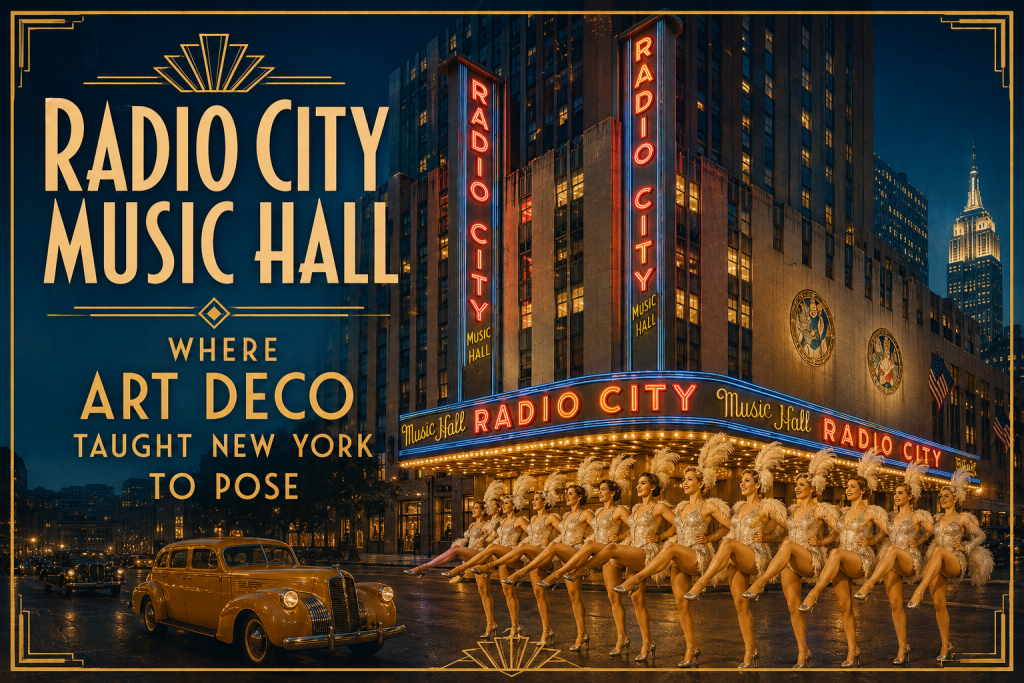
In December 1932, with the country three years into the Depression, John D. Rockefeller Jr. opened a palace for people who could barely afford the ticket. Radio City Music Hall was not built to be practical. It was built to make an ordinary citizen feel, for two hours, like the richest person in New York. That is the secret of Art Deco glamour, and it is a secret the luxury business still runs on today.
The towers got the headlines, but the interiors did the real work. Inside Radio City and the rooms like it, Art Deco stopped being architecture and became theater. The style taught a generation how to walk into a room, how to be seen, and how to pose. The Hamptons did not invent the art of the entrance. These rooms did.
A Palace in the Depths of the Depression
Of course, the timing was the whole point. The Rockefeller family broke ground on Rockefeller Center as the economy collapsed, and they finished it anyway. Radio City, the showpiece, opened its doors as a deliberate act of defiance against the gloom outside.
The impresario Samuel “Roxy” Rothafel ran the place, and his name had already become shorthand for opulence. Cole Porter dropped it into a lyric. The goal was simple but radical, since the hall was meant to be a place where anyone could buy a few hours of pure glamour and dream of better days.
The Room Donald Deskey Designed
The interior belonged to a designer named Donald Deskey, and he made it a manifesto. Deskey rejected the fussy gold of older theaters and chose the machine-age palette instead. Specifically, chrome, aluminum, glass, and Bakelite met marble and gold leaf across more than thirty distinct spaces.
The Grand Foyer still stuns. A four-story ceiling, vast gold-framed mirrors, and starburst chandeliers turn a simple walk to your seat into an event. The ceiling over the Great Stage curves like a setting sun, because the architecture itself was choreographed for awe.
The Critic’s Verdict That Held
Decades later, the architecture critic Paul Goldberger called Radio City the city’s true shrine of Art Deco. Even against the Chrysler Building and the Empire State, no other interior in Manhattan matches it for that early modern flair. The hall earned the title and has kept it.
The Secret Apartment Above the Stage
Hidden high above the auditorium sits one of the great status objects in New York, the Roxy Suite. Rothafel built himself a private Art Deco apartment inside the building, with a twenty-foot ceiling covered entirely in gold leaf. The dining room was domed to flatter the acoustics of conversation.
In fact, the guest book read like a Hollywood call sheet. Alfred Hitchcock, Samuel Goldwyn, and Olivia de Havilland all came up to be entertained beneath that golden ceiling. Today the suite hosts private events, so you can still sip a cocktail where the leading lights of the 1930s did, if you know how to get in.
Glamour as a Business Model
This is the part that should interest any brand chasing prestige. Radio City proved that designed glamour is not a frill. It is a product. In fact, people paid, and still pay, simply to stand inside a room engineered to make them feel elevated.
The Floating Versions
Then the same logic took to the water. The great ocean liners of the 1930s became floating Art Deco palaces, and the French flagship Normandie was the most extravagant of them all. Crossing the Atlantic in first class meant dining inside a moving cathedral of glass and lacquer.
The point was identical to Radio City’s. A liner sold a destination, but it also sold the performance of arriving, the gowns, the grand staircase, the entrance. Café society learned its choreography on those ships and in those lobbies, then carried it everywhere it summered.
What These Rooms Teach the Modern Host
Here is the takeaway for anyone planning an event or building a venue on the East End. Indeed, people do not remember the canapés. Instead, they remember how a space made them feel about themselves. Art Deco understood that the room is the real host, and the room’s job is to flatter.
That principle drives every great Hamptons activation, from a tented gala to a brand’s pop-up on the dunes. Design the entrance. Engineer the awe. Make the guest the most glamorous version of themselves, and they will associate that feeling with your name forever. The broader story of how this style conquered a culture sits in our pillar on the last future we agreed on. The towers that housed it appear in the race to the sky, and the society it served is mapped in the Gatsby Coast.
Where The Conversation Continues
Radio City still teaches the same lesson it taught in 1932. Glamour is not decoration. It is the most persuasive argument a space can make. Social Life Magazine has spent twenty-three summers helping brands and hosts make that argument across the East End.
If your brand wants a room that does the work, this is the conversation to be in. Join the list at sociallifemagazine.com, where the people who design the season’s best entrances already gather. Become a patron of the archive here. A yes is a seat under the gold ceiling. A no is the table by the kitchen door.
Author

Written by
Recent Posts

5 Mindful Wellness Trends Redefining Modern Self-Care This Season

What to Look for in a Hairdresser on the Gold Coast

hiTechMODA Season 16
How to Keep Your Personal Number Private When Booking Events, Rentals and Services
Understanding Compensatory Damages in a Personal Injury Case
Categories
- Art
- Articles
- Business of Luxury
- Celebrities
- Culture
- Entertainment
- Events
- Faces of Summer 2026
- Fashion
- Fashion & Style
- Featured
- Finance
- Food, Spirits, Wine
- Hamptons
- Hamptons Celebrities
- Health
- Health & Beauty
- Lifestyle
- Luxury Lifestyle
- Press
- Profiles
- Real Estate
- Technology
- The Chronicles
- Travel
- Uncategorized
- Weddings