
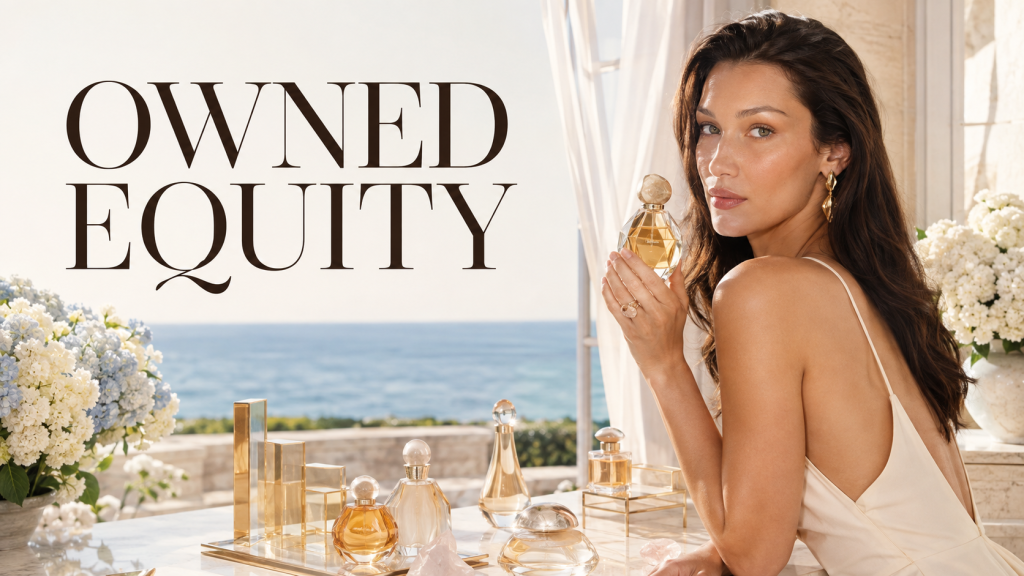
Bella Hadid launched a fragrance company in May 2024, and the industry filed it under vanity project. Two years later, Orebella runs eight-figure revenue and holds the top fragrance spot at Ulta Beauty Middle East. In May 2026 it closed a Series A led by Silas Capital. The vanity project has a cap table now.
The brand matters to this cluster because of its structure. She owns it, unlike nearly every model-fronted fragrance before it, and ownership changes the entire math. Her personal ledger sits in Bella Hadid’s $25 million comeback story.
The Two-Year Tape
Founded: May 2024, built on an alcohol-free formula developed with the Firmenich and Robert fragrance houses. Revenue: eight figures annually, with projections of $20 to $30 million for 2026. Growth: double digits year over year, before the new categories even land.
Distribution: more than 2,000 doors, spanning Ulta in the United States, Douglas across 20 countries, and Selfridges in London. Newest launch: a body and hair mist line that arrived in April 2026. Best evidence of demand: the Jasmine Blues edition sold at twice its forecast.
Why She Owned It Instead
The structural choice is the story. Modeling pays faces to rent themselves out, and the supermodel money hierarchy shows how rarely that rent compounds into a fortune. She watched the licensing era from inside it.
So Orebella launched as an owned brand, not a deal memo. Compare the licenses dominating the 2026 bottle rush, where the stars collect single-digit royalties. An owner keeps the enterprise value, although she also carries the risk.
The precedent she is chasing is obvious. The Rhode exit turned three years of ownership into nine figures, and every founder in this cluster has read that filing twice.
The Comeback Context
The timeline makes the growth stranger and better. She built this while managing the Lyme disease recovery that pulled her off runways for stretches of her twenties. The brand was not a victory lap. It was the way back.
That origin reads commercially, because the customer can tell. A founder formulating around her own sensitivities produces different products than a licensing committee chasing a trend deck. Authenticity is an overused word and an underpriced asset.
It also explains the category choice. Fragrance built on scent memory and self-soothing is wellness wearing perfume’s clothes, which is precisely where the market moved.
The Alcohol-Free Wedge
Differentiation came from her own skin. Alcohol-based sprays irritated it, so the line replaced alcohol with a bi-phase blend of jojoba and almond oils beneath the fragrance molecules. The category did not have a name, so the brand invented one, skin parfum.
Wedges like this age well. A formula claim can eventually be copied, yet the first mover owns the shelf language, and retail buyers reward whoever created the section. Ask the clean-beauty pioneers how that compounds. Notably, the mist expansion stretches the same formula into new aisles without a reformulation bill.
It also plugs into a wellness turn the East End knows intimately. The customer moving alcohol out of her glass is often the same one moving it out of her fragrance. Bella arrived at both, since she co-founded a non-alcoholic aperitif brand first.
The Ulta Machine and the Middle East Surprise
Distribution tells its own story. Ulta carries the line chain-wide in America, while the Middle East stores made it the number one fragrance in the region. Douglas added 500 European doors in March 2026.
The Middle East result deserves a pause. That market is the most sophisticated fragrance audience on earth, layered scents and oud traditions included. A two-year-old celebrity brand winning there is a formulation compliment no ad budget could buy. Her spring retail tour through Kuwait and Dubai treated the region as a home market rather than an afterthought, and the sales numbers repaid the respect.
The expansion coverage counts more than 2,000 locations already. For a brand this young, the shelf came fast, and the shelf is the hard part.
The Series A Read
In May 2026 the company took growth equity, led by Silas Capital with Celebrands participating, per the announcement. A month earlier it installed Anish Agarwal, a Colgate and L’Oréal veteran, as chief executive. Professional money, professional operator.
Contrast that with the funding-light path Gaga chose for her beauty comeback. Taking capital dilutes, yet it also buys speed while the category is hot. Fragrance is hot now, so the trade makes sense.
Watch what she kept. The founder stays across scent development and brand direction, which in this cluster is the difference between a founder and a spokesmodel. The failures always gave that seat away first. Equally, the CEO hire frees the founder to do the one job nobody can replace, being the reason customers picked up the bottle.
The Celebrands Tell
Look closely at the investor list, because one name is a thesis. Celebrands exists specifically to back celebrity-founded companies, meaning institutional capital now underwrites famous founders as an asset class. That is new.
The diligence bar explains why. After the beauty brand graveyard years, funds learned to separate rented faces from operating founders, so the survivors get priced like startups rather than endorsements. Bella cleared that bar with two years of receipts.
Expect the model to spread. The next wave of model-founded brands will raise institutional rounds at year two, and the licensing era will look increasingly like the flip-phone era.
The Sister Ledger
The family context sharpens the picture. Gigi’s $30 million fashion fortune includes her own cashmere label, while Kendall’s 818 founder file proved runway peers could build spirits money. The model-to-founder pipeline is now a family business plan.
Bella’s version is the most structurally aggressive of the three. A new category, an invented product language, outside institutional capital, and a professional CEO before year three. That is startup behavior, not celebrity licensing behavior. Sisters comparing cap tables over dinner is the 2026 version of comparing covers.
Where the Money Lands
So what is the Orebella stake worth? At $20 to $30 million in projected revenue with venture-grade growth, comparable deals price young fragrance brands at several times sales. Even conservative math puts the company’s value above her entire modeling net worth.
That inversion is the headline hiding in this profile. The brand is now the fortune, and the face is its marketing department. The 90s fragrance gold rush made middlemen rich on the opposite arrangement. This time the face owns the middle.
The Series A means her share is no longer all of it, of course. Yet founders who sell a slice at a growth valuation usually end richer than owners of unfunded plateaus. Ask anyone who held a license too long.
The East End Coda
Out here the brand fits a mood that arrived before it did. Sober-curious summers, sensitive-skin routines, and spa menus like the Topping Rose spa’s already sell the softer version of luxury. An alcohol-free skin parfum reads as native.
There is a local proof point most coverage misses. Ulta’s fragrance wall now sits twenty minutes from every summer rental on the South Fork, and the sober-curious dinner party is this season’s default setting. A scent with no alcohol and a wellness story is not chasing the culture here. The culture is chasing it.
For fragrance and wellness sponsors, the signal is timing. The customer redefining her rituals is doing it this summer, in these zip codes, with this magazine on the counter. Meet her mid-redefinition.
Where The Conversation Continues
The wider boards live in the 2026 celebrity net worth rankings and the celebrity beauty empire board. Orebella will be this cluster’s next big revaluation, because Series A brands do not stay private forever.
And when the next Jasmine Blues sells at triple forecast, remember where you read the math first.
Author

Written by
Recent Posts

The First Decision After a Collision Can Be the Most Important One
Two Weeks in Rome and Beyond: Turkish Airlines Itineraries from Boston, Chicago and Onward to India
Top 10 Hair Transplant Clinics in Turkey 2026
Artist Alley to Online Store: How Convention Artists Can Keep Selling After the Event
When an 18-Wheeler Crash Leaves Lasting Consequences
Categories
- Art
- Articles
- Business of Luxury
- Celebrities
- Culture
- Entertainment
- Events
- Faces of Summer 2026
- Fashion
- Fashion & Style
- Featured
- Finance
- Food, Spirits, Wine
- Hamptons
- Hamptons Celebrities
- Health
- Health & Beauty
- Lifestyle
- Luxury Lifestyle
- Press
- Profiles
- Real Estate
- Technology
- The Chronicles
- Travel
- Uncategorized
- Weddings