

The Before: A Soviet-Era Daughter Whose Family Bet Everything On Departure
Chernivtsi to Los Angeles, 1991
Milena Markovna Kunis was born in Chernivtsi, Ukrainian SSR, in August 1983. Her father, Mark, was a mechanical engineer. Her mother, Elvira, was a physics teacher. Specifically, the family was Jewish, and the late-Soviet-era restrictions on Jewish professional life had become impossible to ignore by the late 1980s. In 1991, with the Soviet Union dissolving, the Kunis family applied for refugee status. Subsequently, they emigrated to Los Angeles. Mila was seven. She spoke no English on arrival. Her parents arrived with $250 in cash and effectively no professional network in their new country.
Acting Class At Nine, First Audition At Ten
Within two years, Mila had enrolled in after-school acting classes at the Beverly Hills Studios. Importantly, the choice was not a standard first-generation immigrant career path. Her parents pursued it because Mila herself, at nine, asked for it. By ten, she had a manager. Furthermore, by thirteen, she had landed her breakthrough role as Jackie Burkhart on Fox’s That ’70s Show. Specifically, the show would run from 1998 through 2006 and pay her, by the final season, a reported $50,000 per episode.
The Pivot Moment: That ’70s Show, the Voice, and the Adult Repositioning
Eight Seasons As Jackie Burkhart
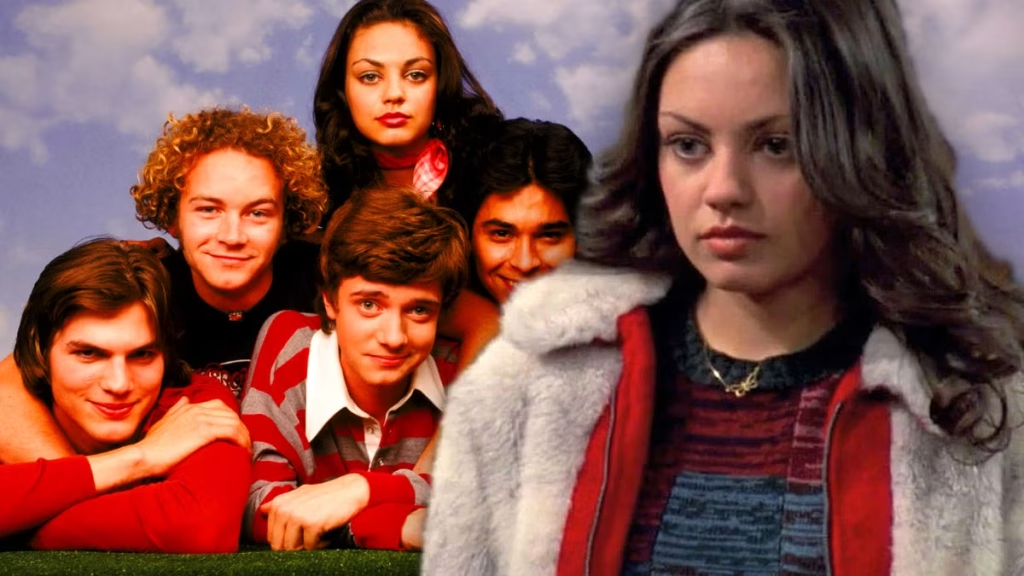
Kunis was fourteen when filming began on That ’70s Show. The show ran for 200 episodes across eight seasons. Her aggregate compensation across the run totaled several million dollars in salary plus syndication participation, by industry estimate. Notably, the show locked her into a comedic-teen register. Industry observers initially assumed it would define her ceiling. Most actresses who emerge from network sitcoms at her age never escape the category. Kunis began planning her exit during the show’s middle seasons.
The Family Guy Voice Work
From 1999 onward, Kunis voiced Meg Griffin on Fox’s Family Guy. The voice role provided steady income and kept her in the union. Importantly, it also gave her cultural recognition that did not depend on her physical image. Specifically, the voice work was a secondary income stream most network-television actors never bother to develop. Kunis treated it as a strategic asset rather than a side project. Furthermore, she has continued voicing Meg into the show’s current seasons. Consequently, the role has paid her continuously for over twenty-five years.
Friends With Benefits and Black Swan, Both 2010

In 2010, Kunis appeared in two films that effectively repositioned her career. Will Gluck’s Friends with Benefits opposite Justin Timberlake repositioned her as a romantic-comedy lead. She could now carry mainstream studio fare. Then Darren Aronofsky’s Black Swan arrived. Importantly, her performance as Lily, the rival ballerina opposite Natalie Portman‘s Nina, earned her a Golden Globe nomination. She also won the Marcello Mastroianni Award at the Venice Film Festival. The combination was rare. Within a single year, Kunis had locked in both mainstream commercial bankability and prestige-film credibility. Subsequently, brands took notice.
The Climb: The $10 Million Jim Beam Deal That Changed a Category
The Signing That Surprised The Spirits Industry
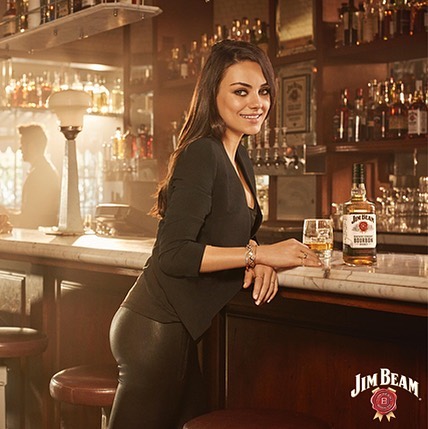
In 2013, Jim Beam’s parent company Beam Inc. signed Kunis. The contract was a multi-year global brand ambassador deal. Reportedly, the deal was worth approximately $10 million across its initial term, per AdAge’s coverage of the partnership. The signing surprised the spirits industry for two reasons. First, bourbon at the time was considered a male-coded category. Female consumers represented approximately 25% of the market. Notably, no major bourbon brand had previously committed an endorsement budget of this scale to a female ambassador. Furthermore, Kunis at thirty was younger than the demographic Jim Beam had historically targeted.
The Category Lift That Followed
Across the seven years following the Kunis signing, bourbon’s female consumer share expanded from approximately 25% to approximately 37%. Distilled Spirits Council data appears in Bloomberg’s coverage of the category shift. Jim Beam’s annual revenue grew from approximately $1 billion at the time of signing to approximately $1.7 billion by 2019. Specifically, not all of that growth can be attributed to Kunis alone. Yet internal Beam analysis at the time credited the Kunis campaigns. The campaigns materially accelerated the brand’s expansion into the female demographic. Furthermore, Suntory acquired Beam Inc. for $16 billion in 2014. The demographic-expansion thesis was a documented component of the acquisition rationale.
The Ad Age Recognition
In 2014, Ad Age named Kunis “Marketer of the Year” in its annual category awards. The recognition was unusual. The award typically went to chief marketing officers or marketing-side executives. Kunis won as a celebrity ambassador. Her campaigns had measurably moved a category. Specifically, the recognition formalized what the spirits industry had been quietly observing. The right ambassador, signed against the right category orthodoxy at the right cultural moment, can produce category-level effects. No marketing-side hire alone can match those effects.
Bad Moms and the Producer Pivot
From 2016 onward, Kunis began layering production credits onto her on-screen work. Bad Moms in 2016 grossed $184 million worldwide on a $20 million budget. Kunis was attached as both star and producer. Furthermore, the franchise’s two sequels and adjacent licensing extensions established Kunis as a producer with commercial track record. She was not a celebrity using a vanity production credit. The producer column on her resume began generating income independent of her on-screen fees. Specifically, this structural diversification is something most actresses at her tier never achieve.
The Placement Economy: Why Kunis Is The Spirits-Category Case Study
The Math On Female-Targeted Category Lift
The Jim Beam deal demonstrates something the placement economy rarely produces in such legible form. Specifically, a single ambassador, signed at the right cultural moment against entrenched category orthodoxy, can generate measurable demographic expansion. That expansion compounds for the brand long after the contract ends. The Distilled Spirits Council data shows female bourbon consumption grew from a 25% category share to 37% across the 2013 to 2020 window. Apply that twelve-point shift to a U.S. bourbon market that grew from $2.5 billion to over $4 billion in the same period. The result is roughly $500 million in incremental female-consumer revenue captured by the category.
The Brands That Have Now Adopted The Model
The Kunis-Beam deal triggered a cascade of subsequent female-celebrity spirits ambassador signings. Specifically, the model has been adopted across the bourbon, whiskey, and tequila categories. Maker’s Mark signed Lin-Manuel Miranda for adjacent positioning. Wild Turkey signed Matthew McConaughey, then expanded to female-coded campaigns. Casamigos with George Clooney triggered the celebrity-tequila wave. Subsequently, the wave produced Kendall Jenner’s 818, Eva Longoria’s Casa Del Sol, and a half-dozen other female-celebrity tequila brands. Furthermore, the Kunis case study sits in the deck of nearly every spirits-category brand manager working today. The thesis is straightforward. A sufficiently durable celebrity ambassador, paired with a category that is structurally underserving a specific demographic, can produce category-level effects that simple marketing-side investment cannot.
The Other Brand Stack

Beyond Jim Beam, Kunis has held smaller ambassador and creative-director roles with various consumer brands. Gemfields tapped her as a face for emerald-jewelry campaigns. Kohl’s partnered with her on activewear collaborations. The Honest Company (founded by Jessica Alba) used her in early campaigns. Notably, Kunis has been more selective than most A-list actresses about brand partnerships. She has declined numerous beauty and fashion deals to maintain the prestige register that Jim Beam paid premium for. Specifically, the strategic discipline is the lesson. Brand asset value compounds when the talent declines deals as deliberately as she signs them.
The Ukraine-To-Beverly Hills Chapter: Where The Identity Got Built
The Soviet-Refugee Origin That Anchors Everything
Kunis has consistently spoken in interviews about her family’s 1991 emigration as the formative event of her life. The decision to leave Ukraine, made by her parents in their thirties with $250 and no English, gave her a working-class American childhood. Hollywood arrived later. Specifically, Kunis attended Rosewood Elementary in Los Angeles. She enrolled at Hubert Howe Bancroft Middle School. She attended Fairfax High School concurrent with her network television work. Furthermore, she enrolled at UCLA Extension and Loyola Marymount University for sporadic college coursework. Her acting schedule prevented a degree-track program. The Soviet-refugee narrative has been a consistent feature of her public identity. Specifically, it differentiates her from the second- and third-generation Hollywood families that dominate her tier.
The Beverly Hills Family Architecture

Since 2014, Kunis has been married to Ashton Kutcher. He was her former That ’70s Show co-star. They began dating in 2012 and married privately in July 2015. Furthermore, they have raised two children, Wyatt (born 2014) and Dimitri (born 2016), in a Beverly Hills family residence. Importantly, the residence is famously modest by Beverly Hills standards. The couple has spoken publicly about choosing not to purchase the typical seven-figure-plus celebrity home. Instead, they opted for a smaller Beverly Hills compound designed around child-rearing rather than entertaining. Specifically, Kutcher and Kunis have publicly stated their intention to leave their children almost no inheritance. Accumulated wealth will be directed toward charitable foundations rather than family trusts.
The Charitable Architecture
Kunis and Kutcher operate jointly through several philanthropic vehicles. Specifically, they launched the Stand With Ukraine fund within days of the February 2022 Russian invasion. The fund raised over $36 million in approximately seven weeks, per CNBC’s coverage of the GoFundMe campaign. The donations supported Airbnb housing for Ukrainian refugees and Flexport logistics for medical and humanitarian supplies. Notably, Kunis personally appeared on broadcast media throughout 2022 advocating for Ukraine. Her family had left the country thirty-one years earlier. The advocacy was authentic and well-organized. Furthermore, it proved structurally additive to her brand-asset profile in ways that typical celebrity philanthropy rarely produces.
What She Built: The Net Worth Breakdown
The $75 Million Estimate
Current credible estimates place Kunis’s personal net worth at approximately $75 million, per cross-referenced reporting from Forbes and other industry tracking. The composition breaks down approximately as follows.
Acting income across career: approximately $35 million in retained capital from a career gross north of $60 million. Sources include That ’70s Show, Family Guy voice work, Friends with Benefits, Black Swan, the Bad Moms franchise, and various other films. Specifically, the Family Guy voice royalties alone have generated meaningful sustained income across two decades.
Brand ambassadorships: approximately $15 million in retained capital from a cumulative gross of $20 million-plus. Sources include the Jim Beam deal, the Gemfields and Kohl’s partnerships, and various smaller deals. Importantly, Jim Beam was the dominant ambassador line by a significant margin.
Production company income and equity: approximately $10 million from her producer credits on the Bad Moms franchise and adjacent projects. Equity stakes in various tech and consumer-product startups she and Kutcher have invested in jointly add to this column.
Real estate and other holdings: approximately $15 million across the Beverly Hills primary residence. Various other property holdings the couple jointly owns add to the line. Notably, Kunis and Kutcher have held real estate primarily for personal use rather than as investment leverage. The choice is unusual for couples at their wealth tier.
The Asset Composition Lesson
The portfolio matters because it inverts the standard A-list actress model in two specific directions. First, Kunis runs significantly higher brand-ambassador income share (~20% of net worth) than her peers. The Jim Beam premium drives most of that delta. Second, she runs significantly lower real estate share (~20%) than her peers. The split reflects the couple’s deliberate decision to underweight property accumulation. Specifically, the architecture is the lesson. Kunis converted her acting prestige into ambassador premium. Subsequently, ambassador premium became producer-equity diversification. Throughout, the real estate footprint stayed deliberately small. Most peers do the inverse. They end up with more property and less operating equity.
The Soft Landing: What The Kunis Case Teaches Every Brand Founder
Three Lessons From the Bourbon Bet
First, the right ambassador can rewrite a category’s gender code. Jim Beam’s bet on Kunis was not the obvious one. The bet was not that she would sell more bourbon to existing bourbon drinkers. The bet was that she would expand the category itself. She would give female consumers a culturally-permitted entry point. Specifically, the strategic insight is rare. Most ambassador deals are sold as “she will sell more of what we already sell.” Few are sold as “she will expand who is allowed to want what we sell.” Brand founders should pay close attention to the difference. Category expansion compounds in ways simple share-shifting never does.
Second, prestige plus mainstream equals ambassador premium. Kunis was bookable to Jim Beam at premium pricing for one reason. She had simultaneously locked in Black Swan prestige cred and That ’70s Show mainstream recognition. Notably, that combination is rare. Most actresses are either prestige-coded (Natalie Portman‘s Harvard-Dior register) or mainstream-coded (Reese Witherspoon’s romantic-comedy register). Rarely are they both at once. Kunis’s positioning across both lanes allowed Jim Beam to pay her at a premium. No purely-mainstream or purely-prestige actress could have commanded that figure.
The Diversification That Most Actresses Skip
Third, the producer pivot is the actor’s path to operating equity. Kunis’s Bad Moms producer credit was the pivot move of her career. The credit established that she could diversify away from acting income into operating equity. Specifically, the move parallels what Jessica Alba did with the Honest Company, but at smaller scale and lower operational risk. Producing pays differently than acting. Producing income compounds across a project’s full lifecycle rather than resetting per film. Furthermore, the producer credential opens equity stakes in adjacent ventures. Pure acting credentials do not.
The Thesis That Outlasts the Contract
Kunis’s case is instructive for one reason. A single strategic ambassador deal reshaped both her career economics and an entire consumer category. The Jim Beam contract paid her approximately $10 million across its initial term. The deal also gave her the marketing case study. Specifically, that case study has anchored her brand-asset value for the subsequent decade. Notably, no subsequent female actress in her tier has commanded a comparable spirits ambassador deal at first signing. The category-expansion thesis Kunis proved cannot be proved twice. The first ambassador to break a category captures the case-study premium. Everyone after captures incremental upside. The thesis was already validated by the first ambassador. That asymmetry is the lesson worth carrying out of her career.
Related Reading
- Hollywood’s $26 Billion Hidden Economy: How Product Placement Built Modern Stardom
- Natalie Portman Net Worth: How Dior’s 15-Year Contract Built $90M
- Jessica Alba Net Worth: From Sin City To $1.44B Honest Company IPO
- Jude Law Net Worth: $70M From Refusing To Choose Between Prestige And Tentpole
- Emma Watson Brand Asset Economics: Burberry, Lancôme, And The Brown Detour
- Meryl Streep Brand Asset Economics: $160M From Refusing Endorsements
How To Work With Social Life Magazine
A fish does not notice the water. A reader does not notice the placement. That is the entire point. Furthermore, it is the entire opportunity for the brand founder who has just finished reading an article and is, without having fully realized it yet, about to scroll down and click one of the following five links.
Six Ways To Connect
If you are a brand, a founder, a creative director, or an in-house marketing lead who has read this far and would like to be considered for an editorial feature in Social Life Magazine’s print or digital ecosystem, the editorial team reviews brand submissions year-round. Pitch us at sociallifemagazine.com/contact.
If you are a brand with a ready-to-run campaign and would like to move faster than the traditional editorial cycle, the Paid Feature program offers three tiers of guaranteed placement across Social Life Magazine’s digital properties, with pricing starting at $975. Full details at sociallifemagazine.com/submit-a-paid-feature/.
Every piece Social Life Magazine publishes reaches an email list of 82,000 pre-qualified affluent readers. The majority summer in the Hamptons and spend the off-season in Manhattan’s core luxury zip codes. The email blast is the single most efficient distribution mechanism in the Hamptons editorial ecosystem. Inquire about placement at sociallifemagazine.com/enflyer.
Events, Print, And Independent Editorial
Polo Hamptons 2026, Social Life Magazine’s flagship event property, returns for its 17th year in July and August 2026. Platinum, Gold, and Corporate Cabana sponsorship packages are available for select categories (automotive is locked by BMW North America, real estate is at capacity, all other categories open). Demographic data, sponsor decks, and custom activation proposals available at polohamptons.com.
Social Life Magazine’s print edition, now in its 23rd year, distributes 25,000 copies per summer issue across Westhampton, Southampton, Bridgehampton, East Hampton, Sag Harbor, Amagansett, and Montauk boutiques, restaurants, and private clubs. Annual subscriptions, including fall/winter Upper East Side doorman distribution, available at sociallifemagazine.com/subscription.
If you’d like to support independent luxury editorial in the age of AI-generated content farms and private-equity-owned media conglomerates, donations to Social Life Magazine’s editorial operations are received via PayPal. Every dollar funds original reporting, photography, and the kind of writing that brands send their marketing teams to study.
Author

Written by
Recent Posts
Legal Options for Investment Fraud Claims

How Custom DTF Printing Adds Ease and Color to Your Boutique
How Often Should You Actually Replace Your Towels?
Apartment Pet Policies: What to Know as a Pet-Owning Tenant
Why Reliable Airport Transportation Matters for Modern Travelers
Categories
- Art
- Articles
- Business of Luxury
- Celebrities
- Culture
- Entertainment
- Events
- Faces of Summer 2026
- Fashion
- Fashion & Style
- Featured
- Finance
- Food, Spirits, Wine
- Hamptons
- Hamptons Celebrities
- Health
- Health & Beauty
- Lifestyle
- Luxury Lifestyle
- Press
- Profiles
- Real Estate
- Technology
- The Chronicles
- Travel
- Uncategorized
- Weddings