
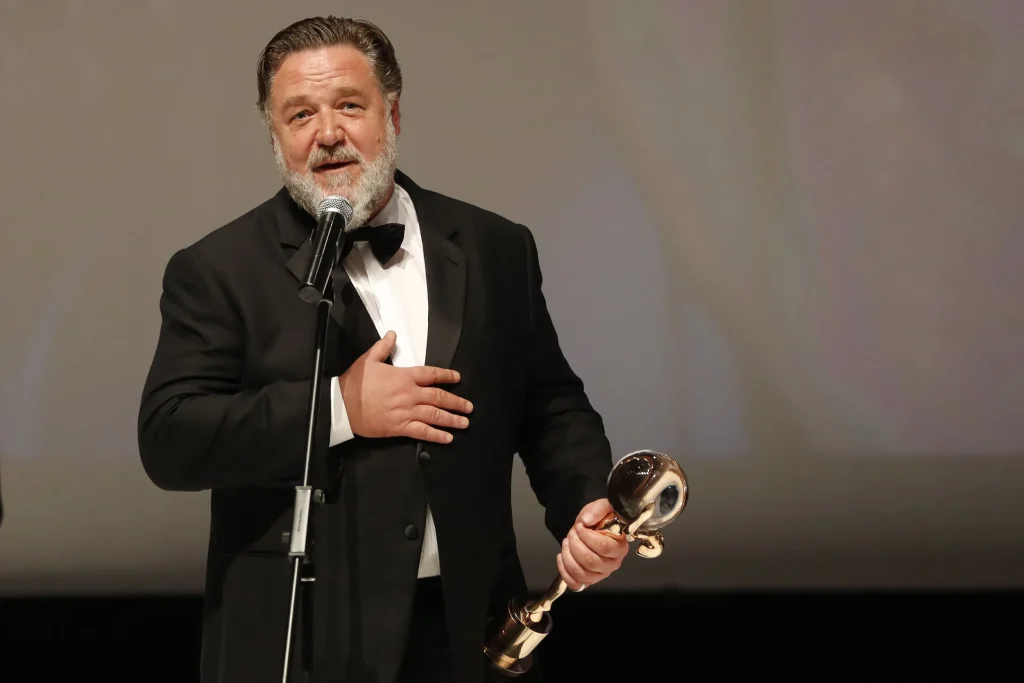
Russell Crowe Net Worth: How a $100 Million Fortune Got Built By the Star Who Refused To Live in Los Angeles
The Before: A Wellington Boy Who Followed His Family Across the Tasman
The New Zealand Childhood and the Australian Migration
Russell Ira Crowe was born in Wellington, New Zealand, in April 1964. Specifically, his father John ran pubs and managed motels. Likewise, his mother Jocelyn did the books. The family moved to Sydney when Russell was four, following film catering work that John had picked up. Specifically, the Crowes worked the catering trucks on Australian film and television productions through the late 1960s and early 1970s. Russell grew up on those sets, occasionally appearing as an extra in series his parents fed crew on. The exposure to working actors at a working-class income level shaped his subsequent relationship to fame in ways that distinguish him from nearly every American peer he later worked alongside.
The School Years and the First Bands
Initially, Initially, Crowe attended Sydney Boys High School. Notably, he was a moderate student academically, a strong rugby player, and an early performer in school productions. Within his teen years, he had recorded a single under the name Russ Le Roq by fourteen. Throughout his late teens, he worked variously as a waiter, a fruit picker, and a bingo caller in Western Australia. Furthermore, he fronted several bands across the late 1980s, including Roman Antix and 30 Odd Foot of Grunts, the latter of which would tour internationally well into Crowe’s Hollywood career. The musical identity matters because it foregrounds something Crowe has consistently demonstrated. He has multiple income streams. None of them depend on Hollywood. All of them get treated as serious work rather than celebrity hobby.
The Pivot Moment: Romper Stomper and the Australian Breakout
The 1992 Performance That Got Hollywood’s Attention
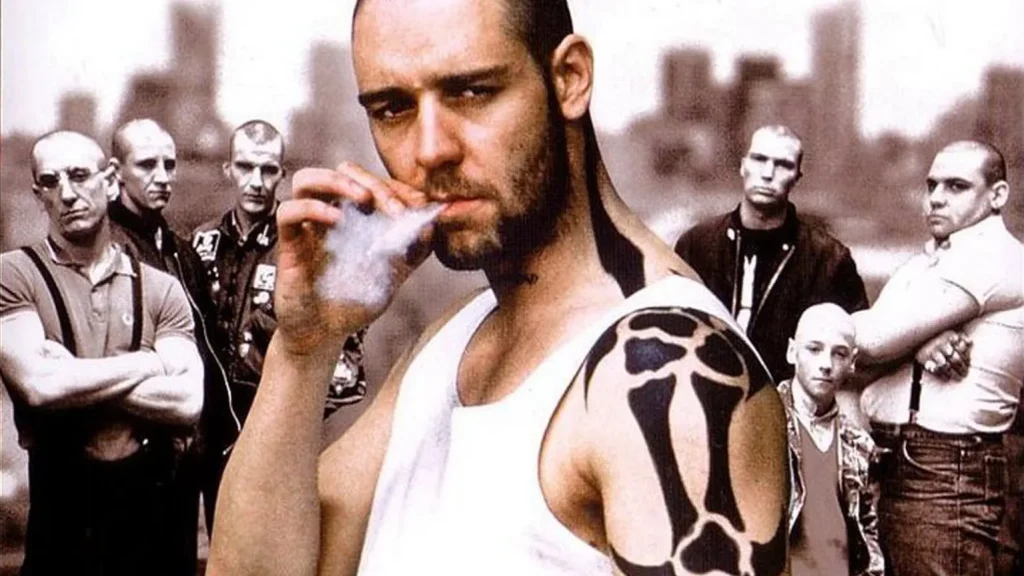
In 1992, Crowe starred in Geoffrey Wright’s Romper Stomper. Specifically, the Australian film centered on Melbourne neo-Nazi skinheads. Notably, the performance was raw, unsettling, and unanimously celebrated by Australian critics. Specifically, it earned Crowe the AFI Award for Best Actor and put him on a shortlist of Australian actors that American casting directors were beginning to track. The film’s American distribution was limited. Yet enough Hollywood agents saw it that Crowe began booking American auditions within eighteen months of release.
The LA Confidential Casting That Changed Everything
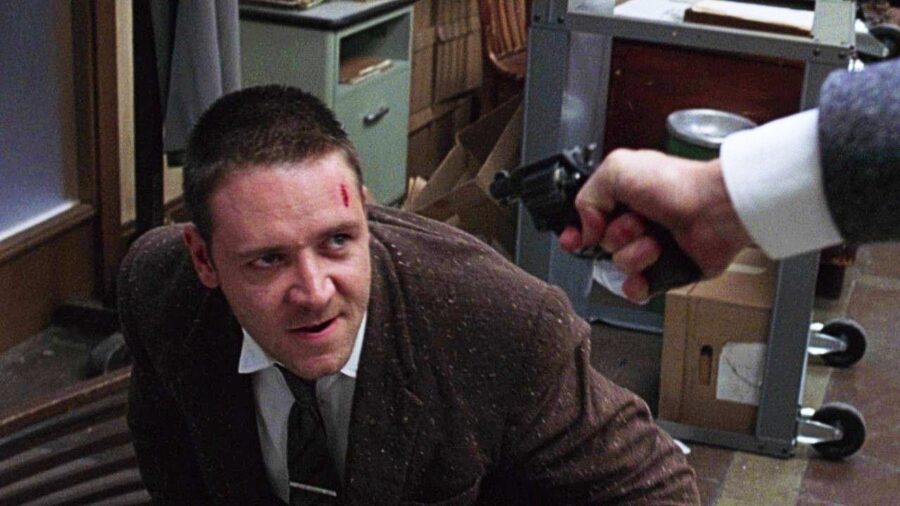
In 1996, Curtis Hanson cast Crowe as Bud White in L.A. Confidential. The film released in 1997 and became one of the most critically celebrated American productions of the decade. Crowe’s performance, opposite Guy Pearce and Kevin Spacey, established him as the rare Australian import who could carry a leading role in mid-century American material. Importantly, the accent never betrayed him. Importantly, the film grossed $126 million on a $35 million budget and earned nine Academy Award nominations. Crowe did not win for it. Yet the casting unlocked the next decade of his career, including the role that would make him globally famous.
The Climb: Three Best Actor Nominations in Three Consecutive Years
The Insider, 1999
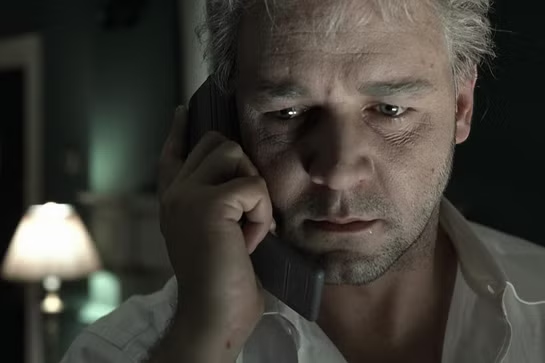
Subsequently, Michael Mann cast Crowe as tobacco-industry whistleblower Jeffrey Wigand in The Insider. The role required Crowe to play a balding, middle-aged American scientist while Crowe was in his mid-thirties and physically larger than the actual Wigand. Specifically, he gained weight, shaved his hairline, and spent months on the cadence of an indoor research executive. Subsequently, the performance earned him his first Best Actor Oscar nomination. He lost to Kevin Spacey for American Beauty. The loss did not slow him down. The next year did the opposite.
Gladiator, 2000
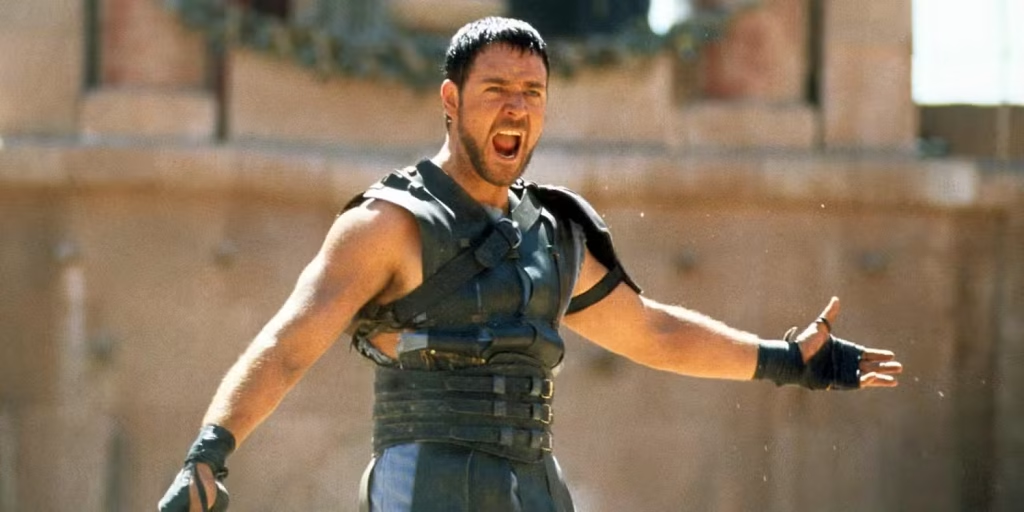
In May 2000, Ridley Scott’s Gladiator released. Notably, the film grossed $460 million worldwide on a $103 million budget. Crowe’s performance as Maximus Decimus Meridius subsequently won him the Academy Award for Best Actor. Specifically, the win arrived in 2001 at age thirty-six. Crowe at the moment of the win had been a working actor for less than a decade in American film and approximately two decades total counting the Australian work. Furthermore, the role generated downstream cultural ripples that ran far beyond standard franchise economics. Gladiator-style sandals re-entered mainstream fashion. Roman-themed prestige television (eventually Rome in 2005, Spartacus in 2010) built directly on the audience appetite the film had proved.
A Beautiful Mind, 2001
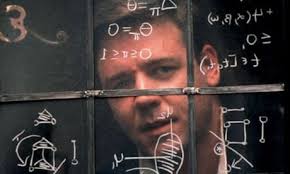
In 2001, Ron Howard’s A Beautiful Mind cast Crowe as mathematician John Nash. Specifically, the role required Crowe to age across decades, perform mental illness with restraint, and carry an interior film through three hours of narrative. He earned his third consecutive Best Actor Oscar nomination, becoming one of a small group of actors in Academy history to receive nominations in three straight years. Notably, he lost to Denzel Washington for Training Day. The losses did not matter. The three nominations had already established him as the most-nominated actor of the early 2000s and one of the highest-paid leading men in Hollywood.
The Salary Era That Funded Everything After
Between 2000 and 2010, Crowe commanded $20 million per picture as his standard fee, with backend participation on most projects. The aggregate gross income from that decade, by industry estimate, ran north of $200 million in salary and participation alone. Importantly, Crowe’s strategic decisions about what to do with that capital diverged sharply from his American peers. They bought Beverly Hills and Bel Air. He bought 1,300 acres of cattle country north of Sydney.
The Placement Economy: Why Crowe Triggers Lift Without Signing Deals
The Counterexample To the Standard Model
Most leading actors at Crowe’s tier maintain a stable of formal endorsement deals. Watches, automotive, men’s fragrance, premium spirits. The deals run multi-year and pay seven to eight figures annually. By industry estimate, a Best Actor winner at his earnings tier should command $5 to 10 million in annual ambassador income. Crowe has consistently declined the category. He has appeared in some Australian advertising over the years. He has not held a major American or European luxury ambassadorship at any point in his career.
What His Films Generated Anyway
The absence of formal deals did not prevent the placement economy from operating around him. Specifically, his films triggered some of the largest accidental category lifts of the 2000s. Gladiator revived gladiator-style sandals as a fashion category. Italian houses including Dolce & Gabbana and various luxury labels monetized the wave into an estimated $200 million in category sales between 2000 and 2010, per Vogue’s retrospective coverage. Crowe collected nothing from any of it. The lift went to the brands that read the cultural moment correctly.
L.A. Confidential catalyzed a mid-century Americana revival in menswear that brands from J. Press to Brooks Brothers traded on for a decade. Furthermore, A Beautiful Mind rehabilitated Princeton-era knitwear as an aspirational category that has shown up in Ralph Lauren and similar editorial positioning ever since. Master and Commander drove a brief but measurable spike in Royal Navy-themed heritage menswear. Specifically, none of these category lifts were structured as deals. Crowe was not paid for any of them. The lifts happened anyway because his films had cultural gravity that brands captured downstream.
The Lesson For Brand Founders
Cultural gravity, correctly applied, generates placement value without placement deals. That is the Crowe lesson, and it is the one most brands do not believe until they see it quantified. Most brand founders calculate placement ROI by comparing fee paid to category lift captured. Furthermore, they assume the lift requires the deal. Crowe’s filmography demonstrates the opposite. The lift is generated by the cultural moment itself. The deal is the mechanism by which the talent captures a share of the lift. When the talent does not sign, the entire lift accrues to whichever brand reads the moment fastest. Specifically, brand founders studying Crowe should not conclude that placement deals are unnecessary. They should conclude that cultural moments are the actual asset, and the deal is the asset-allocation mechanism layered on top.
The Nana Glen Chapter: The 1,300 Acres That Hollywood’s Money Bought
The Property That Defines the Strategy
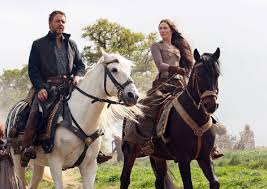
In 1995, Crowe bought a rural property in Nana Glen, New South Wales, approximately 350 miles north of Sydney. The initial purchase was modest. Subsequently, he expanded the holding across the late 1990s and 2000s into a 1,300-acre cattle and sheep property that runs as a working agricultural operation. Importantly, the property is not a celebrity ranch. It runs livestock at commercial scale. It employs farm staff year-round. Furthermore, it sits in a region with no celebrity infrastructure, no paparazzi presence, and no scene to be photographed at. Crowe has spent significant portions of his post-Gladiator career living there.
The 2018 Auction That Financed the Continued Holding
In April 2018, Crowe held what he publicly called “The Art of Divorce” auction at Sotheby’s Australia. Specifically, he sold Hollywood memorabilia, art, and personal items accumulated over thirty years. The auction generated approximately A$3.7 million, per Guardian coverage. The items sold included his Gladiator armor, jockstraps from various roles, a violin used in Master and Commander, and a fiberglass dinosaur skull he had once received as a gift from Leonardo DiCaprio. Specifically, the auction was timed around his divorce from Danielle Spencer, which Crowe characterized publicly as both the financial mechanism and the symbolic gesture of the divorce settlement. The proceeds reportedly went toward sustaining the Nana Glen holding and funding his subsequent producing work.
The South Sydney Rabbitohs and the Sydney Sports Empire
In 2006, Crowe and businessman Peter Holmes à Court bought the South Sydney Rabbitohs. Specifically, the foundational Australian rugby league club had been demoted from the National Rugby League and was facing ongoing financial strain. The purchase price was approximately A$3 million for 75% of the club. Specifically, Crowe and Holmes à Court restructured the club’s finances, marketing, and recruitment. The Rabbitohs won the 2014 NRL Premiership, the club’s first championship in 43 years. Furthermore, the club’s market valuation has multiplied considerably across Crowe’s two decades of ownership, though the Rabbitohs remain a private holding without publicly disclosed valuation. The investment has functioned as both a passion holding and a serious sports asset, structurally similar to other celebrity sports ownership stakes that have appreciated dramatically over the same period.
Sydney Harbour and the Coffs Harbour Footprint
Beyond Nana Glen and the Rabbitohs, Crowe owns a Sydney harbour penthouse in Woolloomooloo and various smaller holdings around Coffs Harbour, the regional center near his cattle property. The geographic footprint is unmistakable. He spends his life almost exclusively within Australia, with travel to film sets layered on top of that base. Specifically, Crowe is one of the very few major Hollywood leading men of his generation who never relocated to Los Angeles, never bought significant American real estate, and never adopted the standard Hollywood lifestyle infrastructure that most of his peers consider non-negotiable.
What He Built: The Net Worth Breakdown
The $100 Million Estimate
Current credible estimates place Crowe’s personal net worth at approximately $100 million, per cross-referenced reporting from Forbes and other industry tracking. The number has compressed somewhat from his peak earnings era due to the 2018 divorce settlement and the auction proceeds being absorbed into ongoing ranch operations. The composition breaks down approximately as follows.
Acting income across career: approximately $50 million in retained capital from a career gross north of $200 million. The compression reflects significant outflows including the divorce settlement, the long-term ranch investment, and the Rabbitohs purchase. Specifically, Crowe has reinvested rather than accumulated, which is the structural choice that distinguishes his portfolio from his American peers’.
Australian real estate (Nana Glen plus Sydney holdings): approximately $30 million, with the cattle property representing the largest single line. Real estate values in regional NSW have appreciated significantly since Crowe’s late-1990s acquisitions.
South Sydney Rabbitohs equity: approximately $10 to 15 million in equity value, depending on how the club is valued against comparable NRL franchises. The club is privately held. Furthermore, public valuation comps for Australian rugby league franchises run lower than American sports comparables, which limits the upside but also limits the volatility.
Production company and project equity: approximately $5 million across various Australian production interests, including his ongoing producing work on independent Australian features.
The Asset Composition Lesson
The portfolio matters because, like the other anchors in this cluster, Crowe’s composition diverges sharply from the standard celebrity model. Most leading actors at his tier hold roughly 60% of net worth in American real estate concentrated in Los Angeles and New York. Crowe holds essentially zero American real estate and roughly 50% of net worth in Australian rural and urban property. Specifically, the geographic concentration is the strategic choice. He bet on his home country’s real estate market and against Hollywood’s. The bet has paid off across thirty years, though it has produced a smaller absolute number than the Hollywood real estate bet would have for comparable peers.
The Soft Landing: What The Crowe Case Teaches Every Brand Founder
Three Lessons From The Refusal
First, geography is a strategic decision. Crowe could have bought Bel Air. He bought Nana Glen. The choice cost him social capital in Hollywood and saved him approximately three decades of relentless paparazzi exposure. Furthermore, it gave him a base of operations entirely outside the gravitational field of the industry he worked in. Every brand founder reading this should ask whether their own geography is the strategic choice or the default. Most founders accept the default. The minority who pick the strategy capture optionality the defaulters never see.
Second, the formal deal is not the only lift mechanism. Crowe’s films generated category lift across menswear, footwear, prestige television, and heritage fashion without him signing a single placement deal. The brands that captured those lifts read the cultural moment correctly. Specifically, brand founders should pay attention to which films and which talent generate cultural gravity even when no formal partnership exists. The fastest brand to recognize a cultural moment captures the lift, regardless of whether the talent has a deal in place. Speed of cultural recognition, in many cases, beats deal-making capacity.
The Asset Class That Most Brands Underweight
Third, reinvestment compounds in directions accumulation does not. Crowe’s strategic move was to take Hollywood income and convert it into Australian real estate, a sports franchise, and ongoing production work. Most actors in his generation took similar income and converted it into Beverly Hills real estate and brand endorsements. The two strategies produced different absolute outcomes but very different volatility profiles. Crowe’s net worth has held steady across thirty years. Many of his peers’ have not. Specifically, the lesson is that long-term durability often beats peak valuation, and the asset class that compounds across decades is rarely the one that compounds in headlines.
The Thesis That Outlasts the Decade
Crowe’s case is instructive because it inverts the standard celebrity playbook in nearly every dimension. He chose Australia over Los Angeles. Reinvestment trumped accumulation. Cultural gravity replaced endorsement deals. The portfolio mix favored a sports franchise and a working cattle ranch over yachts and villas. The choices, taken together, produced a smaller absolute net worth than his peers achieved. They also produced a more durable, more diversified, and more genuinely his own life than most of those peers will ever have. Cultural gravity, correctly applied, produces value without the deal. The talent who masters that skill builds an asset class no Hollywood agent ever fully captures.
The Crowe-Phoenix Gladiator Symmetry
The Crowe hub anchors a structural cross-link to Joaquin Phoenix through the 2000 Gladiator casting, where Crowe played Maximus and Phoenix played Commodus. Specifically, both actors earned Best Actor nominations from that single film, and both subsequently built careers that explicitly rejected the standard Hollywood lifestyle infrastructure their peers considered standard. Crowe bought 1,300 acres of Australian cattle country. Phoenix bought one Hollywood Hills house and refused virtually every endorsement deal of his generation. Furthermore, the two actors who anchored the highest-grossing prestige film of 2000 each demonstrated that Hollywood economics can be played in fundamentally different registers across the subsequent twenty-five years and still produce successful careers.
Related Reading
- Hollywood’s $26 Billion Hidden Economy: How Product Placement Built Modern Stardom
- Joaquin Phoenix Net Worth Strategy: $80M Auteur Economics Of Joker
- Rupert Grint Net Worth: How Ron Weasley Built A £24M Property Empire
- Meryl Streep Brand Asset Economics: $160M From Refusing Endorsements
- Pierce Brosnan Net Worth: How Bond Built A $200M Brand-Asset Platform
- Ralph Fiennes Net Worth: How Voldemort And Bond Funded A $50M Director’s Career
How To Work With Social Life Magazine
A fish does not notice the water. A reader does not notice the placement. That is the entire point. Furthermore, it is the entire opportunity for the brand founder who has just finished reading an article and is, without having fully realized it yet, about to scroll down and click one of the following five links.
Six Ways To Connect
If you are a brand, a founder, a creative director, or an in-house marketing lead who has read this far and would like to be considered for an editorial feature in Social Life Magazine’s print or digital ecosystem, the editorial team reviews brand submissions year-round. Pitch us at sociallifemagazine.com/contact.
If you are a brand with a ready-to-run campaign and would like to move faster than the traditional editorial cycle, the Paid Feature program offers three tiers of guaranteed placement across Social Life Magazine’s digital properties, with pricing starting at $975. Full details at sociallifemagazine.com/submit-a-paid-feature/.
Every piece Social Life Magazine publishes reaches an email list of 82,000 pre-qualified affluent readers. The majority summer in the Hamptons and spend the off-season in Manhattan’s core luxury zip codes. The email blast is the single most efficient distribution mechanism in the Hamptons editorial ecosystem. Inquire about placement at sociallifemagazine.com/enflyer.
Events, Print, And Independent Editorial
Polo Hamptons 2026, Social Life Magazine’s flagship event property, returns for its 17th year in July and August 2026. Platinum, Gold, and Corporate Cabana sponsorship packages are available for select categories (automotive is locked by BMW North America, real estate is at capacity, all other categories open). Demographic data, sponsor decks, and custom activation proposals available at polohamptons.com.
Social Life Magazine’s print edition, now in its 23rd year, distributes 25,000 copies per summer issue across Westhampton, Southampton, Bridgehampton, East Hampton, Sag Harbor, Amagansett, and Montauk boutiques, restaurants, and private clubs. Annual subscriptions, including fall/winter Upper East Side doorman distribution, available at sociallifemagazine.com/subscription.
If you’d like to support independent luxury editorial in the age of AI-generated content farms and private-equity-owned media conglomerates, donations to Social Life Magazine’s editorial operations are received via PayPal. Every dollar funds original reporting, photography, and the kind of writing that brands send their marketing teams to study.
Author

Written by
Recent Posts
What to Sort Early for a Wellington to Auckland Move
Why Local Skin Expertise Matters for Busy Schedules
Broadway And Tentpole: How Six Stars Built Eight-Figure Wealth Running Both Lanes
Jude Law Net Worth: $70M From Refusing To Choose Between Prestige And Tentpole
Mickey Rourke Net Worth: How A $40M Comeback Became A $10M Cautionary Tale
Categories
- Art
- Articles
- Beauty & Skincare
- Celebrities
- Celebrities|Movies
- Celebrities|The Chronicles
- Chronicles
- Entertainment|Culture
- Event Photos
- Events
- Fashion
- Fashion & Style
- Featured
- Food & Beverage
- Food, Spirits, Wine
- Hamptons
- Hamptons Celebrities
- Hamptons Celebrities
- Health
- Health & Beauty
- Lifestyle
- Luxury Lifestyle
- Movies
- Movies|Culture
- Movies|Hamptons Lifestyle
- Press
- Profiles
- Real Estate
- Technology
- The Chronicles
- Travel
- TV
- TV & Film
- Uncategorized
- Weddings