
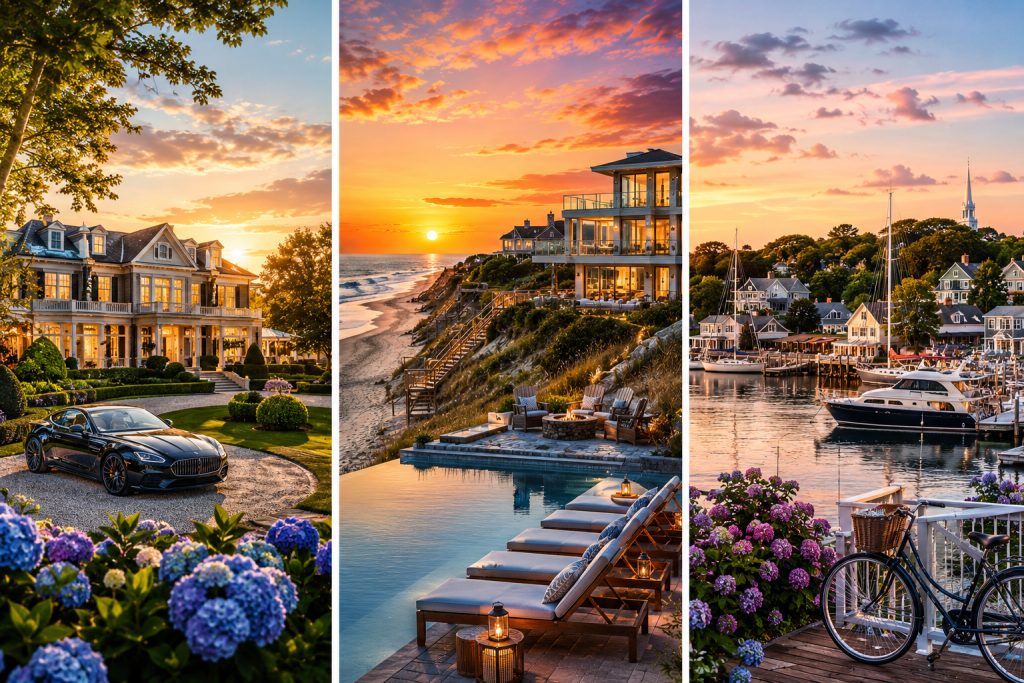
Three Villages, Three Answers, One Question
People who say “the Hamptons” as if it were one place have never had to choose between Bridgehampton vs Southampton vs Sag Harbor. All three villages sit within ten minutes of each other on the South Fork of Long Island. Each costs a fortune. All attract a version of New York money that has decided summer requires a geographic commitment. But the version of money, and the version of summer, and the version of yourself that each village demands are different enough that choosing wrong means spending three months in a place that does not fit.
Sag Harbor is the village that makes powerful people quiet down. Southampton is the village that wrote the rules everyone else pretends not to follow. Bridgehampton is the village that turned farmland into a stage and built the two most important equestrian events on the East End without inheriting a single institution from the Gilded Age.
Harbor. Hedgerows. Field. That is the Bridgehampton vs Southampton vs Sag Harbor shorthand. Below is the long version.
Real Estate: What Your Money Buys in Each Village
Southampton: The Establishment Premium
Gin Lane and Meadow Lane properties trade above $20 million regularly. The broader Southampton market posts a median around $3.5 million, but the range is enormous. What you pay for in Southampton is not just the house. It is the proximity to institutions that have existed for over a century: the Bathing Corporation (1891), the Meadow Club, the parish churches that function as social infrastructure. Southampton real estate is, at its core, a bet on continuity. You are buying into a system that has been sorting people since before your grandparents were born.
Sag Harbor: Cultural Capital Per Square Foot
Sag Harbor’s median sits lower than either neighbor, though “lower” in this context means roughly $2 million. What Sag Harbor offers is walkability: a village center with restaurants, bookstores, Bay Street Theater, the Sag Harbor Cinema that the community spent $7 million to save, and a marina that teaches ambitious people that the water does not care about their cap table. You buy in Sag Harbor because you want to walk to dinner and you do not need the ocean.
Bridgehampton: The Conversion Market
Bridgehampton proper (11932) posts a $3.05 million median. Adjacent Sagaponack (11962) approaches $6 million, making it the most expensive zip code in New York for a decade running. The Bridgehampton market is defined by conversion: potato farms became estates, barns became studios, and the agricultural reserve overlay guarantees that the field next to your $12 million house will never become a subdivision. You buy in Bridgehampton because you want the events calendar, the open landscape, and a village that does not require you to inherit a social position before you can occupy one.
The Tribeca couple looked at all three. Southampton first, because his partner’s parents summered there. Sag Harbor second, because she read about it in the New York Times. Bridgehampton last, because nobody told them to. They bought on Hayground Road for $3.8 million. Asked why, she said: “Southampton felt like joining a club. Sag Harbor felt like performing humility. Bridgehampton felt like nobody was watching.” He said: “The polo field is three minutes away.” Both answers were correct.
Dining: Three Philosophies of the Table
Southampton’s Dining Scene
Southampton dining is formal without announcing itself as formal. The restaurant scene runs on reservation scarcity: getting a table at the right place on the right night is itself a status marker. Prix fixe menus, wine lists curated by sommeliers who remember your preferences from last August, and a dress code that nobody states but everyone understands. Southampton restaurants serve the same function as Southampton clubs: they sort.
Sag Harbor’s Dining Scene
Sag Harbor dining is the inverse. Le Bilboquet has a DJ at midnight. Murf’s Backstreet Tavern has been pouring drinks since 1792. The harbor is visible from half the restaurant patios. Sag Harbor restaurants do not sort. They mix. The billionaire and the bartender eat at the same places, which is either democratizing or a performance of democracy, depending on how closely you examine it.
Bridgehampton’s Dining Scene
Bridgehampton puts eight restaurants on a four-block Main Street and lets you sort yourself. Bobby Van’s is Saturday night for the financial class. Almond is Wednesday for the year-round crowd. Jean-Georges at Topping Rose House is for the couple deciding whether to buy. The Candy Kitchen is for everyone, cash only, no exceptions. Bridgehampton’s dining philosophy is not sorting or mixing. It is choosing. You walk one street. You see every option. Your choice reveals who you are this weekend.
Social Architecture: How Each Village Organizes Status
Southampton: The Institutional Model
Southampton runs on inherited institutions. Bathing Corporation. Meadow Club. Beach Club. Parish. These institutions predate most of their current members. Joining is not transactional. It is social. Membership requires existing members to vouch for you, which means your social capital must already include someone who belongs. Southampton’s status architecture is vertical: layers of access, each requiring the one below it.
Sag Harbor: The Anti-Institutional Model
Sag Harbor has no private clubs of equivalent weight. Status here is cultural, not institutional. It accrues through conversation, through knowing which bookstore to visit, through attending Bay Street Theater openings, through owning a boat at the marina and understanding that the harbor itself is the institution. Sag Harbor’s status architecture is horizontal: proximity and participation rather than membership and exclusion.
Bridgehampton: The Event-Based Model
Bridgehampton’s status architecture is neither vertical nor horizontal. It is calendrical. Status here is organized around events: Polo Hamptons in July, the Hampton Classic in August, Wolffer Estate tastings all summer. Private clubs exist (The Bridge, Atlantic Golf Club), but they are new-money institutions built since 1992, and their ethos is casual. The Bridge has a $1.5 million initiation fee and a dress code that encourages backward caps. Bridgehampton does not ask who your grandfather was. It asks whether you showed up to the field on Saturday.
Southampton says: we will decide if you belong. Sag Harbor says: belonging is not the point. Bridgehampton says: the field is open. Come or don’t.
Beaches: Ocean, Harbor, or Field
Southampton’s Beaches
Cooper’s Beach in Southampton has been ranked among the best beaches in America. Daily parking is $50, making it accessible to anyone willing to pay. The Bathing Corporation’s private beach, by contrast, is accessible only to members. Southampton beaches operate on the same layered-access principle as everything else in the village: public with a premium tier, private with a social gate.
Sag Harbor’s Waterfront
Sag Harbor does not have an ocean beach. It has a harbor. Long Beach, technically in Noyac, is the nearest sand. Havens Beach sits closer to the village center but faces the bay, not the Atlantic. Sag Harbor’s relationship with water is intimate rather than expansive. Boats, docks, sunsets over Shelter Island. If you need the Atlantic, Sag Harbor is the wrong village. If you need the sound of halyards clinking against masts at dusk, it is exactly right.
Bridgehampton’s Beaches
Mecox Beach, Sagg Main Beach, and Scott Cameron Beach offer Atlantic frontage. Sagg Main Beach in Sagaponack requires a town resident permit, filtering by residency rather than payment. Dunes run high. Crowds stay thin. The beach approach through the dunes is one of the most dramatic on the South Fork. Bridgehampton beaches do not carry the brand recognition of Cooper’s Beach or the social infrastructure of Southampton’s private strands. What they offer is emptiness, which in a region defined by crowds is its own form of luxury.
Cultural Institutions: Where Each Village Puts Its Art
Southampton: The Parrish
The Parrish Art Museum, designed by Herzog & de Meuron, is Southampton’s cultural flagship. Permanent collection of American art. Major exhibitions. Architecture that announces institutional ambition.
Sag Harbor: Bay Street and the Cinema
Bay Street Theater and the Sag Harbor Cinema anchor the village’s cultural identity. Live theater, independent film, community fundraising. Sag Harbor’s cultural institutions are participatory: you attend, you donate, you belong by showing up.
Bridgehampton: Dia and the Converted Firehouse
Dia Bridgehampton occupies a converted firehouse at 23 Corwith Avenue. Nine permanent Dan Flavin fluorescent light installations. Rotating exhibitions by Long Island-based artists. Free admission. Friday through Sunday, 11 to 5. Bridgehampton’s cultural institution is quiet, free, and exists inside a building that has been three things in 117 years. It does not announce itself. It waits for you to find it.
The Persona Test: Which Village Fits Which New Yorker
Choose Southampton If
Your social energy is oriented outward: toward the ocean, toward established institutions, toward a hierarchy that has been refined over centuries and provides the specific comfort of knowing exactly where you stand. The weekend involves the beach, the club, the estate section. Understanding that your participation in this system is itself a form of status. Choose Southampton if you want your village to announce your arrival to the world.
The Park Avenue family who summers in Southampton has been doing so for three generations. Grandmother joined the Bathing Corp. Mother chaired the benefit. Daughter rides at the Hampton Classic but boards her horse in Bridgehampton, which is the geographic compromise that nobody in the family discusses.
Choose Sag Harbor If
Your social energy is oriented inward: toward the harbor, toward conversation, toward a cultural ecosystem that rewards curiosity over credentials and participation over position. The weekend involves a bookstore, a theater, a cinema that the village spent $7 million to save, a dive bar from 1792, a French bistro where a DJ plays at midnight. A marina that teaches ambitious people that the water does not care about their cap table. Choose Sag Harbor if you want your village to change you rather than confirm you.
The West Village documentary filmmaker who bought in Sag Harbor in 2018 walks to the marina every morning. She knows the harbormaster by first name. Her Manhattan friends ask how she survives the quiet. She does not experience quiet. She experiences the absence of performance, which is a different thing entirely.
Choose Bridgehampton If
Your social energy is oriented toward the calendar: toward events that happen on specific dates at specific locations on specific fields. The weekend involves Polo Hamptons in July, the Hampton Classic in August, Wolffer Estate tastings in between. A Bobby Van’s porterhouse on Saturday and an Almond chalkboard menu on Wednesday. A Candy Kitchen counter stool that does not care about your net worth. Choose Bridgehampton if you want a village that does not sort you on arrival but gives you a stage to sort yourself.
The Battery Park fintech founder who sold for $120 million chose Bridgehampton because the calendar is his pipeline. Polo Hamptons on July 18, cabana for ten LPs. Hampton Classic on August 30, VIP table for the same ten plus their wives. Bobby Van’s in between for the conversations that started on the field. He does not need Southampton’s institutions because he is building his own. He does not need Sag Harbor’s cultural credibility because credibility, for him, is measured in AUM.
The Verdict: There Is No Wrong Answer (But There Is a Wrong Fit)
All three villages cost a fortune. All three attract extraordinary people. All three are beautiful in July and transcendent in September. The Bridgehampton vs Southampton difference is not quality. It is alignment.
Southampton aligns with people who find comfort in structure. Sag Harbor aligns with people who find comfort in its absence. Bridgehampton aligns with people who build their own structure from the calendar, the field, and the four-block Main Street that puts every option in front of you and asks only that you choose.
Sag Harbor has the harbor. Southampton has the hedgerows. Bridgehampton has the field. On the field, everyone can see everyone. Whether that sounds like freedom or exposure depends entirely on who you are. That is the Bridgehampton vs Southampton question in its purest form. And that is why three villages, ten minutes apart, separated by nothing but road and everything but temperament, continue to attract three completely different versions of the same city.
Where the Conversation Continues
Social Life Magazine has covered all three villages for 23 years. Five summer issues, 25,000 copies each, distributed from Westhampton to Montauk. Our village dossiers are the most comprehensive guides on the East End: Sag Harbor (Chapter 1, 12 pieces), Southampton (Chapter 2, 13 pieces), Bridgehampton (Chapter 3, in progress).
If your brand serves the audience across all three villages (luxury real estate, finance, fashion, beauty, wellness, spirits, or hospitality), editorial positioning in Social Life Magazine reaches them in every restaurant, hotel, and beach club on the South Fork. Submit a Paid Feature here.
Polo Hamptons 2026 runs July 18 and July 25 at 900 Lumber Lane in Bridgehampton. BMW North America is title sponsor. Christie Brinkley hosts. Cabanas and sponsorship packages at polohamptons.com.
Subscribe to Social Life Magazine here.
Three villages. Ten minutes apart. One question: which version of summer fits the version of yourself you are building? The answer is not in this article. It is on Gin Lane, or at the marina, or on the field at 900 Lumber Lane. Go find it.
Related Reading
- Bridgehampton: The Village That Turned Farmland Into a Stage
- Sag Harbor Village Dossier
- Southampton Village Dossier
- Sag Harbor vs Southampton
- Southampton vs East Hampton
- Polo Hamptons 2026
- Hampton Classic 2026
- Best Restaurants in Bridgehampton 2026
- Sagaponack: The Most Expensive Zip Code in America
- Hamptons Real Estate Guide 2026
Author

Written by
Recent Posts

AI for personal finance: where PennyGuard fits

How to Pick a Homecoming Dress for Your Body Type (and Feel Amazing in It)

World Cup Injury Attorney for Vancouver Events
What a 3-Carat Engagement Ring Actually Costs in 2026: The Real Numbers
The Skincare Habits That Make a Real Difference Over Time
Categories
- Art
- Articles
- Business of Luxury
- Celebrities
- Culture
- Entertainment
- Events
- Faces of Summer 2026
- Fashion
- Fashion & Style
- Featured
- Finance
- Food, Spirits, Wine
- Hamptons
- Hamptons Celebrities
- Health
- Health & Beauty
- Lifestyle
- Luxury Lifestyle
- Press
- Profiles
- Real Estate
- Technology
- The Chronicles
- Travel
- Uncategorized
- Weddings