
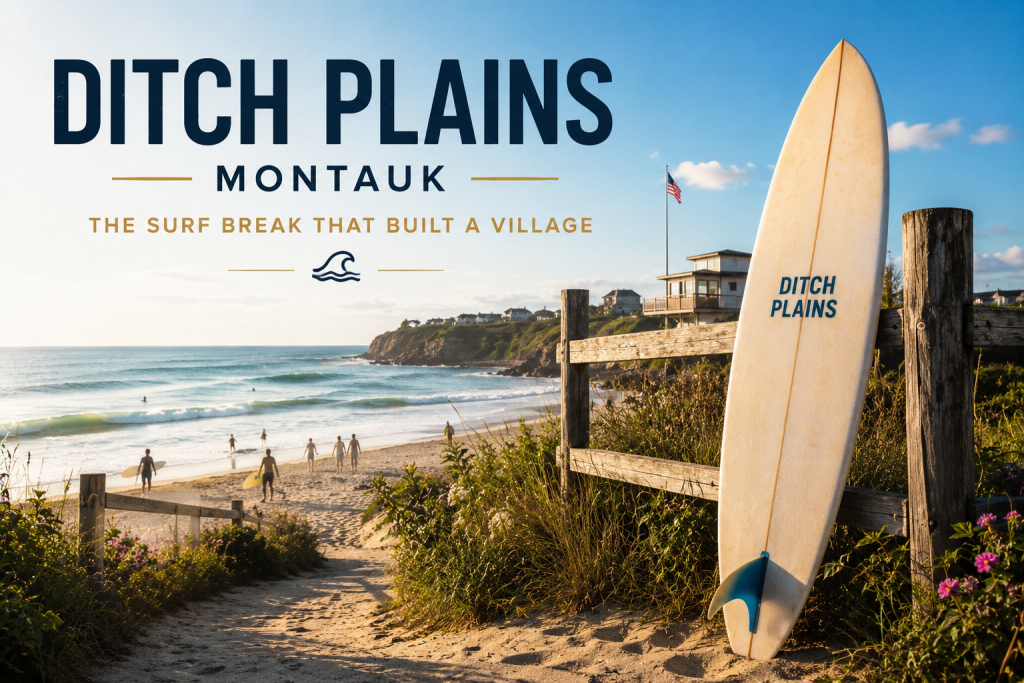
Ditch Plains is the most famous surf break on the East Coast. It is also a neighborhood, a lifestyle, a food truck economy, and above all a real estate contradiction that nobody has resolved. In this stretch of Montauk, the Ditch Witch food truck sells $4 breakfast burritos directly on the sand. Yet three blocks east, on DeForest Road, an oceanfront lot sold for $9 million in December 2024. That was the record. It lasted ten months. Subsequently, 42 DeForest Road closed at $17 million, the highest price ever paid for a property in Ditch Plains. Still, the surfers at dawn could not care less about either number. They are here for the wave, not the comp.
This is Spoke #6 of the Montauk Village Dossier, and it covers the geographic and spiritual center of a village that refuses to choose between salt and money. Because at Ditch Plains, both coexist in a proximity so tight that the spray from one reaches the other.
The First Board, the First Wave
It is 1950. A soldier named Richard Lisiewski, stationed in the New York metropolitan area during the Korean War, brings his surfboard east from New Jersey. At the time, he paddles out at Ditch Plains on a day when the beach belongs to fishermen and their families. Nobody else surfs here. Nobody else surfs anywhere on Long Island. California and Hawaii own the sport. Lisiewski does not care. He catches a wave. And for a brief moment, the entire future of Montauk tilts on its axis.
For the next sixteen years, Ditch Plains remained a quiet family beach. Fishermen stayed at the East Deck Motel, a low-slung 30-room establishment that Sam and Bea Cox had built by moving cottages from Navy Road onto their five-acre oceanfront property. The surf culture that would eventually define this stretch existed only as a distant rumor from the West Coast.
Then in 1966, everything changed. “The Endless Summer” premiered in theaters, and the Beach Boys were singing about catching waves. Meanwhile, a small tribe of pioneers was discovering something remarkable about Montauk’s position at Long Island’s easternmost point. Rusty Drumm, Gene DePasquale, Roger Feit, Allan Weisbecker, and Tony Caramanico recognized that the geography created consistent, well-shaped breaks.
Specifically, the rock reef at Ditch Plains produced waves that peeled left and right with unusual regularity. Southeast swells hit the point cleanly. Northwest winds groomed the faces. In short, for a surf break on the East Coast, it was close to perfect. The pioneers spread the word carefully, because overcrowding kills a surf break faster than any storm. But word spreads. By the early 1970s, Ditch Plains had a permanent surf community, a culture built on dawn patrols and board wax, entirely separate from the social machinery that powered the rest of the Hamptons.
The Trailer Park and the Cabooses
During the 1960s and 1970s, the Ditch Plains trailer park served as ground zero. The park’s rented plots featured power poles for lights and record players. Fishermen occupied mobile homes and converted railroad cabooses on the west side. On the other hand, hippie surfers pitched tents on the east. Despite their differences, the two tribes coexisted peacefully. Both understood the ocean. Neither cared about the social architecture that governed Southampton or Sag Harbor, forty-five and thirty minutes west respectively.
At some point, the town attempted to regulate surfing through a medallion system. Surfers would need to display a medallion to enter the water. As it turned out, the experiment lasted approximately two weeks before proving impossible to enforce. Yet this brief bureaucratic failure created an important artifact. The medallion itself is now one of the treasures of the Montauk Surf Museum. It serves as a physical symbol of the moment when surf culture officially became part of Montauk’s identity. Because you cannot regulate the ocean. Ditch Plains proved that early, and the lesson stuck.
The Break: What Makes Ditch Plains Different
He is twenty-seven and writes code for a Series A startup in Williamsburg. On Saturdays from May through October, he drives a Subaru Outback to Ditch Plains, arriving at 6 a.m. with a wetsuit draped over the passenger seat. Nothing here belongs to him. No rental, no share house. Yet he paddles out, catches four hours of waves, eats a burrito from the Ditch Witch, and drives home. This has been his routine for three years. His startup may fail. The wave will not.
Ditch Plains breaks on a small rock reef that produces beginner-friendly waves in summer. From June through August, the swell typically runs one to three feet, ideal for longboarding. As hurricane season approaches in late August, the swells build. By fall and winter, three-to-five-foot faces become standard. Occasionally, overhead sets roll through with enough power to humble anyone. Montauk works best with a southeast swell and a north-northwest wind.
The Seasonal Rhythm
Summer at Ditch Plains belongs to the tourists and the beginners. The lineup is crowded but forgiving. Longboards dominate. Families spread towels on the sand and children chase foam. It is, above all, friendly. Surfers share waves without the territorial aggression common at breaks from Rockaway to Ocean Beach. The water temperature sits in the mid-60s to low 70s, warm enough for a spring suit or even board shorts on the right day.
Fall changes everything. After Labor Day, the crowds thin dramatically. Southeast hurricane swells push through with more power. The water drops into the 50s. Full wetsuits replace the boardshorts. This is when the serious riders emerge. The shortboarders appear. Dawn patrols become cold, quiet, and genuinely excellent. If summer Ditch Plains is a party, fall Ditch Plains is a conversation you earn by showing up before anyone else is awake.
In contrast to other East Coast breaks, Ditch Plains offers unusual consistency. The position at the very tip of Long Island means swells arrive from multiple angles. Because the reef shapes the wave bottom, the breaks peel predictably. This reliability is precisely what draws the weekend warriors from Brooklyn, the serious longboarders from Rockaway, and the handful of sponsored riders who use Montauk as an off-season training ground between trips to Indonesia.
The Culture of Salt and Sand
The beach itself operates on different rules than any other stretch in the Hamptons. At Cooper’s Beach in Southampton, the right cabana signals the right tax bracket. At Amagansett’s beaches, the crowd performs a studied casualness. Ditch Plains has no cabanas, no beach club, and no performance of any kind. There are surfers, families, sunbathers, and dog walkers. In addition, two food trucks operate during the day. Lifeguards watch the water. A parking pass is required.
The Ditch Witch food truck has served breakfast and lunch directly on the sand since 1994. It is, without exaggeration, the single most democratic institution in the Hamptons. Indeed, a $4 burrito tastes the same whether you drove here in a Subaru or a Range Rover. Of course, this egalitarian energy attracts a specific crowd. You will not find a Chelsea gallerist performing lunch at the Ditch Witch the way she performs it at Le Bilboquet in Sag Harbor. The food truck has no reservations, no dress code, and no social ladder to climb. It just has burritos.
The Real Estate Contradiction: $2 Million Cottages, $17 Million Records
Ditch Plains real estate tells the story of two Montauks occupying the same zip code. The first Montauk is the cottage economy: modest two-bedroom houses with outdoor showers, no pools, and salt-bleached shingles. These trade between $2 million and $3 million. A typical Ditch Plains cottage sits on a quarter-acre lot, was built in the 1960s or 1970s, and carries the vague suggestion that a surfer could have afforded it once. That era ended some time ago. Still, the cottages sell.
The second Montauk is DeForest Road. Specifically, the “On the Break” development, a compilation of oceanfront parcels that has redefined the ceiling. In December 2024, a vacant 1.1-acre lot at 44 DeForest Road sold for $9 million, the highest price ever recorded for a one-acre oceanfront lot in Montauk. Hedgerow Exclusive Properties and Douglas Elliman’s Erica Grossman represented the listing. Ten months later, the eight-bedroom, eight-bath home at 42 DeForest Road closed at $17 million. The buyer was luxury developer Joe Farrell.
On the Break: Where the Money Meets the Wave
The On the Break development sits on what was once the site of the East Deck Motel, the same property where Sam and Bea Cox housed fishermen and surfers in the 1950s. Today, architect Boris Baranovich designed the new-construction homes for builder Hobbs Inc. Each property spans a full acre with direct, private ocean access and over 90 feet of Ditch Plains frontage. Casa Las Olas, at 40 DeForest Road, is currently listed at $17.495 million. For the most recent summer, the compound rented for $1.5 million, Memorial Day through Labor Day.
Kyle Rosko of Hedgerow draws a comparison to California: “Ditch Plains really reminds me of Point Dume in Malibu. It’s surrounded by preserved land that filters right down to the beach. It has that same raw beauty, that same sense of authenticity.” He is not wrong. But the comparison also reveals the core contradiction at the heart of Ditch Plains. Point Dume is one of the most expensive addresses in Malibu. Ditch Plains is becoming one of the most expensive addresses in Montauk. Both still feel, somehow, like surf towns. Whether that feeling survives the $17 million records is the question nobody at the Ditch Witch is asking, because the answer might change the burrito.
The Broader Montauk Market, Viewed from the Break
Ditch Plains does not exist in isolation. To be sure, the broader Montauk real estate market provides context for the numbers. In February 2026, the median listing price across all of Montauk stood at approximately $2.25 million. On average, homes spent 113 days on the market. The sale-to-list price ratio was 94.85%, a sign of softening seller power. In other words, buyers have options. Unless those buyers want oceanfront in Ditch Plains, where options do not exist.
By comparison, median home prices in Bridgehampton hover near $3.8 million, while Sagaponack clears $5.5 million. Ditch Plains falls between these in an unusual way. The cottage economy anchors the lower end near $2 million. But the DeForest Road corridor competes directly with Meadow Lane and Further Lane. No other neighborhood in the Hamptons spans that range within three blocks.
What You Actually Do at Ditch Plains (Beyond Surfing)
Not everyone surfs. In fact, most visitors to Ditch Plains do not. The beach is equally popular for walking, swimming, and a particular kind of spectating. Watching surfers at Ditch Plains is a Montauk tradition in the same way that watching polo at Polo Hamptons is a Bridgehampton tradition. The difference is that nobody at Ditch Plains is wearing linen.
Surf Lessons and Schools
Multiple surf schools operate out of Ditch Plains during the summer season. Corey’s Wave and Aloha Surf School are among the most established. Lessons typically cost $100 to $150 for a group session. Even so, for first-timers, the summer swell is forgiving enough to stand up on the first day. Wetsuits are provided. Boards are provided. The only thing you bring is a willingness to fall. After all, everyone falls at Ditch Plains. That is the point.
The Ditch Plains to Town Circuit
Ditch Plains sits approximately one mile south of downtown Montauk. The walk or bike ride takes fifteen minutes. This proximity means you can surf in the morning, eat at the Ditch Witch, ride into town for lunch at Shagwong Tavern or Harvest on Fort Pond, and return for a late afternoon session. In the evening, you are twenty minutes by car from the Clam Bar at Napeague, the roadside institution that straddles the Montauk-Amagansett border.
The circuit also connects to the broader East End. Bridgehampton is forty minutes west. Sag Harbor is thirty. Southampton is forty-five. But the surfers at Ditch Plains rarely make those drives. The village has everything they need. Everything else is optional.
Where Ditch Plains Fits in the Montauk Story
If Montauk is “the End,” then Ditch Plains is where the End shows its hand. Gurney’s represents luxury. The Surf Lodge represents culture. The fishing fleet represents labor. Ultimately, Ditch Plains represents the one thing none of those can manufacture: authenticity. It is not the performed kind. It is certainly not the studied casualness of Amagansett, nor the conversational ease of Sag Harbor. This is actual authenticity, earned in salt water, visible in the wetsuits drying on every porch railing within a half-mile radius.
Equally important, Ditch Plains is where Montauk’s past and future collide most visibly. Richard Lisiewski paddled out here in 1950 and found emptiness. Rusty Drumm and his tribe arrived in 1966 and found community. Joe Farrell arrived in 2025 and paid $17 million. All three came for the same reason. The wave does not care who is riding it, how much the rider paid for the house behind it, or whether the house exists at all.
Cottages will continue to sell. DeForest Road records will continue to fall. And the Ditch Witch will continue to close at 2 p.m. These facts coexist the way fishermen and hippie surfers coexisted in the trailer park sixty years ago: without resolution, without apology, and without any particular interest in explaining themselves to outsiders. Ditch Plains is not a contradiction. It is a surf break. And surf breaks do not care about your comp.
Where the Conversation Continues
Social Life Magazine has covered the East End for 23 years, five summer issues and 25,000 copies per run from Memorial Day through Labor Day, Westhampton to Montauk. If you are reading this, you already understand that the right coverage at the right time changes everything.
For brands, practitioners, and tastemakers who want to be featured in the publication that the East End actually reads: explore our paid features program. This is how you become part of the record.
Polo Hamptons 2026 returns July 18 and 25 at 900 Lumber Lane in Bridgehampton, forty minutes west of Ditch Plains, with BMW North America as title sponsor and Christie Brinkley as host. Details and sponsorship inquiries at polohamptons.com.
Subscribe to Social Life Magazine: sociallifemagazine.com/subscription.
The wave at Ditch Plains does not wait. Neither should you.
Author

Written by
Recent Posts

How to Choose Useful Tech Gifts for Employees and Clients in 2026
The Garage Question: Which Car Goes South for the Season?
VandS Clinic Review Treatment: How Seoul Injectable and Laser Options Compare for US Patients
Before Buying a View Home: What a Sloped Lot Means for the Purchase

Powerful Strategies to Stay Ahead in a Fast-Moving Real Estate Market
Categories
- Art
- Articles
- Business of Luxury
- Celebrities
- Culture
- Entertainment
- Events
- Faces of Summer 2026
- Fashion
- Fashion & Style
- Featured
- Finance
- Food, Spirits, Wine
- Hamptons
- Hamptons Celebrities
- Health
- Health & Beauty
- Lifestyle
- Luxury Lifestyle
- Press
- Profiles
- Real Estate
- Technology
- The Chronicles
- Travel
- Uncategorized
- Weddings