
Most people assume celebrity chefs earn their fortunes from cooking. They imagine packed restaurants, premium tasting menus, and tips from wealthy patrons accumulating into substantial net worth. The reality inverts this assumption entirely. Restaurants function as credentialing mechanisms, not revenue sources. The chef who treats a Michelin star as the destination rather than the launchpad will never build significant wealth.
How Celebrity Chefs Make Money: The Four-Stage Pipeline
Celebrity chef wealth creation follows a predictable pipeline that operates in four distinct stages. Each stage requires the previous stage’s credibility to unlock. Chefs who understand this architecture optimize for progression rather than perfection at any single stage.
| Stage | Activity | Income Type | Wealth Creation |
|---|---|---|---|
| 1. Credential | Michelin stars, James Beard awards, critical acclaim | Often negative (restaurants frequently lose money) | Zero direct wealth |
| 2. Visibility | TV shows, media appearances, cookbook deals | Salary ranging $1-45M annually | Moderate wealth accumulation |
| 3. Extension | Cookware licensing, product lines, endorsements | Royalties generating $5-20M annually | High passive income |
| 4. Equity | Brand ownership, company stakes, strategic exits | Lump sum transactions $50M-1B | Generational wealth |
The key insight emerges from examining Stage 1. Michelin-starred restaurants operate on razor-thin margins when profitable at all. Many lose money consistently. The star functions as marketing credential, not profit center. Chefs who understand this invest in credentialing only long enough to unlock Stage 2 opportunities.
Stage 1: The Credential Phase
Every celebrity chef fortune begins with credentialing, though the credentialing itself generates no wealth. Michelin stars, James Beard awards, critical acclaim from major publications, and association with prestigious restaurant groups all serve the same function: they authenticate expertise that media platforms will later monetize.
Consider the economics honestly. A Michelin-starred restaurant might generate $5 million in annual revenue. After food costs (30%), labor costs (32%), rent (10%), and operating expenses (18%), the owner might retain 5-10% as profit. That’s $250,000-$500,000 annually from a successful fine dining operation. Respectable income. Not wealth.
The credential phase often costs money rather than generating it. Opening a restaurant capable of earning Michelin recognition requires $2-5 million in capital. Maintaining the standards demands ongoing investment in ingredients, talent, and presentation that compress margins further. Many starred restaurants operate at break-even or loss.
Why Chefs Stay Too Long in Stage 1
Culinary culture celebrates kitchen excellence above business acumen. Chefs who trained under European masters absorbed values that prioritize craft over commerce. This orientation keeps many talented chefs trapped in Stage 1 indefinitely, perfecting dishes while ignoring the pipeline that could transform their expertise into wealth.
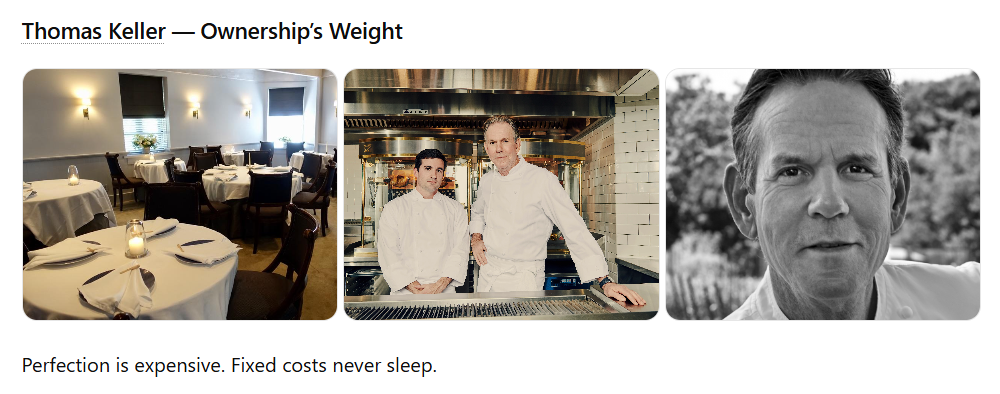
Thomas Keller exemplifies this pattern. French Laundry represents perhaps the pinnacle of American fine dining. Critical acclaim is universal. Yet Keller’s estimated net worth ($80 million) reflects decades of cookbook sales and consulting fees rather than restaurant profits. The restaurants credential brilliantly. They don’t create wealth efficiently.
Stage 2: The Visibility Phase
Television transforms credential into audience. This stage generates the first meaningful wealth accumulation for celebrity chefs, with contracts ranging from $1 million annually for emerging personalities to $45 million for established stars.
The economics shift dramatically. A television show reaching 5 million viewers costs roughly the same to produce whether it reaches 500,000 or 5 million. The marginal cost per additional viewer approaches zero. Advertising rates scale with audience size. Networks pay premium rates to talent who deliver premium audiences.
Gordon Ramsay generates approximately $45 million annually from television contracts spanning Hell’s Kitchen, MasterChef, and various international adaptations. His restaurant portfolio, despite comprising 35+ locations globally, generates perhaps $25 million in profit share. Television produces nearly twice the income with a fraction of the operational complexity.
Guy Fieri’s $80 million Food Network contract represents the largest in cable food history. His shows cost remarkably little to produce because he visits existing restaurants rather than cooking in elaborate studio kitchens. The production efficiency amplifies already-favorable television economics.
Production Economics: Why Format Matters
Not all cooking shows generate equal value. Production costs vary dramatically based on format, and these variations directly impact what networks can pay talent.
Traditional cooking demonstrations require studio construction, multiple camera setups, ingredient styling, and complex post-production. Shows like “Diners, Drive-Ins and Dives” require Guy Fieri to show up, eat food, and react enthusiastically. The cost differential is enormous. The margin differential determines talent compensation.
Competition formats offer another advantage: unlimited episode potential. Recipe shows eventually exhaust ideas or repeat themselves. Competition shows regenerate with every new contestant, every new challenge, every new opponent. Bobby Flay built his brand around competition precisely because the format scales indefinitely.
Stage 3: The Extension Phase
Licensing transforms visibility into passive income. Stage 3 generates wealth while the chef sleeps, travels, or focuses elsewhere. The economics compound rather than requiring continued labor.
Cookware licensing exemplifies the model. A manufacturer develops products, invests in production and distribution, handles retail relationships, and manages inventory. The chef provides brand endorsement and occasional promotional appearances. Revenue flows as royalties without requiring the chef to understand supply chains or worry about manufacturing defects.
Rachael Ray’s cookware licensing generates approximately $10 million annually through partnerships with manufacturers who produce and distribute products bearing her name. Her daily television exposure effectively advertises products available at Target and Walmart. The marketing costs nothing extra. The licensing fees flow regardless.
Wolfgang Puck’s Express locations demonstrate another licensing model. Partners operate 100+ airport and stadium locations bearing Puck’s name. They provide capital, handle operations, and bear business risk. Puck provides brand authentication and collects fees. The structure scales without requiring his involvement in daily management.
The Asymmetric Risk Profile
Licensing creates asymmetric risk-reward structures that favor the licensor entirely. When licensed products succeed, the chef collects royalties. When licensed products fail, the manufacturer absorbs losses. The chef’s downside is limited to reputational association. The upside flows directly.
This asymmetry explains why the wealthiest celebrity chefs systematically shifted toward licensing models. Gordon Ramsay’s post-2010 restructuring emphasized licensing over ownership precisely because the risk profile protects accumulated wealth while maintaining upside exposure.
Stage 4: The Equity Phase
Brand sales and equity exits crystallize accumulated value into generational wealth. Stage 4 transactions compress years of projected future income into immediate capital, creating liquidity events that operational income could never match.
Emeril Lagasse sold his brand portfolio to Martha Stewart Living Omnimedia for approximately $50 million in 2008. The transaction included trademarks, intellectual property, the “BAM!” catchphrase, and licensing relationships. He retained his restaurants and personal appearance income. The brand sale monetized accumulated equity without ending his career.
Rachael Ray’s Nutrish pet food deal demonstrates sophisticated Stage 4 architecture. She licensed her name to a pet food company, collected royalties during operations ($15 million annually), then received additional payment when Smucker’s acquired the parent company for $1.9 billion. The same asset generated income twice: during operations and at exit.
What Makes Chef Brands Valuable
Not every celebrity chef can command Stage 4 valuations. Buyers pay premiums for specific characteristics that separate licensable brands from personality-dependent fame.
Trademarked identifiers matter enormously. “BAM!” functions as verbal logo with independent commercial value. Distinctive personas, catchphrases, and visual identities create protectable intellectual property that transfers to buyers.
Established licensing relationships with proven revenue demonstrate that the brand generates income independent from personal appearances. Buyers want cash flows, not promises. Track records of royalty generation command premium multiples.
Clear separation between brand assets and operating entities enables transactions. Chefs who commingle personal brand with restaurant operations complicate potential exits. Corporate structures that isolate licensable assets facilitate future sales.
Case Studies: The Pipeline in Action
Gordon Ramsay: $220 Million
Ramsay earned three Michelin stars at his Chelsea restaurant by 2001 (Stage 1). Television opportunities followed immediately, with UK shows launching in 2004 and American shows in 2005 (Stage 2). Cookware licensing, endorsements, and product deals expanded throughout the 2010s (Stage 3). His corporate structure now positions potential brand exits (Stage 4 preparation).
The 2010 near-bankruptcy clarified his strategy. Post-restructuring, Ramsay shifted from restaurant ownership to licensing arrangements. New locations operate under agreements where partners provide capital and bear operational risk. Ramsay provides brand, training protocols, and occasional appearances. The Stage 3 optimization protected and accelerated wealth accumulation.
Ina Garten: $60 Million
Garten’s pipeline moved unusually. She operated the Barefoot Contessa specialty food store for 18 years (Stage 1 credentialing through retail rather than fine dining). Her first cookbook in 1999 and Food Network show in 2002 launched Stage 2. Cookbook royalties and selective licensing constitute Stage 3.
Notably, Garten never pursued Stage 4 aggressively. She declined extensive licensing opportunities that could have generated higher short-term income. The scarcity positioning protected brand value for potential future exits while generating substantial Stage 2-3 income. Her East Hampton authenticity cannot be manufactured or replicated.
Wolfgang Puck: $120 Million
Puck pioneered the pipeline before it had a name. Spago in 1982 established Stage 1 credentials. The Governors Ball relationship beginning in 1994 provided Stage 2 visibility (40 million Oscar viewers annually). Express licensing created Stage 3 passive income. Wolfgang Puck Companies exists as Stage 4-ready holding structure.
His Oscars positioning demonstrates sophisticated visibility strategy. The catering fee matters less than the annual global brand advertising the broadcast provides. Puck attached to existing attention rather than building audience independently.
The Patterns: What Separates Wealthy Chefs from Famous Chefs
Analyzing successful pipeline traversals reveals consistent patterns that separate chefs worth $100 million from those worth $10 million despite similar fame levels.
Michelin stars are marketing expenses, not profit centers. The smartest chefs invest in credentialing only long enough to unlock Stage 2 opportunities. Extended Stage 1 optimization generates diminishing returns.
The jump from Stage 1 to Stage 2 determines wealth trajectory. Chefs who never secure television or major media platforms remain trapped in credential-generating activities that don’t compound.
Television contracts generate 10-50x restaurant operating profits. The math is unambiguous. A successful restaurant generates $300,000-$500,000 in annual owner profit. A successful television franchise generates $5-45 million annually.
Licensing creates passive income that compounds. Stage 3 revenue flows regardless of the chef’s daily activities. This financial freedom enables focus on Stage 4 preparation rather than operational management.
The pipeline typically requires 10-15 years to traverse fully. Patience matters. Chefs who expect immediate wealth from any single stage misunderstand the architecture.
The Playbook: Applying Pipeline Thinking
For Social Life Magazine readers involved in hospitality, food and beverage, or personal brand businesses, the Michelin-to-Media Pipeline offers applicable lessons beyond celebrity chef economics.
Credential strategically, not indefinitely. Expertise authentication matters, but extended credentialing without monetization progression represents misallocated effort. Determine what Stage 2 looks like for your industry and optimize toward it.
Visibility precedes extension. Licensing and passive income opportunities require established audience awareness. Building visibility platforms enables everything that follows.
Asymmetric structures protect and compound. Business arrangements where you capture upside while partners absorb downside should be pursued aggressively once brand equity supports them.
Plan for exits from the beginning. Corporate structures, trademark protection, and intellectual property development create optionality that becomes valuable during Stage 4 negotiations.
How Celebrity Chefs Make Money: Final Assessment
The Michelin-to-Media Pipeline explains how celebrity chefs actually build wealth in ways that contradict casual assumptions. Restaurants credential expertise but rarely generate significant profits. Television monetizes credibility at multiples operational businesses cannot match. Licensing creates passive income that compounds over decades. Brand sales crystallize accumulated equity into generational wealth.
Understanding this pipeline reveals why Gordon Ramsay’s $220 million fortune derives primarily from television contracts while his 35+ restaurants contribute modestly. It explains why Ina Garten built $60 million without opening restaurants. It illuminates why Jamie Oliver survived the collapse of 60 restaurants with his net worth largely intact.
The pattern applies beyond celebrity chefs to anyone building expertise-based businesses. The credential authenticates. The platform monetizes. The licensing compounds. The exit crystallizes. Understanding this architecture transforms how sophisticated observers evaluate celebrity wealth and their own strategic positioning.
Related Articles
- Why Restaurant Ownership Rarely Creates Chef Wealth
- Licensing vs. Ownership: Why the Richest Chefs Stopped Opening Restaurants
- Gordon Ramsay Net Worth 2025: How He Built $220 Million
- Celebrity Chef Net Worth Rankings 2025
For coverage inquiries, brand partnerships, and advertising opportunities, contact Social Life Magazine. Experience culinary excellence at Hamptons’ premier lifestyle events: Polo Hamptons.
Author

Written by
Recent Posts

AI for personal finance: where PennyGuard fits

How to Pick a Homecoming Dress for Your Body Type (and Feel Amazing in It)

World Cup Injury Attorney for Vancouver Events
What a 3-Carat Engagement Ring Actually Costs in 2026: The Real Numbers
The Skincare Habits That Make a Real Difference Over Time
Categories
- Art
- Articles
- Business of Luxury
- Celebrities
- Culture
- Entertainment
- Events
- Faces of Summer 2026
- Fashion
- Fashion & Style
- Featured
- Finance
- Food, Spirits, Wine
- Hamptons
- Hamptons Celebrities
- Health
- Health & Beauty
- Lifestyle
- Luxury Lifestyle
- Press
- Profiles
- Real Estate
- Technology
- The Chronicles
- Travel
- Uncategorized
- Weddings