
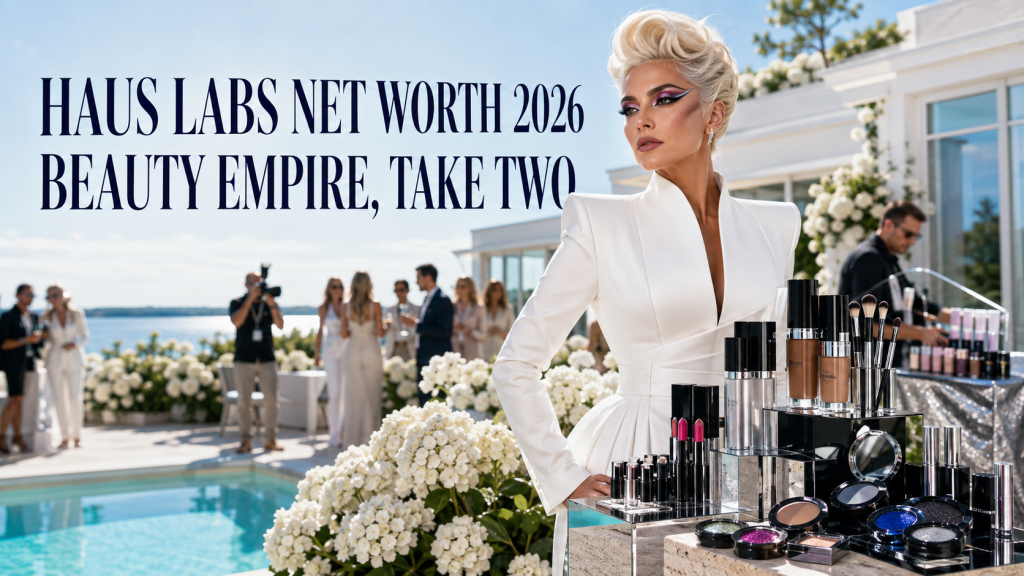
Lady Gaga’s beauty brand died once already. The 2019 Amazon experiment faded quietly, and by 2021 it was doing $20 million a year, hospice numbers in prestige beauty. Then came the 2022 Sephora relaunch, and the Haus Labs net worth question got interesting again. As a result, revenue quadrupled inside a year. Indeed, resurrection is a business model.
Specifically, this spoke covers the beauty vertical of a much larger fortune. For the full picture, read Lady Gaga’s $900 million breakdown, together with the celebrity wealth archive.
The Numbers at a Glance
Amazon-era revenue: roughly $20 million in 2021. First year back at Sephora: an estimated $80 to $100 million, with 400 percent growth reported. Outside funding: a modest $10.4 million led by Lightspeed.
Shade count on the flagship foundation: 51. SKUs after the reformulation: about 90, with some 2,700 ingredients stripped out. Doors: 500 Sephora locations by fall 2022, then Sephora at Kohl’s nationwide in 2024, then the Asian expansion that began in 2025.
Fragrance prehistory: millions of bottles sold under license back in 2012, with the royalties long since banked. Ownership today: undisclosed, although the cap table has barely been diluted.
The Amazon Funeral
Although it ended badly, the 2019 launch was a real first. Notably, Haus Laboratories arrived as the first prestige beauty brand built exclusively on Amazon, and it even topped the makeup category on Prime Day. The strategy still failed, because Amazon is where beauty gets restocked, not discovered.
Prestige cosmetics need storytelling shelf space, whereas an algorithm sorted by price offers none. Eventually the brand slipped to $20 million a year and kept fading. In hindsight the mismatch was obvious, although nobody said so during Prime Day. Of course, most celebrity founders would have taken the write-off and issued a gracious statement.
In fact, she nearly became an entry in our autopsy of failed celebrity beauty brands. Instead she became its control group, the founder who fixed the channel rather than blaming the category.
The Sephora Resurrection
The relaunch was a teardown, not a repaint. Altogether, roughly 2,700 ingredients came out of the formulas, the line rebuilt around a clean-artistry position, and the name tightened to Haus Labs by Lady Gaga. Sephora opened 25 doors in June 2022, then 500 by fall.
One product did the heavy lifting. The Triclone foundation shipped in 51 shades with fermented arnica and a skincare-grade ingredient list, and TikTok turned it into a phenomenon. A single challenge generated 9.4 billion views. Meanwhile, the campaign ran through 1,700 creators, so the earned media arrived before any ad spend.
Revenue grew 400 percent year over year after the move, as the case-study coverage documents. The estimated run rate now sits near nine figures. Death to nine figures in three years is the fastest arc in this cluster.
The Operator Behind the Curtain
Every survivor in this category has an operator, and hers came from a familiar address. CEO Ben Jones was chief digital officer at The Honest Company, the trust machine we mapped in the Jessica Alba breakdown. Rhode hired Honest’s former chief executive for the same reason.
Honest alumni now run two of the most valuable celebrity beauty operations in America. That is not coincidence, since Honest solved the hardest problem first, selling trust at drugstore speed with prestige margins.
Sarah Tanno, Gaga’s own makeup artist, runs global artistry. The founder demonstrates products on stage mid-concert. Attendance, as the failed brands proved, cannot be faked.
The Fragrance Footnote
There is a prehistory chapter most profiles skip. Back in 2012, her Fame fragrance launched through a Coty license and moved millions of bottles, black-liquid gimmick included. The volume was enormous, yet the wealth impact was modest, because licensors keep the upside. By comparison, those 2012 racks moved units that would embarrass most modern launches.
That experience reads like tuition for Haus Labs. She had already run the rented-name model once, so the second brand was built on equity from day one. Coty, incidentally, later became the cautionary buyer in the Kylie saga.
Founders rarely get to run the same experiment twice with both structures. She did, and the delta between the two outcomes is the cleanest argument for ownership this cluster has produced.
The Mayhem Effect
Beauty brands ride their founder’s cultural calendar, and hers has been relentless. The Mayhem album arrived in March 2025, followed by a Coachella headline set and a world tour. Each moment put the face, and therefore the foundation, back in the feed.
Tour economics amplify the effect. Every arena night is a two-hour product demonstration, because the stage makeup is the product line. No media plan buys that placement, although several have tried.
The result shows up in search. Interest in the brand spikes with every drop, every red carpet, every viral clip. In this cluster, only Rihanna runs a comparable flywheel, and she tours less.
Where Haus Labs Fits in the $900 Million
Beauty is one of four verticals in the larger fortune. Touring, catalog, film, and business interests stack toward the $900 million our full profile documents, and Haus Labs is the vertical still compounding. The music industry rankings show how rare that diversification is.
The film vertical keeps feeding the beauty one. Every red carpet is a launch event, the same conversion we track across the Devil Wears Prada cast fortunes. Prestige roles keep the face in circulation without a media budget.
A Star Is Born and House of Gucci built the acting credibility. The Vegas jazz residency monetizes the standards catalog. Each vertical hands the beauty brand another audience it never paid to acquire.
The Peer Table
The comparison set is familiar to readers of this cluster. Fenty’s $1.4 billion machine owns the top, with Rare Beauty’s billion-dollar climb beside it. Rhode’s billion-dollar sale proved the exit route.
Haus Labs plays a different position. It is the comeback asset, worth less than the giants but growing faster than any of them from its 2022 floor. So any Haus Labs net worth estimate is a growth story, not a headline number.
The 25 percent male customer base is the quiet differentiator. No other celebrity beauty brand pulls that number, which means the addressable market is simply bigger. Still, growth is the scarcest asset in beauty right now, and she owns more of it than anyone.
The Ownership Question
Valuation is the deliberately missing number. The company has never disclosed one, and with only $10.4 million raised, it never had to. Small rounds keep private math private. Rare Beauty and Fenty ran the same quiet playbook, until the numbers forced disclosure.
The stake arithmetic still favors the founder heavily. A brand doing an estimated nine figures in revenue, priced at even a conservative multiple, implies a company worth several hundred million. Compare Rhode’s 3.8 times sales and the range gets exciting.
Whether she ever sells is the open question. The Fenty model says hold and compound, while the Rhode model says exit at peak heat. Her funding discipline keeps both doors open, which is exactly where a founder wants to stand.
What the Comeback Teaches
Channel fit beats channel first. Being the first prestige brand on Amazon was a headline, yet it was the wrong shelf for a $40 foundation. Sephora shoppers browse, and browsing is where artistry brands win.
Second lesson: relaunch beats shutdown when the founder is real. The market forgave the Amazon detour because the reformulation showed actual work. Contrast that patience with the graveyard, where the rented faces got no second chance.
Third: keep the funding small. At $10.4 million raised, the cap table stayed clean, so whatever exit eventually comes flows mostly to the founder. The Rhode sellers can confirm that math.
The Status Read
Gaga’s advantage was never reach alone. It was artistic credibility, the kind earned through a decade of costume changes that the fashion establishment eventually canonized. When she sells makeup, the claim is artistry, not adjacency.
That is a different asset class from an influencer’s familiarity. Familiarity depreciates with the feed, while artistry appreciates with each museum retrospective. The beauty aisle prices the difference at roughly 400 percent growth.
Out East, the same rule applies to brands. The houses that survive here sell a point of view, and the ones that rent one summer at a time rarely make it to Labor Day.
The East End Read
Translate the comeback into local terms and it lands close to home. The East End rewards second acts, because half the fortunes out here are themselves reinventions. A founder who survived a public failure owns a better story than one who never stumbled.
The wellness corridor proves the appetite. Gwyneth Paltrow’s longevity pivot and Goop’s Sag Harbor chapter built empires on taste rather than volume, the same trade Haus Labs runs with artistry. Distinction sells here at any price point.
For the brands watching, the lesson is placement over reach, again. The women buying $49 foundation and the women booking August facials sit on the same aspirational ladder. One magazine covers both ends of it.
Where The Conversation Continues
The full field sits in the 2026 celebrity net worth rankings, with the beauty-specific board in our celebrity beauty brand net worth table. Expect the Haus Labs net worth line to climb while the category consolidates.
For beauty brands studying the comeback, the campus is open. The July issue and the Bridgehampton tents seat the people who fund second acts. Presence, as always, is the first product.
Author

Written by
Recent Posts

The First Decision After a Collision Can Be the Most Important One
Two Weeks in Rome and Beyond: Turkish Airlines Itineraries from Boston, Chicago and Onward to India
Top 10 Hair Transplant Clinics in Turkey 2026

Artist Alley to Online Store: How Convention Artists Can Keep Selling After the Event
When an 18-Wheeler Crash Leaves Lasting Consequences
Categories
- Art
- Articles
- Business of Luxury
- Celebrities
- Culture
- Entertainment
- Events
- Faces of Summer 2026
- Fashion
- Fashion & Style
- Featured
- Finance
- Food, Spirits, Wine
- Hamptons
- Hamptons Celebrities
- Health
- Health & Beauty
- Lifestyle
- Luxury Lifestyle
- Press
- Profiles
- Real Estate
- Technology
- The Chronicles
- Travel
- Uncategorized
- Weddings