
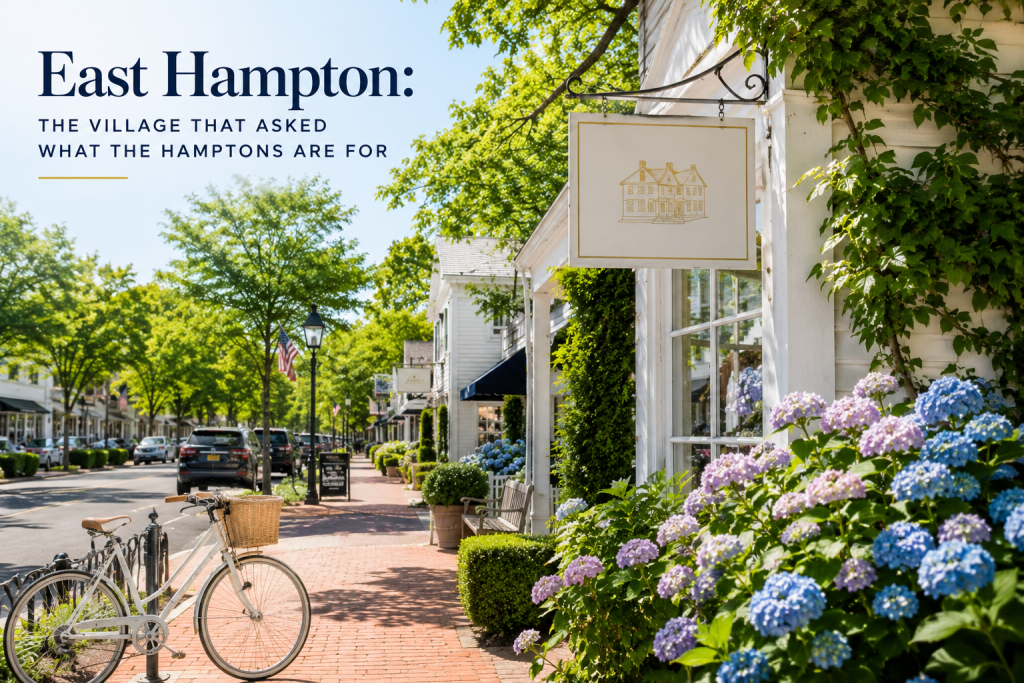
Thursday Evening: The Arrival That Settles the Argument
East Hampton does not introduce itself. Founded in 1648 by Puritan farmers who crossed Long Island Sound from Maidstone, Kent, by way of Lynn, Massachusetts, the village has been answering the same question for 378 years: what, exactly, is all of this for? Indeed, every other village in the Hamptons has built its identity in response to East Hampton’s. Southampton codified the rules. Sag Harbor defined itself in opposition. Bridgehampton commodified the spectacle. Amagansett chose institutional absence. All of them are answering East Hampton.
You feel this on Thursday evening, pulling east on Route 27 past Bridgehampton’s polo fields and Sagaponack’s farm stands. Still, the landscape shifts. Hedgerows thicken. Signage disappears. Certainly, the village announces itself through subtraction rather than addition, and the first thing you notice is the absence of anything trying to impress you. A Tribeca media executive in a black Range Rover (the one who just closed a $40M content deal and wants a weekend where nobody knows what that means) takes the left onto Main Street and feels something older than money. The population in the village proper hovers around 1,500 year-round. By July, it swells past 30,000. Naturally, this ratio tells you everything about the place.
She pulls into the gravel lot behind Newtown Lane at 6:47 on a Thursday.
The Celine store is still open. The light inside is the color of old linen.
A woman in $900 Brunello Cucinelli linen pants walks out with nothing in her hands.
The purchase was the visit.
She walks toward BookHampton. She will buy something she already owns.
The duplicate is the point.
East Hampton has always understood that the most expensive thing you can buy is the feeling of having already arrived.
She has. She just doesn’t know it yet.
The Village Green: Where 1648 Still Runs the Clock
Main Street in East Hampton is not a street. It is a broad common, laid out by those original settlers in the Puritan New England fashion: houses on either side, livestock in the middle, a meeting house at the center of civic gravity. Town Pond, once the communal watering hole for cattle, still anchors the southern end of the green. However, the cattle have been replaced by swans, and the swans have been replaced (in symbolic function, at least) by tourists taking photographs. The South End Burying Ground holds gravestones from the 1600s. Similarly, Mulford Farm, one of America’s most intact English Colonial farmsteads, sits on its original home lot. Also, the 1804 Gardiner Windmill still stands. Clinton Academy, chartered in 1784 as the first academy in New York State, still faces the street.
All of this is within a five-minute walk. Specifically, that concentration of historical density per square foot exceeds anything in Southampton or Sag Harbor. Of course, neither village would admit this, but the National Register of Historic Places confirms it. East Hampton’s Main Street Historic District is one of the most significant colonial landscapes in the northeastern United States. A financial advisor from the Upper East Side (the kind who manages family offices worth $500M and summers in East Hampton because his grandfather did) walks this stretch on Friday mornings. He passes the same landmarks his grandfather passed. Ultimately, that continuity is the asset. Not the windmill. Not the gravestones. The fact that the walk itself has not changed.
The Maidstone Club: The Institution That Wrote the Playbook
In 1891, a group of wealthy summer residents established a private club and named it after the English town from which East Hampton’s original settlers had emigrated. Notably, they named it the Maidstone Club, a deliberate callback to the village’s 1648 founding mythology (East Hampton was originally called Maidstone until 1662). Willie Park Jr., the Scottish architect, designed the links course. Roger Bullard built the clubhouse in 1922. Even so, initiation fees today are estimated between $500,000 and $1 million, though the club does not confirm this. Prospective members need existing member sponsorship, committee vetting, and (most importantly) legacy connections that reach back generations.
Groucho Marx played the course as a guest in the 1950s but was denied membership. Likewise, George Plimpton was shunned. Diana Ross was rejected despite being married to Arne Naess Jr., a member who subsequently resigned in protest. In fact, these rejections became more famous than any acceptance ever could. The Maidstone understood, from its founding, that exclusivity is manufactured through refusal. However, the East End private club hierarchy has shifted. Southampton’s Meadow Club and Bathing Corporation, Shinnecock Hills Golf Club, and National Golf Links of America all compete for position. Yet the Maidstone retains something the others cannot replicate: the original claim. It was first. In the Hamptons, first is forever.
He has been on the waiting list for eleven years.
His net worth crossed $200M four years ago. It made no difference.
His college roommate got in after six. Legacy. His grandfather had been a member.
At dinner parties in Bridgehampton, he calls it “the club” and everyone knows which one.
He never says the name out loud.
Naming it would imply he thinks about it.
Thinking about it would imply he hasn’t made it.
He hasn’t.
Guild Hall: The Cultural Center No Other Village Has
Guild Hall opened on August 19, 1931. Aymar Embury II designed the building. Mrs. Lorenzo E. Woodhouse funded it. One thousand people crammed into the theater and gallery on opening night, and the local paper declared that “East Hampton has never known a celebration like that.” In contrast to Bay Street Theater in Sag Harbor (which serves a similar role on a smaller scale) and the Parrish Art Museum in Water Mill (which focuses exclusively on visual art), Guild Hall combines a performing arts theater, a visual art museum with three galleries, and an education center under one roof.
The theater (now the Hilarie and Mitchell Morgan Theater, formerly the John Drew Theater) served as a summer testing ground for Broadway-bound productions. Tennessee Williams and Eugene O’Neill credited it with establishing their reputations. Notably, Edward Albee maintained a lifelong relationship with the space. After a comprehensive $29 million renovation completed in 2024, Guild Hall now presents over 200 programs annually and hosts approximately 60,000 visitors each year. Its permanent collection holds 2,400 works. Essentially, Guild Hall fills a role that no other East End institution can: it is the cultural town hall, the place where Willem de Kooning once showed work alongside local high school students, where the distinction between world-class and community-based dissolves into something more interesting than either category alone.
Newtown Lane: The Shopping Street as Social Theater
Ralph Lauren. Tiffany. Gucci. Celine. These names line Newtown Lane and its tributaries from Memorial Day through Labor Day, transforming a two-block stretch into the closest thing the East End has to a luxury shopping corridor. Naturally, BookHampton anchors the literary end. The seasonal retail economy here operates on a rhythm familiar to anyone who has studied Worth Avenue in Palm Beach or Madison Avenue in Manhattan: the stores exist less to sell product than to confirm status. A purchase at the East Hampton Gucci is not functionally different from a purchase at the SoHo Gucci. However, the context is entirely different. Buying in East Hampton means you are here. Being here is the luxury.
A medspa founder from Williamsburg (the kind who built a $12M injectable empire and just opened her third location in Flatiron) walks Newtown Lane on Saturday mornings. She doesn’t need the Tiffany. She needs the photograph of herself outside the Tiffany, posted to Instagram with a location tag that reads “East Hampton, NY.” Specifically, that tag converts at a higher rate than any paid advertisement she has ever run. Her followers know what it means. Meanwhile, a venture partner from Greenwich Village (Series B portfolio, $180M under management, weekend house on Middle Lane) browses BookHampton for something he saw reviewed in the Times Literary Supplement. He will buy it, display it on the coffee table, and reference it at exactly one dinner party. After all, cultural capital compounds differently than financial capital.
The Dining Room of the East End
Nick and Toni’s: The Restaurant That Defined the Category
Craig Claiborne walked through the door on August 3, 1988. Nick and Toni’s had not announced its opening. Still, the retired New York Times food critic seated himself at his preferred table (carried over from the previous restaurant, a pizza and meatball place called Ma Bergman’s) and began the process of making a Hamptons institution. Toni Ross and her late husband Jeff “Nick” Salaway had trained under Jonathan Waxman at Jams in Manhattan, the restaurant that introduced California cuisine to New York in 1984. They brought that sensibility east: wood-fired oven, northern Italian dishes, seasonal ingredients from farms within twenty miles.
Ruth Reichl awarded two stars in the Times during the mid-1990s. GQ gave the Golden Dish Award. Food and Wine declared it the best Italian restaurant on the East End. Also, Executive Chef Joe Realmuto joined as a line cook in 1994 and still runs the kitchen. Located at 136 North Main Street, Nick and Toni’s functions less as a restaurant than as the Hamptons’ living room. Friday night table assignments are social cartography: where you sit tells you exactly where you stand. Naturally, the boldface names fill the dining room, but the real regulars are the families who have been coming for three generations.
Swifty’s at the Hedges: The Debut That Turned Away 1,600
In the summer of 2025, Robert Caravaggi’s Swifty’s opened an outpost at the Hedges Inn on James Lane, bringing the Palm Beach polish of the Colony Hotel to East Hampton Village. Andrew and Sarah Wetenhall purchased the Hedges Inn, a historic 13-room boutique hotel, and installed Executive Chef Tom Whitaker with a menu of elevated American fare sourced from Montauk Shellfish, Balsam Farms, and Wolffer Estate. Over 1,600 guests were turned away during opening weekend alone. In fact, seventy staff members made the journey from Palm Beach to ensure consistency. Because the Hedges Inn itself carries historical weight (Henri Soule owned the property in the 1950s, running it as a summer home for Le Pavillon), the 100-seat indoor/outdoor restaurant became, instantly, the most anticipated debut in East End dining history.
Indeed, Swifty’s represents something more than a new restaurant. The original Swifty’s in Manhattan closed in 2016. Since then, its revival first at the Colony, then at the Hedges, traces the migration of old-guard New York social life from the Upper East Side to Palm Beach to the Hamptons. This is the same trajectory that the broader Hamptons dining scene has followed for decades: Manhattan institutions establishing summer outposts, testing whether their social capital translates outside the five boroughs. Swifty’s answered that question on opening weekend. The valet line told the story before the first course arrived.
The Rest of the Table
Tutto il Giorno (Gabby Karan de Felice’s seasonal Italian with a private garden) draws the fashion crowd. Also, The 1770 House offers fine dining inside a historic inn. The Palm East Hampton is the steakhouse institution. Fresno runs wine-driven, long-standing, and dependable. EHP Resort and Marina operates The Boat House for waterfront dining. Coniglio, a 2026 Palm Beach import on Newtown Lane, targets the crowd that already knows the original. Lion’s Nook occupies the former Rowdy Hall space. Certainly, this depth of dining exceeds what Sag Harbor, Southampton, or Bridgehampton can offer individually. East Hampton is the dining capital of the East End, and the competition is not particularly close.
The Beaches: Where the Sand Tells You Who You Are
Main Beach appears on “best beach in America” lists with the regularity of a tax return. Wide sand, lifeguards, facilities, and the social energy of a place where being seen matters as much as swimming. In comparison, Cooper’s Beach in Southampton offers similar quality with a different crowd. In particular, Main Beach is where the East Hampton establishment gathers. Naturally, on a Saturday in July, the parking lot functions as a showroom for Range Rovers, G-Wagons, and the occasional Porsche Taycan that signals the owner read an article about sustainability.
In contrast, Georgica Beach is quieter. Access comes through Lily Pond Lane, and the crowd reflects the address: media executives, entertainment industry figures, the kind of people whose names you recognize but whose faces you might not. Also, Two Mile Hollow is the locals’ choice, historically significant for its role in East End LGBTQ+ culture. Egypt Beach serves the Further Lane corridor. Wiborg Beach stays residential and intimate. Each beach answers the same question differently: what kind of person are you when you take your shoes off? The Hamptons beach hierarchy is real, and East Hampton holds more positions in it than any other village. Ultimately, that concentration is not an accident. It is an inheritance.
Lily Pond Lane and Georgica Pond: The Power Geography
Two addresses define East Hampton’s position in the Hamptons real estate hierarchy. Lily Pond Lane runs east from Ocean Avenue toward Georgica Beach, approximately one mile of oceanfront and pond-front estates priced between $25M and $70M. Specifically, David Geffen’s compound sits at the top of that range. Jon Bon Jovi purchased at $7.6M in 2004. Martha Stewart owned the oldest house on the street (built 1874) until selling to Kenneth Lerer for $16.5M in 2021. The 2025 sale of 33 Lily Pond Lane closed at $39M with 171 feet of ocean frontage.
Georgica Pond is different. The freshwater lake covers approximately 290 acres and creates a natural boundary that separates the merely wealthy from entertainment royalty. Beyonce and Jay-Z purchased “Pond House” for $26M in 2017. Steven Spielberg is a longtime resident. Tom Ford bought “Lasata” (Shinnecock for “place of peace,” Jackie Kennedy’s childhood summer home) for $52M in 2023. Ronald Perelman holds one of the largest positions. In contrast to Meadow Lane in Southampton, which concentrates finance billionaires, Georgica attracts entertainment and media power. The Whittle estate sold for $64.67M in 2024. Meanwhile, Further Lane‘s western section (before it crosses into Amagansett) holds the Rosenstein compound at $147M.
The hedge fund manager from Park Avenue South bought on Georgica Close in 2019.
He tells people at dinner that he “lives near the pond.”
He means Georgica. Everyone at the table knows which pond.
His neighbor is a filmmaker whose last three movies grossed $2B combined.
They have never spoken.
Proximity is not access.
The filmmaker waves from his kayak sometimes.
The hedge fund manager waves back and considers it a relationship.
Grey Gardens: The Story the Hamptons Cannot Forget
At 3 West End Road sits the most famous cautionary tale in American real estate. Specifically, Grey Gardens was the home of Edith Ewing Bouvier Beale (“Big Edie”) and her daughter Edith Bouvier Beale (“Little Edie”), aunt and first cousin of Jacqueline Kennedy Onassis. By the 1970s, the once-grand estate had deteriorated into a house overrun with cats, raccoons, and structural decay. In 1975, the Maysles brothers released their documentary, capturing two women of extraordinary pedigree living in extraordinary squalor. Naturally, the film became an instant landmark of American cinema. HBO produced a dramatization in 2009 starring Drew Barrymore and Jessica Lange.
Eventually, Ben Bradlee Jr. and Sally Quinn purchased the property and completed a $15.5M renovation that restored it to something approaching its original grandeur. However, the restoration cannot erase the story. Grey Gardens endures as a metaphor for what happens when the Hamptons forget you, when the social machinery that maintains these estates stops functioning, when inheritance becomes burden rather than privilege. Every other power address on the East End exists as an aspiration. Grey Gardens exists as a warning. Importantly, the distance between Lily Pond Lane and West End Road is less than a mile. In the Hamptons, a mile can span the distance between dynasty and decline.
The Springs Art Colony: Where American Art Went to Reinvent Itself
In 1945, Jackson Pollock and Lee Krasner moved to a farmhouse at 830 Springs-Fireplace Road, in the hamlet of Springs within the Town of East Hampton. Notably, the house cost $5,000. The barn became a studio. Indeed, inside that studio, Pollock developed the drip technique that would redefine Western art. Krasner, working in the upstairs bedroom, produced a body of work that would take decades to receive its proper critical recognition. Ultimately, Pollock died in a car accident in 1956, a mile from the house. Since then, the Pollock-Krasner House and Study Center has operated as a museum, open to the public.
Similarly, Willem de Kooning built his studio in Springs. Thomas Moran had established an artist colony in the 1870s. Childe Hassam and William Merritt Chase followed. Before the Abstract Expressionists arrived, East Hampton was already an art destination. After they arrived, it became the art destination. Consequently, the East End gallery scene today draws directly from that lineage. Contemporary dealers position themselves in proximity to the same landscape that produced Pollock’s “Number 1A” and de Kooning’s “Woman” series. For a collector from Chelsea (the Manhattan kind, the one who runs a $30M gallery and summers in Springs because the address carries curatorial credibility), this geography is not incidental. It is the entire point.
East Hampton Airport: The Most Controversial Front Door in America
East Hampton Airport (HTO) processes over 30,000 operations per year. Whether helicopters, seaplanes, or private jets, the volume is staggering. For the people who fly in, HTO is the most efficient entry point to the East End: forty minutes from the East Side heliport in Manhattan, direct to a car waiting on the tarmac. For the people who live underneath the flight path, it is the single most contentious piece of infrastructure in the Hamptons. Noise complaints have, since the 1990s, driven regulatory battles over landing restrictions, curfews, and flight path adjustments.
The airport is also a class signifier, and not a subtle one. Specifically, who flies in versus who drives in versus who takes the Jitney versus who rides the LIRR tells you everything about where someone sits in the Hamptons hierarchy. A private equity partner from Midtown (the kind who manages a $4B fund and keeps a helicopter share at $250K per season) considers the flight a business expense. His neighbor on Further Lane, a novelist who has lived in Springs for thirty years, considers the noise an invasion. They are both right. Of course, East Hampton has always contained these contradictions. The airport just makes them audible.
East Hampton vs. Everyone: The Comparison That Settles Itself
Sag Harbor’s thesis is that powerful people want to quiet down. It offers harbor over ocean, conversation over hierarchy. Southampton’s thesis is institutional inheritance: hedgerows as architecture, concealment as credential. Bridgehampton’s thesis is spectacle: polo fields, the Hampton Classic, events as economic engine. Amagansett’s thesis is the contradiction that never resolves: $115M sales and $4 zucchini in the same zip code.
Yet East Hampton does not have a single thesis. Instead, it has all of them. The Maidstone Club answers exclusivity. Guild Hall answers culture. Lily Pond Lane answers celebrity. Georgica Pond answers dynastic power. Nick and Toni’s answers social commerce. Newtown Lane answers aspiration. The airport answers access. The witchcraft trials of the 1650s (Elizabeth Garlick and Goody Davis, predating Salem by forty years) answer control. Grey Gardens answers decline. The Village Green answers origin. East Hampton is not one idea. It is geological strata, layer upon layer of American ambition, and the reader’s job is to dig.
The East Hampton Dossier: Your Spoke Map
This pillar page is the entry point. Each spoke below goes deeper into one facet of East Hampton’s identity. Together, they form Chapter 5 of The Modern Culture Hamptons Bible: A Narrative Luxury Guide to the Villages That Quietly Run New York Summer.
The Village Spokes: Institutions and Power Addresses
- Best Restaurants in East Hampton 2026. Nick and Toni’s, Swifty’s, Tutto il Giorno, Coniglio, The 1770 House, The Palm, Fresno, EHP Resort dining, Lion’s Nook.
- East Hampton Real Estate 2026: Lily Pond Lane, Georgica, and the $70 Million Compound. The power addresses, the price points, and the social physics of buying in.
- The History of East Hampton: Maidstone to Metropolis. 1648 founding, witchcraft trials, Colonial farmsteads, the LIRR transformation.
- East Hampton Beaches: Main Beach, Georgica Beach, and Two Mile Hollow. The hierarchy of sand.
- The Maidstone Club: The Institution That Wrote the Rules. Founded 1891, the waiting list, the rejections, the endurance.
- Guild Hall East Hampton: The Hamptons’ Cultural Center. Aymar Embury 1931, the $29M renovation, 200+ programs per year.
- Lily Pond Lane: Where Celebrity Meets Pedigree. Geffen $70M, Bon Jovi, Martha Stewart, and the oldest house on the street.
The Deep Cuts: Stories, Art, and Access
- Georgica Pond and the Dynastic Estates. Beyonce and Jay-Z, Spielberg, Tom Ford’s “Lasata,” the Kennedy connection.
- Grey Gardens: American Aristocracy in Decline. The Beales, the Maysles documentary, the $15.5M renovation.
- Newtown Lane: The Luxury Shopping Street of the East End. Ralph Lauren, Tiffany, Gucci, and the retail economy as social theater.
- Pollock, de Kooning, and the Springs Art Colony. The farmhouse that redefined Western art.
- East Hampton Airport (HTO): The Most Controversial Front Door in America. 30,000+ operations, noise wars, the class signifier in the sky.
- 72 Hours in East Hampton: A Weekend Itinerary. Thursday arrival through Sunday departure, every persona, every hour.
- Where to Stay in East Hampton. The Hedges Inn, Baker House 1650, Mill House Inn, EHP Resort, and the rental market.
Where the Conversation Continues
Social Life Magazine has covered the East End for 23 years, five summer issues per season, 25,000 copies each, distributed from Westhampton to Montauk in the restaurants, hotels, bookstores, and beach clubs where this audience actually gathers. Fall and winter issues (15,000 copies each) go directly to Upper East Side doorman buildings. If you have read this far, you are the audience. Indeed, we know because we put copies of the magazine in the same rooms where you eat, shop, and sleep.
If your brand serves the East Hampton audience (luxury goods, real estate, wellness, beauty, hospitality, financial services, fashion), a paid feature in Social Life Magazine places you inside the conversation, not adjacent to it. Specifically, the publication’s East End distribution footprint and UES winter reach put your brand in front of the exact consumer who is reading this page right now. Submit a paid feature here and let us build something together.
Polo Hamptons 2026 returns to 900 Lumber Lane in Bridgehampton on July 18 and 25, with BMW North America as title sponsor and Christie Brinkley as host. Notably, the crowd is 2,500 people who buy what you sell. Cabanas, VIP tables, and sponsorship packages are available at polohamptons.com. If you want your brand in front of the Hamptons’ most photographed summer afternoon, this is your window.
Stay connected. Subscribe to Social Life Magazine for year-round coverage of the villages, people, and power dynamics that shape the East End. Subscribe here.
East Hampton asked what the Hamptons are for. After 378 years, the village is still the only one with enough answers to keep the question interesting.
Author
Written by
Recent Posts

Powerful Strategies to Stay Ahead in a Fast-Moving Real Estate Market
How Latino Players Have Helped Shape Modern Basketball Culture
10 Best Designer iPhone 18 Pro Cases to Choose From

AI for personal finance: where PennyGuard fits

How to Pick a Homecoming Dress for Your Body Type (and Feel Amazing in It)
Categories
- Art
- Articles
- Business of Luxury
- Celebrities
- Culture
- Entertainment
- Events
- Faces of Summer 2026
- Fashion
- Fashion & Style
- Featured
- Finance
- Food, Spirits, Wine
- Hamptons
- Hamptons Celebrities
- Health
- Health & Beauty
- Lifestyle
- Luxury Lifestyle
- Press
- Profiles
- Real Estate
- Technology
- The Chronicles
- Travel
- Uncategorized
- Weddings