
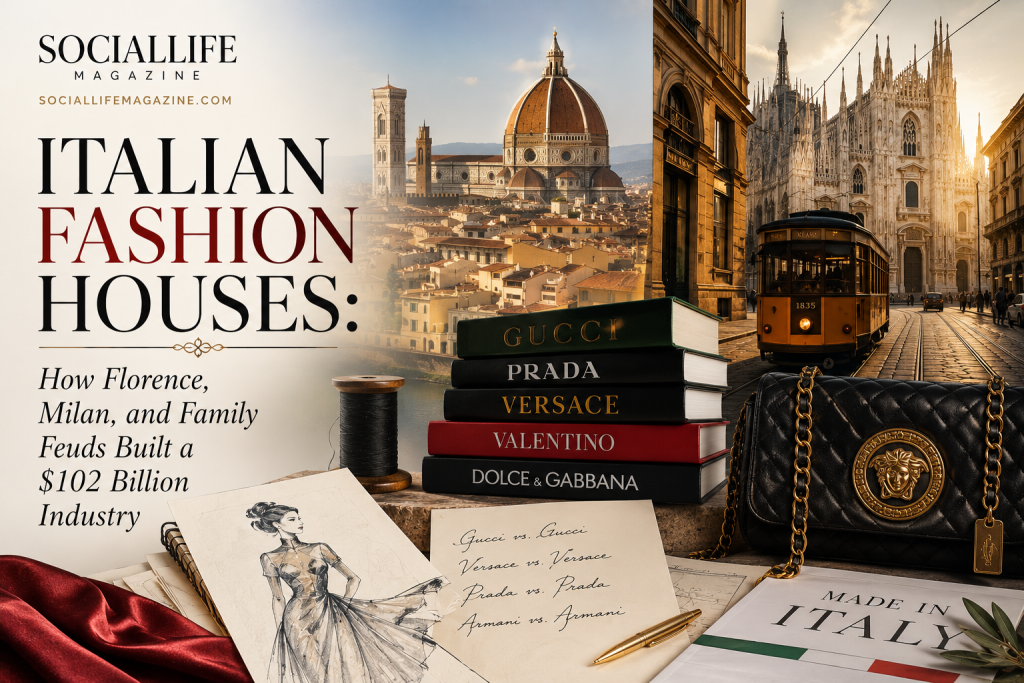
On the evening of March 27, 1995, Maurizio Gucci walked out of his Milan office at Via Palestro 20 and took four bullets on the front steps. His ex-wife Patrizia Reggiani had hired the gunman through her personal psychic for $365,000. At the time of his death, the brand his grandfather founded in a Florence leather workshop carried a valuation near $4 billion. However, no family member would ever control it again. That murder is the most dramatic chapter in the story of Italian fashion houses, but it is not the most important one. In fact, the most important chapter is how an entire country of family workshops, textile mills, and leather artisans built a parallel fashion system that eventually forced Paris to share the throne.
For nearly a century, France held an unchallenged monopoly on fashion authority. Italian craftsmen produced beautiful goods, but they did so anonymously. They supplied Savile Row tailors and Parisian couturiers who took the credit and kept the margins. Florence had its leather. Naples had its suits. Como had its silk. Yet none of them had the cultural permission to tell wealthy women what to wear. That permission belonged to Paris, and Paris guarded it with institutional force.
The Evening That Broke the French Monopoly
Everything changed on a single evening in February 1951. A Florentine aristocrat named Giovanni Battista Giorgini invited American department store buyers to a fashion show at his private residence, the Villa Torrigiani. Buyers from Bergdorf Goodman and B. Altman attended expecting fine craftsmanship at modest prices. Instead, they left with order books that would reroute the global fashion supply chain permanently. Giorgini had assembled designers including Emilio Pucci, Simonetta Visconti, and the Fontana Sisters. Their collections combined Italian craftsmanship with a relaxed sensuality that Parisian couture lacked entirely. As a result, within two decades, Milan had replaced Florence as the center of Italian design.
By the mid-1970s, Italian fashion houses were generating revenues that made their French rivals genuinely nervous for the first time. What follows is the complete map of those houses. From the Gucci family’s self-destruction to Giorgio Armani’s quiet empire, from Gianni Versace’s assassination to Miuccia Prada’s intellectual revolt, these are the families, fortunes, and catastrophes that built the Italian corridor. Each profile links to a deeper individual history. Together, they explain how craft became commerce, commerce became culture, and culture became a $100 billion industry.
Gucci: The Family That Built a Fortune and Then Destroyed Itself
Guccio Gucci opened a leather goods shop in Florence in 1921 after working as a bellboy at the Savoy Hotel in London. While there, he noticed the luggage carried by wealthy British travelers. He studied their preferences carefully. Then he returned to Italy and built a business selling that same aesthetic back to them at Italian prices. His sons Aldo, Vasco, and Rodolfo expanded the operation into a global brand. They opened stores in New York (1953), London, Paris, and Tokyo. By the 1970s, the double-G logo was consequently among the most recognized symbols in luxury retail.
However, the family’s ambition eventually consumed it from inside. Aldo Gucci was convicted of tax evasion in 1986. He served a year in federal prison at age 81. His son Paolo sued the family repeatedly. At one point, Paolo attempted to launch a competing brand using the Gucci name. Family meetings reportedly devolved into physical confrontations. Paolo once showed up to a board meeting with a tape recorder. Aldo slapped it out of his hands. The resulting assault charge made international headlines. Meanwhile, Maurizio, Rodolfo’s son, sold his 50% stake to Bahrain-based investment group Investcorp in 1993 for $170 million. Two years later he was dead on those steps in Milan. Reggiani was subsequently convicted in 1998 and served 18 years. She told reporters she hired the hitman because Maurizio had humiliated her. The psychic who brokered the deal also went to prison.
The Tom Ford Resurrection
Tom Ford arrived at Gucci in 1990 as a womenswear designer. At the time, the house was generating only $230 million annually and hemorrhaging credibility. Investcorp nevertheless gave him creative control in 1994. Ford understood something essential about Gucci’s DNA. It was not Florentine craftsmanship. Instead, it was sex, danger, and the permission to want things you probably should not have. His campaigns with photographer Mario Testino consequently defined the visual language of late-nineties luxury.
Kering (then PPR) acquired a controlling stake in 1999. Ford departed in 2004 after a power struggle with CEO Domenico De Sole. Today Gucci generates approximately €7.65 billion annually. No family member holds a single share. Among all Italian fashion houses, Gucci’s trajectory from family workshop to corporate asset therefore remains the most studied cautionary tale in the business. Furthermore, it established a template that would repeat across the industry: founding families create the value, then lose control of it entirely.
Prada: The Intellectual Who Made Ugly Beautiful
Mario Prada founded the house in 1913 as Fratelli Prada. He sold leather goods and imported English steamer trunks from a shop in Milan’s Galleria Vittorio Emanuele II. The location was prestigious. The business, however, was unremarkable. For sixty years, Prada operated as a respected but unexceptional luxury goods retailer. Wealthy Milanese women visited out of habit rather than desire. Mario Prada reportedly believed women should not be involved in business. His granddaughter Miuccia proved that particular theory catastrophically wrong.
Miuccia Prada took control in 1978. She held a PhD in political science from the University of Milan. She also had a background in Communist politics that would have horrified her grandfather. In 1984, she introduced the black nylon backpack. It was arguably the most counterintuitive product launch in luxury history. Nylon was industrial fabric. It cost almost nothing per yard. Nevertheless, Prada charged $450 for a bag made of it. The fashion world lost its collective mind with approval.
The Prada Paradox
The logic behind the nylon bag was cultural capital in its purest form. By using cheap materials at luxury prices, Miuccia created a product that could only be understood by people who already understood fashion. For example, a tourist buying Louis Vuitton monogram was purchasing visible status. In contrast, a woman buying a Prada nylon bag was purchasing the confidence to carry something ugly and make it aspirational through sheer conviction. That distinction attracted editors, stylists, architects, and a specific category of wealthy women who considered visible logos vulgar. Prada consequently became the thinking person’s luxury brand.
That positioning is also the most profitable in fashion. Intellectual consumers are ferociously loyal and largely price-insensitive. Prada Group generated approximately €4.7 billion in revenue in 2024. Miuccia and her husband Patrizio Bertelli still control the company. Additionally, Miu Miu, the secondary line launched in 1993, has experienced a dramatic commercial resurgence since 2022. Viral micro-skirts drove much of the growth. The consumer base skews roughly 25 years younger than Prada’s core customer. As a result, the combined Prada-Miu Miu portfolio occupies a singular position among Italian fashion houses. It is the only major group where the founding family still runs operations, controls creative direction, and refuses to sell to a conglomerate.
Versace: Gold, Grief, and the Morning Everything Changed
Gianni Versace moved from Calabria to Milan in 1972 with no money and no connections. However, he possessed an aesthetic so loud it practically had its own sound system. He founded his label in 1978. Within a decade, he had become the most visible designer on Earth. His Medusa logo became ubiquitous. The safety-pin dress on Elizabeth Hurley (1994) generated front-page tabloid coverage worldwide. Chainmail gowns similarly became red carpet fixtures. His mansion on Ocean Drive in Miami Beach, purchased in 1992 for $2.95 million, became a 23,000-square-foot monument to baroque maximalism. Versace dressed everyone from Princess Diana to Tupac Shakur. No other designer has ever matched that cultural range.
Furthermore, Versace understood celebrity as a raw material before anyone else in fashion did. He seated supermodels at his dinner table. He paid them enough to make modeling a genuine career rather than a stepping stone. Naomi Campbell, Claudia Schiffer, Cindy Crawford, and Linda Evangelista became his personal ambassadors. In return, they became global brands themselves. That symbiosis between designer and celebrity, now standard practice across the industry, was essentially a Versace invention.
The Morning on Ocean Drive
On July 15, 1997, Gianni Versace was shot twice on the steps of that Miami Beach mansion. Andrew Cunanan, a spree killer who had already murdered four other men across the United States, pulled the trigger. Versace was 50 years old. Cunanan killed himself eight days later on a houseboat less than three miles away.
Donatella Versace consequently inherited creative control of a house built entirely around her brother’s vision. She struggled publicly for years. Critics compared every collection unfavorably to Gianni’s work. She battled substance abuse and entered rehabilitation. Nevertheless, she gradually rebuilt both herself and the house. Her breakthrough came at the Spring 2018 show. She sent a tribute collection down the runway featuring Gianni’s greatest prints. The finale walk, with Campbell, Crawford, Schiffer, Carla Bruni, and Helena Christensen closing together, generated more social media impressions than any runway moment in history at that time.
Michael Kors Holdings (later renamed Capri Holdings) acquired Versace in 2018 for $2.12 billion. Tapestry Inc. then attempted to acquire all of Capri Holdings in 2023 for $8.5 billion. The FTC blocked the deal. Donatella still serves as creative director. Annual revenue exceeds $1 billion. The house therefore occupies a unique position among Italian fashion houses. Its identity is inseparable from two violent deaths and one woman’s refusal to let grief become the final chapter.
Armani: The Empire That Belongs to One Man
Giorgio Armani did not attend fashion school. Instead, he studied medicine at the University of Milan for three years, then dropped out. A stint as a department store buyer at La Rinascente followed. He subsequently designed for Nino Cerruti before launching his own label in 1975. His first act of creative genius was removing the lining from a men’s suit jacket. The unstructured blazer moved with the body instead of against it. Within five years, Richard Gere wore Armani in American Gigolo (1980). As a result, every man in finance, media, and entertainment decided he needed one.
Armani then did something almost no designer has managed. He built a vertically integrated empire spanning Giorgio Armani, Emporio Armani, Armani Exchange, Armani Casa, Armani Hotels, and Armani Restaurants. All of this was accomplished without taking a single external investment dollar. Not a single share was ever sold to a conglomerate. The Armani Group consequently generates approximately €2.5 billion in annual revenue. It remains 100% privately held through his holding company.
The Succession Question
Armani turned 90 in 2024. He has no children and no publicly named successor. The fashion industry has speculated about the company’s future for over a decade. Armani has reportedly considered establishing a foundation to preserve the brand’s independence after his death. The alternative is acquisition by LVMH, Kering, or a private equity group. Any of those options would fundamentally alter the brand’s identity.
Among major fashion houses globally, Armani therefore represents the last significant privately held, founder-controlled empire. When the succession resolves, it will mark a definitive end. Specifically, it will close the era in which a single designer could build and retain complete ownership of a global luxury brand without external capital. The fashion press watches. The conglomerates wait. Armani, characteristically, says nothing.
Valentino and Fendi: Roman Glamour and the Fur Trade
Valentino Garavani launched his couture house in Rome in 1960. He spent the next five decades dressing the women who most needed to be noticed. His client list included Jacqueline Kennedy (her wedding dress for the Onassis marriage in 1968), Elizabeth Taylor, and Sophia Loren. Valentino Red, his signature shade, became as identifiable as Tiffany blue. The house built its reputation on a specific promise. Wear this, and you will look like the most important woman in whatever room you enter.
Valentino retired in 2008 after a final couture show that received a standing ovation lasting seven minutes. Kering subsequently acquired the house in 2012. Creative director Pierpaolo Piccioli (2016 to 2024) elevated the brand into a critical and commercial powerhouse. His Fall 2022 couture collection, shown entirely in a single shade of hot pink, became one of the most discussed runway moments of the decade. Celebrities including Zendaya, Florence Pugh, and Anne Hathaway wore his designs to major events. In fact, Piccioli’s ability to make couture feel culturally urgent rather than historically reverent was his signature achievement. Alessandro Michele then succeeded him in 2024, bringing a maximalist sensibility honed during his years at Gucci. Valentino currently generates an estimated €1.4 billion annually under Kering ownership.
The brand’s transition from founder-led to corporate-owned has required particularly careful stewardship. Each creative director must honor the heritage while attracting a consumer born decades after the founder’s prime. Moreover, Valentino’s positioning as a couture house gives it cultural authority that most Italian brands lack. It is one of the few Italian fashion houses that holds official membership in the Chambre Syndicale de la Haute Couture. That membership places it in direct competition with the Parisian houses on their own institutional turf.
Fendi and the Double Loyalty
Fendi presents a different Italian narrative entirely. Founded in Rome in 1925 as a fur and leather shop, it became famous through two parallel loyalties. Karl Lagerfeld served as creative director for 54 years (1965 to 2019). That is the longest creative tenure in fashion history. Simultaneously, five Fendi sisters and then their daughters maintained family involvement across three generations.
LVMH acquired the house in 2001. Lagerfeld nevertheless continued until his death. Silvia Venturini Fendi, the last family member in a creative role, still designs accessories and menswear. The Baguette bag (1997) also remains one of the best-selling luxury handbags ever produced. It has generated over $1 billion in cumulative revenue. Fendi consequently proves that among Italian fashion houses, family involvement and conglomerate ownership are not inherently contradictory. They simply require a family willing to accept reduced control in exchange for expanded resources.
The Second Tier That Redefined the Rules
Below the dominant houses sits a cluster of Italian brands that have experienced transformative revivals. Each has proved a different thesis about what luxury can mean in the twenty-first century. Bottega Veneta, founded in Vicenza in 1966, spent decades known primarily for its intrecciato woven leather technique. Its original tagline was “When your own initials are enough.” Under creative director Daniel Lee (2018 to 2021), the house became the defining quiet luxury brand for a generation that considered logos embarrassing. Revenue approximately doubled during Lee’s three-year tenure. Subsequently, Matthieu Blazy took over and continued the momentum. Under Kering ownership, annual revenue now exceeds €1.7 billion.
Dolce & Gabbana, founded in Milan in 1985, built an empire on Sicilian sensuality and Catholic iconography. Domenico Dolce and Stefano Gabbana celebrated the Italian south with unapologetic intensity. However, a 2018 controversy involving advertisements perceived as racist toward Chinese consumers triggered a massive boycott. The incident reportedly cost the brand hundreds of millions in lost revenue. The house has partially recovered but remains privately held. It also remains stubbornly independent, refusing acquisition offers despite the commercial pressure.
The Quiet Revolutionaries
Brunello Cucinelli built something genuinely unprecedented. Working from the medieval hilltop village of Solomeo in Umbria, he created a $4 billion cashmere empire. His company pays workers above-market wages. It closes at 5:30 PM daily and prohibits overtime. Cucinelli calls it “humanistic capitalism.” Wall Street, meanwhile, calls it a premium stock with 15% annual revenue growth. He went public in 2012 on the Milan exchange. Since then, the company’s market capitalization has grown roughly tenfold. His model therefore proves that among Italian fashion houses, the family workshop ethos can survive corporatization. The condition is that the founder writes the corporate rules.
Salvatore Ferragamo arrived in California at age 16 in 1914. He made shoes for Hollywood, fitting Marilyn Monroe, Audrey Hepburn, and Sophia Loren. He then returned to Florence to build a luxury house that still bears his name. The Ferragamo family retained majority control until 2024. They then explored strategic options that could include a partial sale. Similarly, Ermenegildo Zegna, founded in 1910 as a wool mill in Piedmont, went public on the New York Stock Exchange in 2021 through a SPAC merger. Annual revenue exceeds €1.9 billion. The Zegna family retained controlling interest. Both houses illustrate the defining tension of modern Italian fashion. Founding families want to stay. Capital requirements of global competition, however, make staying increasingly difficult.
How the Italian System Actually Works
Understanding Italian fashion houses requires understanding how their economic logic differs fundamentally from the French model. France built fashion from the top down. Couture came first. Ready-to-wear followed. Then accessories. Then perfume. The prestige pyramid therefore descends from the atelier. Italy, in contrast, built from the bottom up. Textiles came first, then manufacturing, then design, then brand. The prestige pyramid ascends from the factory floor. That structural difference explains a persistent paradox. Italy produces better fabrics, better leathers, and better manufacturing infrastructure than France. Yet France commands higher average price points and greater cultural authority.
Northern Italy’s industrial districts still form the manufacturing backbone of global luxury. Tuscany produces leather goods for dozens of houses that claim Parisian identity. Como produces silk for most of the European luxury market. The Veneto region produces footwear. Biella produces suiting wool. Even houses that are nominally French often manufacture in Italy. Consequently, when you buy a bag with a French name on it, there is a meaningful probability that Italian hands in an Italian factory produced it. The irony is structural. France owns the mythology. Italy owns the means of production. According to industry estimates, Italian manufacturers produce roughly 50% of the world’s luxury leather goods and approximately 60% of its luxury footwear. Those factories employ hundreds of thousands of workers across small and medium enterprises. Many of these firms have served the same luxury clients for generations. The relationship between a Tuscan tannery and a Parisian fashion house can span decades without a written contract. Trust, quality, and consistency substitute for legal agreements.
The Talent Pipeline
Furthermore, Italian fashion education has become a global export industry in its own right. Institutions like Polimoda in Florence and Istituto Marangoni in Milan train thousands of international students annually. Many of those graduates go on to work for French and American houses. Additionally, Italy’s apprenticeship tradition ensures that artisanal skills pass directly from experienced craftspeople to the next generation. Italy trains the talent. Other countries hire it. That pattern mirrors the broader manufacturing dynamic and reinforces Italy’s position as the industry’s indispensable but under-credited engine.
The Conglomerate Divide
Unlike France, where LVMH and Kering consolidated the industry early, Italy’s fashion landscape remains split between conglomerate-owned and independent houses. Gucci, Bottega Veneta, and Valentino belong to Kering. Fendi and Bulgari belong to LVMH. Versace belongs to Capri Holdings. Meanwhile, Armani, Prada, Dolce & Gabbana, and several others remain independent.
That divide creates a competitive dynamic unique to Italian fashion. Independent houses can take creative risks that corporate-owned houses cannot justify to shareholders. Corporate-owned houses, on the other hand, can invest in retail expansion at scales that independent houses cannot afford. Neither model has proven definitively superior. Both coexist. And that coexistence is ultimately what keeps Italian fashion houses collectively dangerous to every other fashion capital on Earth. Paris may own the language of fashion. Milan owns the factory floor. Because of that, neither city can afford to ignore the other.
Where The Conversation Continues
Each house profiled above has a dedicated article in this series. The individual histories go deeper into the founder, the fortune, and the failures that shaped each brand. Follow the links below, or return to the History of Fashion pillar for the complete timeline across French, Italian, American, British, and contemporary houses.
The Italian Spokes:
- Gucci: The Murder, the Psychic, and the $7.65 Billion Aftermath
- Prada: The Nylon Bag That Outsmarted the Logo
- Versace: Gold Chains, Ocean Drive, and the Morning After
- Armani: The Last Man Standing Alone
- Valentino: The Red That Dressed Every First Lady
- Fendi: 54 Years of Lagerfeld and the Baguette That Printed Money
- Dolce & Gabbana: Sicily, Scandal, and the Refusal to Sell
- Bottega Veneta: When Your Own Initials Are Enough
- Brunello Cucinelli: The Cashmere King of Solomeo
- Ferragamo: Hollywood Shoes and a Florentine Dynasty
- Zegna: From the Wool Mill to Wall Street
- Tom Ford: The Texan Who Resurrected Gucci and Built His Own Empire
Social Life Magazine covers the intersection of fashion, wealth, and culture across the East End every summer and beyond. For features, events, and the stories behind the names that matter, explore our Luxury Lifestyle section or follow the full Chronicles archive for the complete collection.
Author

Written by
Recent Posts

Planning an Arizona Road Trip? Practical Details to Handle Before You Leave

Short Homecoming Dresses That Feel Polished, Not Overdone
Men’s Health After 40: Important Changes to Pay Attention To
What You Need to Know About Spray Tanning

Simple Ways to Upgrade Your Summer Drink Routine
Categories
- Art
- Articles
- Business of Luxury
- Celebrities
- Culture
- Entertainment
- Events
- Faces of Summer 2026
- Fashion
- Fashion & Style
- Featured
- Finance
- Food, Spirits, Wine
- Hamptons
- Hamptons Celebrities
- Health
- Health & Beauty
- Lifestyle
- Luxury Lifestyle
- Press
- Profiles
- Real Estate
- Technology
- The Chronicles
- Travel
- Uncategorized
- Weddings