
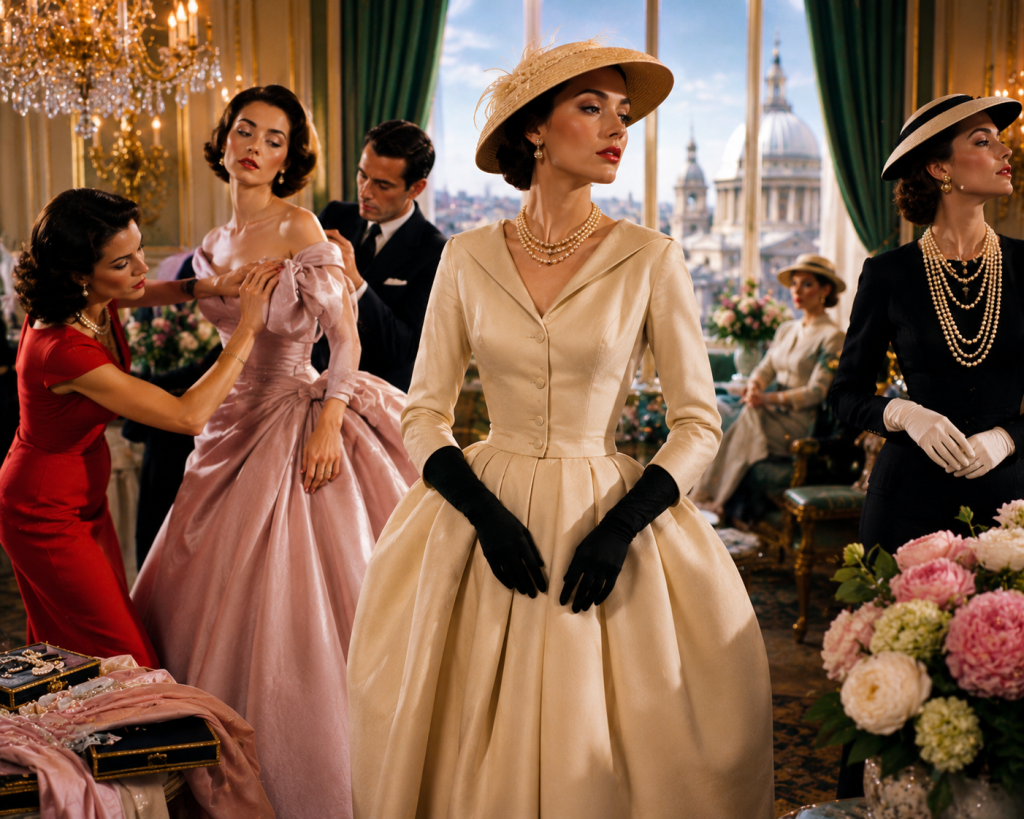
The 1950s invented modern fashion. Not fashion as personal expression or cultural rebellion, both of which came later, but fashion as an organized industry with codified hierarchies, global distribution, and a business model that would survive for seven decades. Christian Dior’s New Look launched the decade. Salvatore Ferragamo’s Hollywood celebrity machine proved that shoes could build empires. Cristobal Balenciaga demonstrated that a single designer’s genius could sustain an entire house without commercial compromise. And a 71-year-old woman named Coco Chanel came out of retirement and quietly outlasted all of them. Fashion in the 1950s was the decade that built the architecture every luxury brand still inhabits, from the licensing agreements that fund couture to the Italian supply chain that manufactures it to the American market that consumes more of it than any other nation on earth.
The decade began in rubble. Europe was still rebuilding from the war. Fabric rationing had only recently ended. Women had spent six years in utilitarian clothing designed for factory floors and civil defense duties. The psychological hunger for beauty, opulence, and the specific pleasure of wearing something impractical was enormous. The designer who understood that hunger first would own the decade. Christian Dior understood it first.
The New Look and the Dior Revolution
On February 12, 1947, Christian Dior showed his first collection at 30 Avenue Montaigne in Paris. Cinched waists achieved through internal corseting. Padded hips that created an exaggerated hourglass silhouette. Full skirts falling below the calf that required up to 25 yards of fabric per garment, more material than most women had been permitted to purchase during six years of rationing. Rounded shoulders. Soft bust lines. Every element was a repudiation of wartime austerity and a declaration that femininity, luxury, and extravagance were not only acceptable but necessary.
Harper’s Bazaar editor Carmine Snow reportedly said “It’s quite a revolution, dear Christian. Your dresses have such a new look.” The name stuck. The collection restructured the global fashion industry in a single afternoon. Within 48 hours, every fashion editor in Paris was rewriting their seasonal coverage around the New Look. Six months later, every major department store in America was ordering Dior. Revenue hit $15 million within two years from a standing start. By the mid-1950s, Dior accounted for over half of France’s entire fashion export revenue. One house, one designer, one collection had repositioned an entire national industry.
The New Look was not universally beloved. British Labour MP Bessie Braddock called it “the dictatorial whim of Paris designers” and argued that wasting fabric on extravagant skirts while rationing continued was morally offensive. Coco Chanel (then in self-imposed exile in Switzerland) dismissed Dior’s corseted silhouettes as retrograde: “Dior doesn’t dress women. He upholsters them.” American feminists objected to the return of restrictive undergarments. All objections were commercially irrelevant. Women wanted the New Look because it made them feel beautiful after a decade of feeling utilitarian, and no political argument could compete with that desire.
The Licensing Innovation
Dior’s most lasting contribution to the fashion industry was not the New Look itself but the business model he built around it. In 1947, the same year as his debut collection, Dior launched Miss Dior perfume. Stockings, furs, scarves, handbags, and eventually menswear followed throughout the 1950s. Each product carried the Dior name and generated revenue independent of the couture atelier where gowns were made by hand for individual clients.
The licensing strategy was controversial among purists who believed that attaching a couturier’s name to mass-produced products diluted the sacred aura of haute couture. It was also enormously profitable, demonstrating for the first time that a fashion brand’s most valuable asset was not its garments but its name. Perfume subsidized the couture. Couture generated the prestige. Prestige sold the perfume. That circular logic became the financial model that every luxury house would eventually adopt, and among the French fashion houses, Dior’s licensing blueprint remains the template that funds couture operations to this day.
When Dior died suddenly of a heart attack in 1957, at age 52, the house passed to his 21-year-old assistant Yves Saint Laurent, beginning the first great succession drama in modern fashion. The question of whether a house could survive its founder’s death, and if so, how, would recur at every major fashion house for the next seven decades. Dior answered it first: yes, but only if the name is bigger than the person who made it.
Balenciaga: The Architect’s Architect
While Dior dominated commercially, Cristobal Balenciaga dominated technically. Operating from his atelier on Avenue George V, the Spanish-born designer produced garments of such architectural precision that Dior himself called him “the master of us all.” Givenchy called him “the architect of haute couture.” Chanel, who dismissed nearly everyone, called Balenciaga “the only true couturier” among her contemporaries.
Balenciaga’s innovations during the 1950s were structural rather than decorative. His semi-fitted suit (1951) anticipated the relaxed tailoring that Armani would commercialize two decades later. A balloon jacket (1953) treated fabric as a three-dimensional medium that could hold shape without internal structure. The sack dress (1957) eliminated the waistline entirely, replacing Dior’s corseted hourglass with a straight silhouette that liberated the body. Later innovations including the babydoll dress (1958) and the cocoon coat (1960) continued the exploration of volume and simplicity that would influence minimalist designers from Jil Sander to Prada decades later.
Unlike Dior, Balenciaga refused to license his name, declined most press interviews, closed his shows to photographers until 1956, and restricted his client list to women he personally approved. The commercial limitation was deliberate: Balenciaga believed that expanding his audience would compromise his craft. His clothes were sold in limited quantities at extraordinary prices to clients who understood that they were purchasing the finest construction in the world. That philosophy, which prioritized artistic integrity over revenue maximization, would be tested to destruction after his retirement in 1968. Demna Gvasalia’s appointment at Balenciaga in 2015 represented the most radical possible answer to the question the founder’s restraint had posed: what happens when a house built on purity is handed to a designer built on provocation?
The Italian Renaissance: From Florence to the World
Italian fashion emerged as a global force during the 1950s through an event that combined commercial ambition with strategic genius: the Sala Bianca shows at the Pitti Palace in Florence, organized by Giovanni Battista Giorgini beginning in 1951. Giorgini invited American buyers and press to Florence for runway presentations that introduced Italian designers to the world’s largest luxury consumer market. The shows were revolutionary in concept: rather than asking Americans to come to individual ateliers (as the French model required), Giorgini aggregated Italian talent in a single spectacular venue and marketed Italian fashion as a coherent national proposition.
Salvatore Ferragamo was already the most internationally recognized Italian luxury brand by the time the Sala Bianca shows began. His Hollywood connections (he had made custom shoes for Audrey Hepburn, Marilyn Monroe, Eva Peron, and the Duchess of Windsor) gave Italian craftsmanship a celebrity visibility that no advertising campaign could match. Each pair of custom shoes photographed on a movie star’s feet was a commercial for Italian artisanship broadcast to millions of consumers worldwide. Ferragamo understood, before any Italian competitor, that celebrity endorsement was the most efficient marketing channel in luxury, a principle that Versace would later industrialize into a business model.
Guccio Gucci’s leather goods house in Florence expanded from a single shop to an international brand during the 1950s. The bamboo-handle bag (created in 1947 using Japanese bamboo because leather was scarce during wartime) and the horsebit loafer (introduced in 1953) became enduring design icons that generated revenue for seven decades. The Gucci brand’s association with Florentine craftsmanship and equestrian heritage (the horsebit, the stirrup, the red-and-green web stripe) established a luxury vocabulary that every subsequent creative director, from Tom Ford to Alessandro Michele to Demna, has reinterpreted rather than replaced.
Valentino Garavani
opened his Roman atelier in 1959, beginning a career that would span 45 years and produce one of the most recognized color signatures in luxury. Valentino Red (a specific shade of crimson inspired by the red dresses Valentino saw at the Barcelona opera as a young student) became a color with the same cultural authority as Tiffany Blue or Hermes Orange. Fendi continued its evolution from a Roman fur workshop into a fashion house during the decade, building the artisan infrastructure and family management structure that would attract Karl Lagerfeld as creative director in 1965.
The 1950s established Italy as the second pole of global fashion alongside France, a position it has never relinquished. Where Paris offered intellectual rigor, institutional prestige, and the mystique of haute couture, Italy offered sensuality, color, artisan craftsmanship, and an instinct for commercial product that French couture houses considered beneath their dignity. That complementary tension between French prestige and Italian commerce would define the luxury industry’s geography for the next seven decades.
Chanel Returns: The Comeback That Outlasted the Competition
In 1954, at age 71, Coco Chanel reopened her couture house at 31 Rue Cambon after fifteen years of self-imposed exile. (She had closed the house in 1939 at the outbreak of war and spent the intervening years in Switzerland, where her wartime associations with German officers complicated any earlier return.) Her comeback collection was initially savaged by the French press, who considered her tweed suits dowdy and conservative compared to Dior’s sculptural New Look. The French critics saw a designer who had not evolved. American buyers saw a designer who had arrived exactly where modern women needed to go.
Within two years, the Chanel suit had become the uniform of wealthy working women on both sides of the Atlantic. Its appeal was functional as much as aesthetic: the chain-weighted hem kept the jacket from riding up, the bracelet-length sleeves allowed movement, the collarless neckline framed the face without constraining the neck, and the boxy silhouette permitted sitting, walking, working, and socializing without the postural restrictions that Dior’s corseted New Look imposed. Chanel’s suits were not anti-fashion. They were anti-discomfort, and that proposition proved durable enough to sustain the brand for seventy years after her comeback.
Coco’s 1950s return
also established the design codes that would become the brand’s permanent DNA: tweed (sourced from Scottish mills and later from Parisian weavers), chain-weighted hems, quilted leather handbags (the 2.55, named for its February 1955 launch), the camellia as decorative motif, costume jewelry (designed to look obviously fake, because real jewelry was vulgar), and the interlocking CC logo. These codes were the raw material that Karl Lagerfeld would reinvent over 36 years and that Matthieu Blazy now inherits at a house generating $19.7 billion in annual revenue. The history of fashion has produced few moments where one designer’s second act generated more lasting commercial value than the entire careers of contemporaries who were being praised as innovators.
What Fashion in the 1950s Built
Fashion in the 1950s established the institutional framework that luxury still operates within: Paris as the prestige capital, Italy as the commercial engine, New York as the largest consumer market, licensing as the financial model, the creative director as the most powerful individual in the industry, and the celebrity endorsement as the most efficient marketing channel. Every subsequent decade has modified these structures. None has replaced them. The New Look is gone. The licensing model is permanent. Balenciaga is dead. His house is a $1.7 billion brand. Chanel closed and reopened. Her codes are worth $19.7 billion. The 1950s built the machine. Everything since has been the machine running.
For the Hamptons social circuit, the 1950s were the decade that established the East End as a destination for the creative and social elite who would define its character for the next seventy years. The women who wore Dior to dinner in Southampton and Chanel to lunch in Bridgehampton were creating the social codes that their great-granddaughters now maintain with the same instinctive precision, updated for Instagram but fundamentally unchanged in purpose: to signal belonging in a community where taste is the entry requirement and fashion is the language spoken at the door.
Where The Conversation Continues
Connect With Social Life
Social Life Magazine has covered the intersection of luxury fashion, power, and the Hamptons for over two decades. Our five summer issues, distributed from Memorial Day through Labor Day across the East End, reach 25,000 readers who define the season’s cultural conversation. From Westhampton to Montauk, this is the publication that brands trust when the audience matters more than the impression count.
We deliver an additional 15,000 copies to Upper East Side doorman buildings during fall and winter, extending the Hamptons conversation into Manhattan’s most exclusive residential addresses. Our 82,000 email subscribers receive curated editorial that blends fashion authority with Hamptons insider access.
Polo Hamptons, our signature sporting and lifestyle event in Bridgehampton, brings together the brands and personalities that shape luxury culture. Christie Brinkley hosts. Getty and McMullan photograph.
Contact Cass Almendral, Head of Business Development, at [email protected] to discuss editorial features, event sponsorships, and brand activations for the 2026 season.
For Polo Hamptons corporate cabana inquiries, reach Justin Mitchell at [email protected].
Author

Written by
Recent Posts
The Skincare Habits That Make a Real Difference Over Time
Hamptons-Ready Beauty: Polished Makeup for Long Summer Days
Is Now a Good Time to Sell a Home in NJ?

The Hidden Work Behind a Seamless Hotel Weekend
Choosing Scratching Furniture for a British Shorthair
Categories
- Art
- Articles
- Business of Luxury
- Celebrities
- Culture
- Entertainment
- Events
- Faces of Summer 2026
- Fashion
- Fashion & Style
- Featured
- Finance
- Food, Spirits, Wine
- Hamptons
- Hamptons Celebrities
- Health
- Health & Beauty
- Lifestyle
- Luxury Lifestyle
- Press
- Profiles
- Real Estate
- Technology
- The Chronicles
- Travel
- Uncategorized
- Weddings