
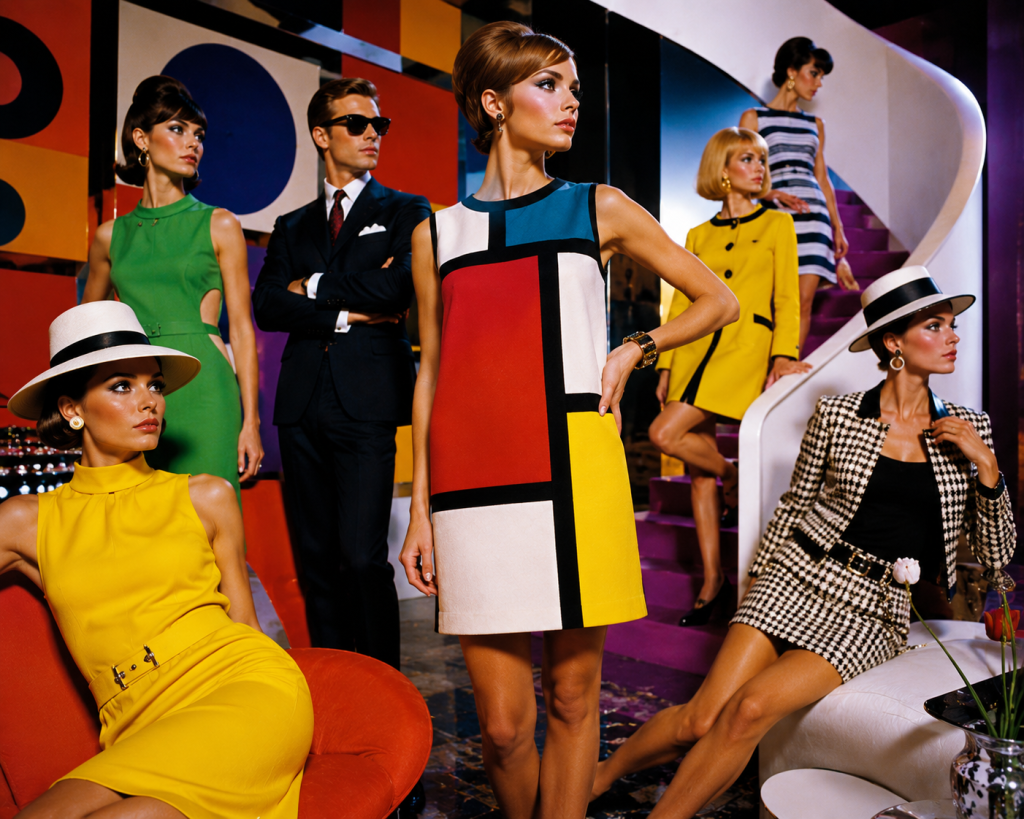
The 1960s broke fashion. Not broke as in damaged, but broke as in shattered the old system entirely. Haute couture’s authority collapsed under the weight of a youth culture that refused to dress like their parents. Ready-to-wear went from an afterthought to the industry’s commercial center. A 25-year-old Algerian-born designer named Yves Saint Laurent invented a new category of luxury. He made couture’s exclusivity available to women who worked for a living. Fashion in the 1960s democratized style, weaponized youth, and proved that the street could dictate to the atelier.
The forces driving the rupture were demographic, cultural, and economic. The postwar baby boom produced the largest generation of young consumers in history. Those consumers had money from the postwar expansion. They had cultural identity from rock and roll, civil rights, and the counterculture. They had zero interest in dressing like the generation that built the nuclear bomb and suburban conformity. When they walked past the haute couture houses on Avenue Montaigne and kept going toward the boutiques on King’s Road, fashion’s power structure shifted permanently.
The numbers told the story before the critics caught on. Haute couture’s customer base shrank from roughly 15,000 women worldwide in 1950 to fewer than 2,000 by 1970. Meanwhile, the global ready-to-wear market expanded from $20 billion to over $50 billion. The 1960s did not kill couture. Demographics killed couture. The decade simply gave the industry permission to stop pretending otherwise.
Yves Saint Laurent and the Invention of Modern Fashion
Yves Saint Laurent inherited Dior at 21 when Christian Dior died of a heart attack in 1957. His Trapeze collection (Spring 1958) generated front-page coverage and proved the house could survive its founder’s death. But subsequent collections pushed Dior in directions the Boussac family found risky. His Beat collection (Fall 1960) featured black leather jackets, turtlenecks, and crocodile-skin topcoats inspired by Left Bank bohemians. The conservative clientele revolted. Orders dropped. Boussac fired him.
The Breakdown and the Comeback
What followed ranks among fashion history’s most dramatic personal crises. The French army drafted Saint Laurent during the Algerian War. Twenty days of military service triggered a severe nervous breakdown. Doctors at Val-de-Grace military hospital administered sedatives, antipsychotics, and electroshock therapy. He emerged gaunt, traumatized, and furious. Dior replaced him with Marc Bohan during his hospitalization. Saint Laurent sued for breach of contract, won damages, and used the settlement to fund his next act.
With partner Pierre Berge managing the business, Saint Laurent launched his own couture house in 1961. The early collections revealed a fully formed creative vision despite his youth. His pea coat (Fall 1962) translated naval utility into Parisian elegance. The Mondrian dress (Fall 1965) reproduced Piet Mondrian’s primary-color grids on a wool shift dress. It proved fashion could function as an intellectual medium. Le Smoking (Fall 1966), the women’s tuxedo, let a woman claim power through sartorial choice. The Safari jacket (Spring 1968) took colonial-era khaki and rebuilt it as urban sophistication.
Each garment translated masculine or utilitarian codes into feminine luxury. Saint Laurent understood that the modern woman needed clothes communicating authority without sacrificing beauty. No previous designer addressed that need with such systematic precision.
Rive Gauche: The Revolution on Rue de Tournon
In 1966, Saint Laurent did something no couturier had attempted. He opened Rive Gauche, a ready-to-wear boutique on Rue de Tournon that sold Saint Laurent designs off the rack. A dress costing $3,000 in the couture salon appeared in a similar version at Rive Gauche for $300. Quality stayed excellent. Design stayed unmistakably Saint Laurent. Only the custom fitting disappeared, and for most women, that loss felt like liberation.
The move violated the fundamental assumption governing fashion since 1858: that luxury required custom fitting, personal service, and prices excluding most of the population. Rive Gauche offered couture-quality design in a space that felt more like a gallery than a fitting room. Walls carried bold colors. Contemporary music played on the sound system. Young saleswomen replaced matronly couture attendants. Revenue from the boutiques eventually exceeded the couture business. The future of luxury lay in branding, not bespoke craftsmanship.
The Consumer Saint Laurent Invented
Rive Gauche did more than create a revenue stream. It created a new consumer. The Rive Gauche customer was younger than the couture client, professionally active, and culturally engaged. She went to galleries on Saturday afternoons, read Simone de Beauvoir, worked in publishing or advertising or academia, and wanted clothes signaling intelligence without requiring explanation. She spent serious money on garments reflecting her identity rather than her husband’s social position.
That consumer profile became the target audience for every major fashion brand launched over the following six decades. Armani’s power suits served her in the 1980s. Prada’s intellectual nylon served her in the 1990s. Miu Miu’s Gen-Z micro-minis serve her granddaughter today. Saint Laurent did not just design for this woman. He invented her as a commercial category.
The Youth Quake: London Replaces Paris
London replaced Paris as fashion’s cultural capital during the mid-1960s. Music drove the shift (the Beatles, the Rolling Stones, the Who). Photography amplified it (David Bailey, Terence Donovan, Brian Duffy). New models embodied it (Twiggy, Jean Shrimpton). Retail innovation sold it (Mary Quant, Biba, Ossie Clark). Quant’s miniskirt, sold from her King’s Road boutique Bazaar starting in 1964, represented a generational rejection of the structured femininity that Dior imposed and Chanel softened.
Quant understood something the Parisian establishment missed: baby boomers wanted to dress as a tribe, not as individuals. The miniskirt functioned as a membership card for a generational identity. Wearing it said you were young, or wanted to be, or at minimum understood what young meant in 1965. Not wearing it placed you on the other side of a cultural divide the decade made permanent.
Biba, founded by Barbara Hulanicki in 1964, pushed the London boutique concept further. Her Kensington shop created an immersive retail environment. Dark interiors, art nouveau aesthetics, communal changing rooms, and rock music made Biba feel like a nightclub that happened to sell clothes. The concept foreshadowed the experiential retail strategies luxury brands would spend billions developing decades later.
The Space Age Response
Andre Courreges and Pierre Cardin in Paris responded with futuristic aesthetics. They created the “Space Age” look, translating the decade’s technological optimism into fashion. Courreges showed white go-go boots, silver shift dresses, and astronaut-style goggles. Cardin built sculptural garments from vinyl, metal, and geometric jersey.
Paco Rabanne pushed furthest. He constructed garments from plastic discs, aluminum plates, metal chains, and fiberglass panels. His 1966 collection “Twelve Unwearable Dresses in Contemporary Materials” became fashion’s first deliberate provocation: garments designed for cameras rather than closets. These collections generated enormous press coverage and minimal commercial revenue. They established an enduring industry dynamic: the most photographed collections are rarely the most profitable. But the publicity subsidizes the commercial lines that follow.
The Establishment Holds Its Ground
The youth quake forced the French fashion houses to confront a hard truth: their customer base was aging and their aesthetic was calcifying. The generation that would define the next fifty years of consumption showed no interest in couture as configured.
Chanel refused to adjust. Coco dismissed the miniskirt as “an ugly exposure of the knee” and kept producing the suits her American clientele demanded. Her stubbornness paid off. The Chanel suit outlasted the miniskirt because practicality outlasts provocation in every consumer market. Balenciaga, equally stubborn but less commercially resilient, maintained his couture-only model until retiring in 1968. He claimed the industry no longer valued craftsmanship. Both conceded the cultural conversation to younger voices.
Italy Builds the Machine
While Paris and London fought the culture war, Italy built the manufacturing and distribution infrastructure that would dominate luxury for six decades. The decade’s Italian story centered on systematic supply chain construction, not headline-grabbing cultural moments.
Valentino Garavani achieved his defining moment by dressing Jacqueline Kennedy for her 1968 wedding to Aristotle Onassis on Skorpios. Kennedy chose Valentino for the wedding dress, the going-away outfit, and multiple honeymoon garments. Every major newspaper and magazine in the world published the photographs. In one event, Valentino established himself as the choice of international aristocracy and American political royalty. That celebrity-bridal pipeline later dressed Princess Marie-Chantal of Greece, Elizabeth Hurley, and Anne Hathaway. Maria Grazia Chiuri and Pierpaolo Piccioli inherited and modernized the strategy decades later.
Lagerfeld, Gucci, and the Retail Expansion
Fendi hired Karl Lagerfeld as creative director in 1965. The appointment began a 54-year relationship that transformed a Roman fur house into a $1.6 billion global brand. Lagerfeld was 32 and already designing for Chloe simultaneously. He treated fur the way a contemporary artist treats found material: shaving mink to the weight of silk, reversing pelts so the leather faced outward, dyeing fox in colors nature never intended. His inverted double-F logo, reportedly sketched on a napkin in five seconds, became one of luxury fashion’s most recognized brand marks.
Gucci expanded from Florence to Milan, Rome, New York, London, and Palm Beach during the decade. The boutique network would generate billions in subsequent decades. Jackie Kennedy carried a Gucci shoulder bag so frequently that the company renamed it the “Jackie” in her honor. That move created one of the first celebrity-named luxury products. The brand gained the same celebrity visibility that Ferragamo achieved through Hollywood footwear. Internal family dynamics, however, already showed the stress fractures that would produce a murder and a corporate collapse in the 1990s.
The Invisible Supply Chain
Zegna’s textile mills in Biella supplied a growing share of the world’s finest suit fabrics. The company positioned itself as the essential infrastructure behind Italian menswear. When Armani launched in 1975, Zegna fabrics built his first collections. When Tom Ford rebuilt Gucci in the 1990s, Italian manufacturers using Biella materials produced his suits. The supply chain that Zegna, the Como silk weavers, and the Tuscan leather tanneries developed became the invisible engine behind Italian fashion’s dominance. No other country had this infrastructure. No other country could build it from scratch.
The Italian fashion system that the 1970s would weaponize took shape during the 1960s. A fashion press obsessed with Parisian couture and London’s mod revolution barely noticed. Italy built a machine while everyone else built a spectacle. The machine outlasted every spectacle.
The American Market Evolves
Ralph Lauren launched his Polo label in 1967. He sold wide neckties from a single counter at Bloomingdale’s in New York. Four inches wide when the standard measured two and a half, cut from finer fabrics, and priced at twice the going rate. Lauren understood that American men wanted European quality without European pretension. A well-made tie served as the entry point for a lifestyle brand. By decade’s end, Polo generated enough revenue to fund expansion into menswear, womenswear, and the home collection that would make Lauren a billionaire.
Hollywood and the Fashion-Film Merger
Hollywood cemented its role as fashion’s most powerful marketing channel. “Breakfast at Tiffany’s” (1961) turned Givenchy’s little black dress and triple-strand pearl necklace into enduring style icons. The opening scene (Audrey Hepburn eating a pastry outside Tiffany’s at dawn) became fashion’s most replicated image. A single cinematic moment generated more commercial value than an entire advertising campaign. “Bonnie and Clyde” (1967) triggered a 1930s revival so significant that department stores created dedicated Bonnie-and-Clyde sections. Fashion and cinema merged into a single cultural-commercial complex during the 1960s. Television, music, and social media would join the merger in subsequent decades.
What Fashion in the 1960s Changed Forever
Fashion in the 1960s established the principle governing the industry for the next sixty years: luxury’s future lies in ready-to-wear, not couture. Saint Laurent proved it commercially with Rive Gauche. The youth quake proved it culturally with the miniskirt. Italian manufacturers proved it operationally with the supply chain. Couture survived as a marketing channel and idea laboratory (a function it still serves at Chanel, Dior, and Valentino). But the commercial center of fashion shifted permanently. Every house in the Fashion Empire, from Prada to Armani to Ralph Lauren, stands on the foundation the 1960s poured.
The Portable Creative Director
The decade also turned the creative director into a transferable asset. Saint Laurent moved from Dior to his own house. Lagerfeld joined Fendi while continuing at Chloe. That practice, normalized in the 1960s, eventually produced the creative director carousel defining the 2020s. Michele moved from Gucci to Valentino. Blazy moved from Bottega Veneta to Chanel. Demna moved from Balenciaga to Gucci. The transferability of creative talent is the most consequential structural change the 1960s produced. It has only accelerated.
For the Hamptons social circuit, the 1960s brought fashion’s generational war to the East End. The mothers wore Chanel to the Meadow Club. The daughters wore miniskirts to Montauk. Both made fashion statements. Both spent money. The tension between heritage and disruption has never resolved in the Hamptons. Resolving it would eliminate the competitive energy that makes the social scene worth covering, worth attending, and worth sponsoring. Social Life Magazine exists in the space between those two positions. Neither side has won because winning would end the game, and the game is what makes the East End worth the drive from Manhattan.
Where The Conversation Continues
Connect With Social Life
Social Life Magazine has covered the intersection of luxury fashion, power, and the Hamptons for over two decades. Our five summer issues, distributed from Memorial Day through Labor Day across the East End, reach 25,000 readers who define the season’s cultural conversation. From Westhampton to Montauk, this is the publication that brands trust when the audience matters more than the impression count.
We deliver an additional 15,000 copies to Upper East Side doorman buildings during fall and winter, extending the Hamptons conversation into Manhattan’s most exclusive residential addresses. Our 82,000 email subscribers receive curated editorial that blends fashion authority with Hamptons insider access.
Polo Hamptons, our signature sporting and lifestyle event in Bridgehampton, brings together the brands and personalities that shape luxury culture. Christie Brinkley hosts. Getty and McMullan photograph. The corporate cabana and sponsor activations create direct engagement with an audience that treats attendance as a social credential.
The Social Life Guest House in Sag Harbor offers select brands the opportunity to integrate into our editorial through experiential activations. It is a restored residence designed for content creation, product placement, and the kind of organic media coverage that feels editorial because it is.
Whether you are a luxury brand seeking Hamptons credibility, a wellness company building prestige positioning, or a financial services firm targeting high-net-worth audiences, Social Life Magazine offers a platform that combines print authority, digital reach, and experiential access in one integrated partnership.
Contact Cass Almendral, Head of Business Development, at [email protected] to discuss editorial features, event sponsorships, and brand activations for the 2026 season.
For Polo Hamptons corporate cabana inquiries, reach Justin Mitchell at [email protected].
Author

Written by
Recent Posts
The Skincare Habits That Make a Real Difference Over Time
Hamptons-Ready Beauty: Polished Makeup for Long Summer Days
Is Now a Good Time to Sell a Home in NJ?

The Hidden Work Behind a Seamless Hotel Weekend
Choosing Scratching Furniture for a British Shorthair
Categories
- Art
- Articles
- Business of Luxury
- Celebrities
- Culture
- Entertainment
- Events
- Faces of Summer 2026
- Fashion
- Fashion & Style
- Featured
- Finance
- Food, Spirits, Wine
- Hamptons
- Hamptons Celebrities
- Health
- Health & Beauty
- Lifestyle
- Luxury Lifestyle
- Press
- Profiles
- Real Estate
- Technology
- The Chronicles
- Travel
- Uncategorized
- Weddings