
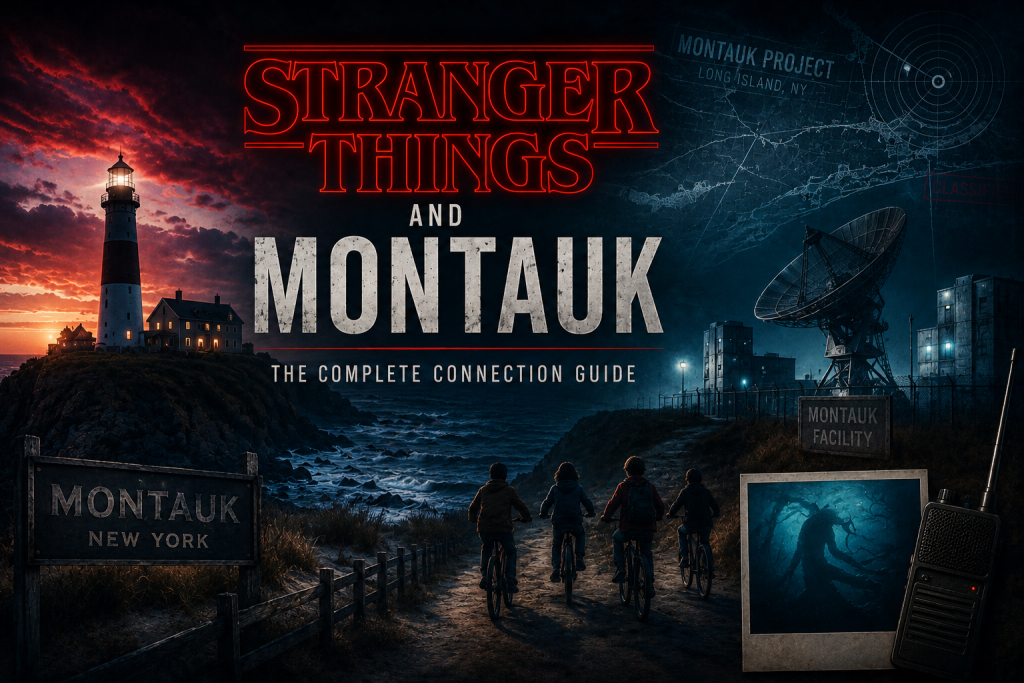
The Complete Connection Guide
Initially, the show was called Montauk. Its setting was Long Island. Its year was 1980. And the protagonist was a conspiracy-obsessed projectionist with “the looks of a serial killer” who had spent a decade investigating a military base at the end of the road. Then the name changed. Then the setting moved to Indiana. The time period shifted to 1983. And the protagonist became a police chief played by David Harbour. And Stranger Things and Montauk became, to most of the show’s audience, separate things entirely.
In fact, they are not separate things. They have never been separate things. Indeed, every major narrative element of Stranger Things traces directly to the Montauk Project conspiracy, which traces to a self-published book from 1992, which traces to a decommissioned Air Force station at the tip of the South Fork, which traces to documented government programs including MKUltra, the Stargate Project, the Philadelphia Experiment, and Operation Paperclip. Indeed, the thread is continuous. In other words, the only thing that changed was the wrapping.
This is the definitive guide to every connection between Stranger Things and Montauk, from the original pilot through the series finale through the spinoffs currently in production.
The Original Concept
Initially, Matt and Ross Duffer’s first concept was a found-footage film called The Montauk Experiment, featuring a character based on Duncan Cameron, the psychic who Preston Nichols described as the Montauk Project‘s most gifted subject. The concept evolved into a serialized television pitch. The original pilot script was titled Montauk and set at the eastern tip of the South Fork in October 1980.
The pilot’s protagonist looked nothing like the Hopper audiences eventually met. Interestingly, early development notes describe a character with “the looks of a serial killer” and “balding hair and big oval glasses.” Instead, he was a projectionist at a local movie theater, not a police chief. For years, he had spent a decade investigating Camp Hero. Initially, other characters dismissed him as a paranoid loner. Eventually, the character arc was later split: the conspiracy investigator became Hopper, the personal connection to the experiments became Terry Ives (Eleven’s mother and MKUltra test subject).
The Name Change
In fact, the transformation from Montauk to Stranger Things was driven by three forces, each documented in detail in the full name change analysis. First, the Duffers wanted a suburban Spielberg aesthetic that Montauk’s coastal landscape couldn’t provide. Second, a plagiarism lawsuit from filmmaker Charlie Kessler complicated the use of the name. Third, Georgia’s tax incentives made filming in Atlanta’s suburbs dramatically cheaper than filming on Long Island.
Notably, David Harbour said in a 2025 interview that he thought the original title was “so strong.” He noted that “Montauk has this end-of-the-world feeling. Indiana feels safe. That’s what makes the horror work.” Of course, the Duffers gained marketability. Whether they lost something harder to measure is a question that the series finale answered by bringing the story back to where it started.
The Structural Parallels
The side-by-side comparison between Hawkins Lab and Camp Hero reveals a one-to-one correspondence across every structural category. Both are government facilities on the outskirts of small communities. Each features underground levels. They conduct experiments on children. And both produce a catastrophic event involving an interdimensional portal. Both are covered up through institutional denial.
Camp Hero is Hawkins Lab. The Montauk Boys are Eleven. The Upside Down is the portal Duncan Cameron allegedly opened. MKUltra is referenced by name. The Stargate Project‘s remote viewing becomes Eleven’s primary ability. The Philadelphia Experiment provides the World War II origin story. The Duffers didn’t borrow loosely from the Montauk mythology. They mapped it.
The Season 5 Finale
On New Year’s Eve 2025, the series finale closed the loop. In the epilogue, Hopper tells Joyce he’s been offered a job as Chief of Police in Montauk. He asks her to move there. She says yes. For fans who knew the show’s origin story, the moment was seismic. Of course, Ross Duffer told Collider it was “a wink to deep-cut fans.” Matt Duffer admitted he’d warned his brother that fans would misinterpret the reference. “But I actually think it’s really cute,” Matt said. “I’m glad we have it.”
After all, the show began as Montauk. It ended with Hopper choosing Montauk. The geography the Duffers left behind in development was the geography they returned to in the final scene. The original pilot never got made. But the place it was set, the conspiracy it drew from, and the mythology it adapted are now permanently embedded in one of the most-watched finales in streaming history.
The Franchise Expansion
The Stranger Things spinoffs ensure that the franchise will continue generating traffic for the foreseeable future. Tales From ’85, the animated spinoff, premiered on April 23, 2026, and has already been renewed for a second season arriving in fall 2026. A live-action spinoff with “a different mythology” is in development. A stage play, The First Shadow, runs in London’s West End.
As a result, every new release sends fans back to the origin story. Back to the Montauk Project, back to Camp Hero. Back to the self-published book from 1992 that made all of this possible. After all, the franchise generates approximately 20 million searches per month. Still, a meaningful fraction flows to queries about the real-life inspiration. And the real-life inspiration sits at the end of Long Island, at a state park with sealed buildings and a radar tower that still moves, waiting for the next wave of visitors.
What It Means for the East End
The connection between Stranger Things and Montauk is not a pop culture footnote. It is a permanent traffic generator for the East End. Camp Hero State Park sees increased visitor traffic after every major franchise release. Ditch Plains draws visitors who know it as the beach where the Montauk Monster washed ashore. Montauk real estate benefits from the name recognition the franchise provides. Eothen, Jackie O’s summer compound, the Memory Motel where the Stones drank: all of it feeds the Montauk narrative that Stranger Things amplified for a global audience.
Ultimately, for brands operating on the East End, the franchise is not something to acknowledge casually. Instead, it is a market force. And its output schedule (at least one major release per year for the foreseeable future) means the traffic will compound rather than decay. As a result, the question for Montauk-adjacent businesses is not whether to engage with the franchise’s cultural footprint. It is whether they can afford not to.
Where the Conversation Continues
Stranger Things and Montauk are connected forever. Social Life Magazine has covered the East End for 23 years. The stories at the intersection of entertainment, conspiracy, and East End culture land here first.
If you have a story, a brand, or a project that belongs in these pages, reach out at sociallifemagazine.com/contact.
For brands looking for premium editorial placement, our paid feature submission portal is open at sociallifemagazine.com/submit-a-paid-feature/.
Stay in the loop with our weekly email blast covering events, openings, and who’s doing what Out East. Sign up at enflyer.sociallifemagazine.com.
Polo Hamptons 2026 returns to Bridgehampton on July 18 and July 25 with BMW as title sponsor. For event details and sponsorship opportunities, visit polohamptons.com.
Never miss a feature, a profile, or a party recap. Subscribe to Social Life Magazine at sociallifemagazine.com/subscription.
If the work we do matters to you, you can support independent East End journalism directly via PayPal.
Author

Written by
Recent Posts
How to Measure Whether a Hair Loss Treatment Is Working
Is Online Psychiatry Covered by Insurance? What to Know Before Booking
Four Habits of Quietly Successful Entrepreneurs

The Most Common Preventable Health Concerns Doctors See Today
What Affects a Rideshare Injury Settlement?
Categories
- Art
- Articles
- Business of Luxury
- Celebrities
- Culture
- Entertainment
- Events
- Faces of Summer 2026
- Fashion
- Fashion & Style
- Featured
- Finance
- Food, Spirits, Wine
- Hamptons
- Hamptons Celebrities
- Health
- Health & Beauty
- Lifestyle
- Luxury Lifestyle
- Press
- Profiles
- Real Estate
- Technology
- The Chronicles
- Travel
- Uncategorized
- Weddings