
The 2000s were the decade when luxury fashion discovered it could sell to everyone and nearly destroyed itself trying. Logo mania returned with industrial int
The 2000s were the decade when luxury fashion discovered it could sell to everyone and nearly destroyed itself trying. Logo mania returned with industrial intensity. Fast fashion emerged as an existential threat. Blogs replaced gatekeeping editors as the voices determining what mattered. And a series of creative director appointments reshaped the industry’s power structure in ways nobody anticipated. Fashion in the 2000s was the decade of maximum commercial ambition and minimum strategic discipline. The gold rush generated unprecedented revenue while creating the brand dilution problems that the 2010s and 2020s would spend billions trying to fix.
Two forces defined the era. First, the democratization of luxury through accessible product categories (fragrance, cosmetics, sunglasses, entry-level leather goods) let consumers buy into a brand for $50 rather than $5,000. Second, fast fashion retailers emerged who could copy a runway design, manufacture it, and deliver it to stores before the original luxury version reached department store floors. Both forces expanded fashion’s audience. Both eroded its exclusivity. The tension between access and aspiration became the decade’s defining commercial dilemma.
The Logo Tsunami
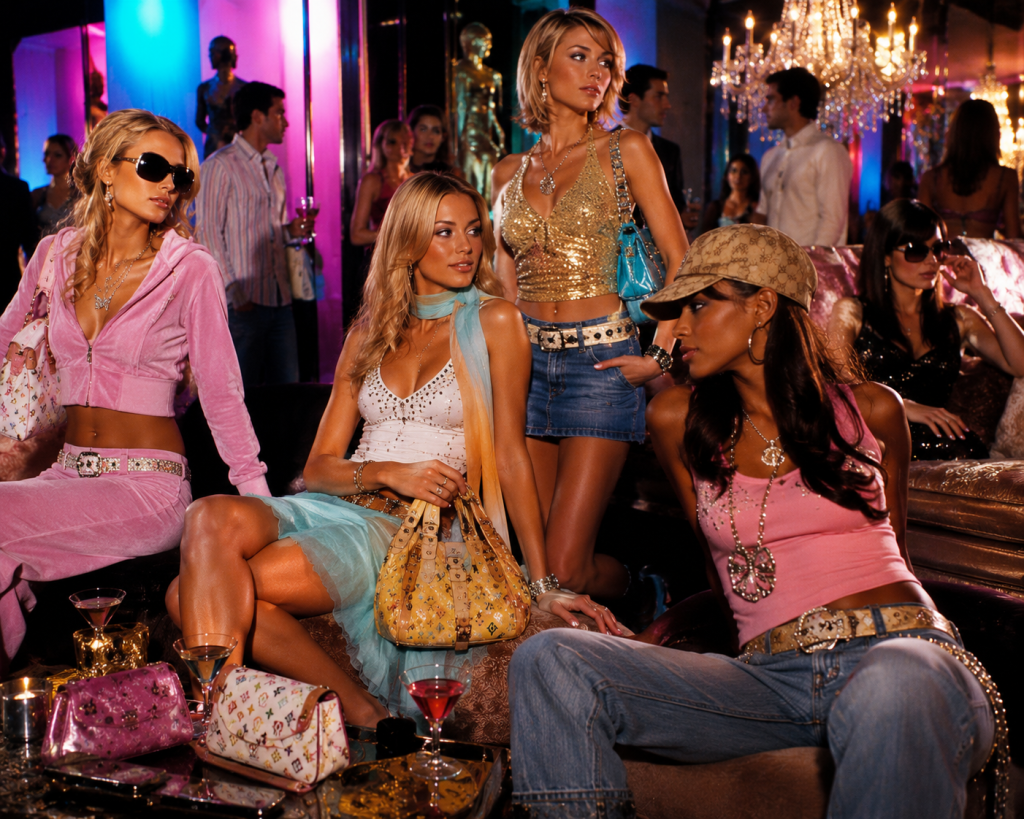
If the 1990s belonged to anti-logo sophistication (Prada nylon, Armani restraint, Helmut Lang austerity), the 2000s flipped the script with violent enthusiasm. Louis Vuitton’s monogram canvas became the most recognized luxury pattern on earth. Gucci’s interlocking Gs appeared on belts, wallets, sneakers, and baby carriers. Fendi’s double-F covered everything from handbags to ski goggles. Dior’s Saddle bag, carried by every celebrity photographed between 2000 and 2005, became the decade’s defining accessory.
The Accessibility Trap
The reason for the logo explosion was economic, not aesthetic. Entry-level logo products (a monogram wallet at $300, a logo belt at $500, a branded keychain at $150) let aspiring consumers participate in luxury without buying a $3,000 jacket. Volume exploded. Revenue at LVMH doubled during the decade. Gucci, Dior, and Fendi each grew accessories revenue by triple digits. The math worked beautifully on quarterly earnings calls.
The problem was structural. Volume and exclusivity move in opposite directions. When every college student in America carried a Louis Vuitton Speedy (whether authentic or counterfeit), the monogram stopped signaling membership in an exclusive club. It started signaling participation in a mass market. Brands that spent decades building exclusivity watched their own accessibility strategies erode the premium positioning that justified their prices.
Gucci under Tom Ford reached peak revenue and peak dilution simultaneously. Ford departed in 2004 alongside CEO Domenico De Sole after a power struggle with Kering (then PPR) management. His exit left a house generating over $3 billion in revenue with no creative direction and a brand identity stretched across too many product categories. The dilution problem would not find its resolution until Alessandro Michele reinvented the brand entirely in 2015. That eleven-year gap between Ford and Michele ranks among the most expensive identity crises in luxury history.
The Fast Fashion Revolution
Zara’s parent company Inditex grew from $2 billion in revenue in 2000 to $16 billion by 2010. The growth proved that speed could substitute for heritage and affordability could substitute for exclusivity. Zara’s design-to-store cycle of two weeks (compared to six months for traditional luxury) meant that runway trends appeared in Zara stores before the luxury versions reached department store floors. A Prada silhouette shown in Milan on Monday appeared in Zara’s windows in Madrid by the following Friday.
Designer Collaborations Blur the Line
H&M’s designer collaborations further dissolved the boundary between luxury and mass market. Karl Lagerfeld designed for H&M in 2004. The collection sold out in minutes. Stella McCartney followed in 2005. Versace joined in 2011. Each collaboration offered designer aesthetics at fast fashion prices. Consumers discovered they could approximate a luxury look for $49.99. The luxury industry had to answer a question it never expected: why should a customer pay $5,000 for a garment when an $80 version captures 80% of the visual impact?
The answer luxury settled on was bifurcation. Invest more heavily in ultra-premium products (haute couture, limited editions, VIP client experiences) to maintain exclusivity at the top. Simultaneously expand accessible categories (fragrance, beauty, eyewear, small leather goods) to capture volume at the bottom. The middle ground (ready-to-wear priced between $1,000 and $5,000) got squeezed from both directions and never fully recovered.
Lagerfeld’s Chanel Perfects the Bifurcation
Chanel under Karl Lagerfeld executed the bifurcation strategy more successfully than any competitor. The couture shows grew increasingly spectacular. Lagerfeld built a supermarket inside the Grand Palais, launched a rocket from the runway, and recreated an iceberg for a Fall collection. Each show cost between $3 million and $10 million. Each generated press coverage worth hundreds of millions.
Bag prices increased annually, often by 10-15% per year, with no measurable impact on demand. The Classic Flap bag that cost $1,150 in 2000 would cost over $10,000 by 2024. Chanel’s $50 lipstick and $100 perfume allowed a global consumer base to participate in the brand without diluting the core luxury proposition. The prestige products (couture, bags, fine jewelry) remained exclusive. The accessible products (beauty, fragrance, eyewear) drove volume. Revenue grew from approximately $3 billion in 2000 to over $17 billion by 2022. No house navigated the decade’s contradictions more profitably.
The Blog Revolution and Fashion Democratization
Fashion blogging emerged in the mid-2000s and fundamentally altered who held power in the industry. Bryan Boy, Susie Lau (Style Bubble), Tommy Ton, and The Sartorialist gained front-row seats at fashion shows previously reserved for magazine editors and department store buyers. The shift was structural. For the first time in the history of fashion, individuals without institutional backing could influence what consumers bought.
The Gatekeepers Fight Back
Magazines fought the insurgency on multiple fronts. Vogue’s Anna Wintour initially dismissed bloggers as amateurs in jeans cluttering the front row. Then she co-opted them through advertising partnerships and social media integration. Wintour adapted by expanding Vogue’s digital presence and using the Met Gala as a brand event generating social media conversation that bloggers could not replicate at the same scale. The Met Gala became fashion’s Super Bowl during the 2000s. Wintour turned a fundraiser into the most photographed event on earth.
The tension between institutional gatekeepers and independent voices would escalate through the 2010s as Instagram replaced blogs. But the structural damage happened in the 2000s. Once a 22-year-old with a camera phone could influence purchasing decisions, the magazine editor’s monopoly on taste was broken permanently. That monopoly will never return.
The Italian Houses Consolidate and Reposition
Prada spent the early 2000s recovering from its failed conglomerate strategy. The Jil Sander, Helmut Lang, and Fendi acquisitions that Patrizio Bertelli had pursued in the late 1990s nearly bankrupted the company. Prada divested each acquisition at a loss and refocused on organic growth through the main Prada line and Miu Miu. The painful lesson (grow organically, not through acquisitions) held for twenty-two years. Then Bertelli acquired Versace in 2025, proving that lessons learned from failure have expiration dates.
Bottega Veneta and the Anti-Logo Thesis
Bottega Veneta, acquired by Gucci Group (Kering) in 2001 for a modest price, underwent a quiet revolution under creative director Tomas Maier. His positioning statement (“When your own initials are enough”) represented the philosophical opposite of the decade’s logo mania. Bottega sold intrecciato woven leather with no visible branding. The customer who carried a Bottega bag in 2005 was making a deliberate statement against the monogram tsunami surrounding her. Maier built the brand from roughly $100 million to over $900 million during his 17-year tenure. Daniel Lee and Matthieu Blazy would later supercharge that anti-logo positioning into a $2 billion business.
Valentino’s Succession and the Italian Specialists
Valentino Garavani retired in January 2008, ending a 45-year tenure as creative director. His final couture show in Paris drew a standing ovation from an audience that included every major figure in the industry. The retirement triggered one of the Italian fashion industry’s most closely watched succession challenges. Maria Grazia Chiuri and Pierpaolo Piccioli took over as co-creative directors and began the modernization that would eventually send Chiuri to Dior and establish Piccioli as one of couture’s most poetic voices.
Ferragamo maintained its specialist positioning in leather goods and footwear. Zegna continued supplying the finest menswear fabrics to competitors while building its own retail business. Brunello Cucinelli, who went public in 2012, carved out the “humanistic capitalism” positioning that would attract global attention during the quiet luxury wave of the 2020s. Dolce and Gabbana rode the celebrity red carpet harder than any competitor. Their Alta Moda program (custom couture for ultra-wealthy clients, shown in spectacular locations from Capri to Sicily to Venice) created a revenue stream that traditional couture houses had abandoned.
The American Market: Ralph Lauren and the Lifestyle Ceiling
Ralph Lauren hit the lifestyle brand ceiling during the 2000s. Revenue exceeded $5 billion. The brand encompassed clothing, home furnishings, restaurants, paint colors, and a fantasy of American aristocracy so complete that it functioned as a parallel reality. But growth decelerated. The core customer aged. Younger consumers drifted toward European luxury brands that offered cultural credibility Ralph Lauren’s preppy Americana could not match.
Tory Burch launched in 2004 and immediately captured the market Ralph Lauren’s women’s line had underserved. The Reva ballet flat (a $195 shoe with a gold logo medallion) became the decade’s most commercially successful shoe launch. Burch built a $1.5 billion brand by offering American women European-inflected design at accessible luxury prices. The positioning occupied territory between Ralph Lauren (too preppy) and Gucci (too expensive). No other brand had identified or filled that gap.
The 2008 Crisis: When the Music Stopped
The global financial crisis of 2008 hit luxury fashion with the force of a market correction that had been building for a decade. Lehman Brothers collapsed in September. Luxury spending contracted 8% globally within six months. Stores that had expanded aggressively during the boom suddenly carried too much inventory in too many locations serving too few customers willing to spend.
The Reckoning and the Recovery
The crisis exposed the fragility of the logo-driven growth model. Houses that depended on aspiring consumers (who bought logo belts and entry-level bags to signal status they had not yet achieved) suffered worst. Those consumers disappeared overnight when bonuses evaporated and credit tightened. Houses that served established wealth (Hermes, Brunello Cucinelli, Bottega Veneta) barely noticed. Their customers did not buy luxury with bonuses. They bought luxury with capital.
Recovery came faster than anyone predicted. Chinese consumers, largely unaffected by the Western financial crisis, increased their luxury spending throughout 2009 and 2010. China became the industry’s growth engine almost overnight. By 2012, Chinese consumers accounted for roughly 25% of global luxury purchases. The geographic dependency that would define (and eventually threaten) the luxury industry for the next fifteen years took root during the post-crisis recovery.
E-Commerce Emerges
Net-a-Porter launched in 2000. Natalie Massenet built the first luxury e-commerce platform at a time when most fashion houses considered online sales beneath their brand positioning. Luxury products required touch, personal service, and the atmosphere of a physical boutique. Or so the industry believed. Net-a-Porter proved otherwise. Revenue reached $1 billion by 2015. Richemont acquired the platform for $5.3 billion.
The luxury industry spent the 2000s arguing about whether e-commerce would dilute brand equity. While the argument continued, consumers migrated online. By decade’s end, the question had changed. E-commerce no longer asked for permission. It demanded a strategy. Houses that delayed (Chanel held out until the late 2010s for most categories) maintained exclusivity but conceded market share. Houses that adopted early (Burberry became the most digitally advanced luxury brand by 2009) gained customers but worried about brand positioning. Neither approach proved definitively correct, which meant the debate would continue through the 2010s until the pandemic settled it permanently.
What Fashion in the 2000s Reveals About Excess
Fashion in the 2000s proved that revenue growth without brand discipline leads to brand erosion. Every house that chased volume through logo proliferation spent the following decade rebuilding the exclusivity it had sold. The decade also proved that fashion’s distribution monopoly had ended permanently. Fast fashion, blogs, and e-commerce gave consumers access to trends, commentary, and purchasing options that bypassed every traditional gatekeeper.
The Winners and the Lesson
The French and Italian fashion houses that emerged strongest maintained pricing discipline (Chanel, Hermes) or built brand equity through creative direction rather than logo distribution (Bottega Veneta, Prada). Hermes never discounted, never put its logo on a keychain, and never chased volume. Revenue grew steadily throughout the decade. The Birkin bag became the most desired object in luxury fashion precisely because Hermes made it almost impossible to buy. Scarcity, it turned out, was the most effective marketing strategy the 2000s produced. Every house that chose the opposite approach (accessibility, volume, logo proliferation) spent the following decade learning that lesson the expensive way.
For the Hamptons social circuit, the 2000s were the decade of visible wealth. Monogrammed bags at every charity benefit. Logo belts at every restaurant opening. Ralph Lauren estates expanding across every lane in Southampton. The excess ran on hedge fund bonuses and real estate valuations that seemed incapable of decline. When the financial crisis hit in 2008, the East End social scene contracted briefly and then resumed with the specific resilience of a community that defines itself by consumption. Lehman Brothers partners disappeared from benefit committees. New money from tech and private equity filled their seats before the next summer season. The logos got quieter after the crash. The spending did not stop. It simply got smarter, rotating toward brands like Hermes, Bottega, and Cucinelli that signaled wealth through quality rather than insignia. That rotation, from loud luxury to quiet luxury, ranks as the 2000s’ most lasting contribution to East End social culture and the most expensive lesson the industry learned about the relationship between visibility and value.
Where The Conversation Continues
Connect With Social Life
Social Life Magazine has covered the intersection of luxury fashion, power, and the Hamptons for over two decades. Our five summer issues, distributed from Memorial Day through Labor Day across the East End, reach 25,000 readers who define the season’s cultural conversation. From Westhampton to Montauk, this is the publication that brands trust when the audience matters more than the impression count.
We deliver an additional 15,000 copies to Upper East Side doorman buildings during fall and winter. Our 82,000 email subscribers receive curated editorial that blends fashion authority with Hamptons insider access.
Polo Hamptons, our signature sporting and lifestyle event in Bridgehampton, brings together the brands and personalities that shape luxury culture. Christie Brinkley hosts. Getty and McMullan photograph.
Contact Cass Almendral, Head of Business Development, at [email protected] to discuss editorial features, event sponsorships, and brand activations for the 2026 season.
For Polo Hamptons corporate cabana inquiries, reach Justin Mitchell at [email protected].
nsity. Fast fashion emerged as an existential threat. Blogs replaced gatekeeping editors as the voices that determined what mattered. Fashion in the 2000s was the decade of maximum commercial ambition and minimum strategic discipline, a gold rush that generated unprecedented revenue while creating the brand dilution problems that the 2010s and 2020s would spend billions trying to fix.
The Logo Tsunami
If the 1990s had been about anti-logo sophistication, the 2000s flipped the script. Louis Vuitton’s monogram canvas, Gucci’s interlocking Gs, Fendi’s double-F, and Dior’s Saddle bag turned conspicuous branding into the dominant aesthetic. Entry-level logo products let aspiring consumers participate in luxury without buying a $3,000 jacket. Volume exploded. Revenue at LVMH doubled during the decade.
The problem was that volume and exclusivity are inversely correlated. When every college student carried a Louis Vuitton Speedy, the monogram stopped signaling membership in an exclusive club. Gucci under Tom Ford reached peak revenue and peak dilution simultaneously, a tension that would not be resolved until Alessandro Michele reinvented the brand in 2015.
The Fast Fashion Revolution
Zara’s parent company Inditex grew from $2 billion in revenue in 2000 to $16 billion by 2010. Zara’s design-to-store cycle of two weeks meant runway trends appeared in stores before the luxury versions reached department store floors. H&M’s designer collaborations (Karl Lagerfeld in 2004, Versace in 2011) further blurred the line between luxury and mass market.
The luxury industry’s response was bifurcation. Chanel under Lagerfeld executed this most successfully: the couture shows grew more spectacular, the bag prices increased annually, and the brand’s $50 lipstick allowed a global consumer base to participate without diluting the core proposition.
The Blog Revolution
Fashion blogging emerged in the mid-2000s and fundamentally altered who had power. For the first time in the history of fashion, individuals without institutional backing could influence what consumers bought. The tension between institutional gatekeepers and independent voices would escalate through the 2010s as Instagram replaced blogs.
The Italian Houses Consolidate
Prada spent the early 2000s recovering from its failed conglomerate strategy before refocusing on organic growth. Bottega Veneta, acquired by Kering in 2001, was rebuilt under Tomas Maier into a quiet luxury brand whose “When your own initials are enough” positioning represented the philosophical opposite of the decade’s logo mania.
Valentino Garavani retired in 2008. Maria Grazia Chiuri and Pierpaolo Piccioli took over as co-creative directors. Ferragamo, Zegna, and Brunello Cucinelli each carved out defensible specialist positions. Armani maintained his independence while every peer was acquired or consolidated.
What Fashion in the 2000s Reveals About Excess
Fashion in the 2000s proved that revenue growth without brand discipline leads to brand erosion. The French and Italian fashion houses that emerged strongest were those that maintained pricing discipline (Chanel, Hermes) or built brand equity through creative direction rather than logo distribution (Bottega Veneta, Prada).
For the Hamptons social circuit, the 2000s were the decade of visible wealth. Monogrammed bags at every charity benefit. Logo belts at every restaurant opening. Ralph Lauren estates expanding across every lane in Southampton. The excess was genuine and unapologetic, funded by hedge fund bonuses and real estate valuations that seemed incapable of decline.
Where The Conversation Continues
Connect With Social Life
Social Life Magazine has covered the intersection of luxury fashion, power, and the Hamptons for over two decades. Our five summer issues reach 25,000 readers from Westhampton to Montauk.
Contact Cass Almendral, Head of Business Development, at [email protected] to discuss editorial features, event sponsorships, and brand activations for the 2026 season.
For Polo Hamptons corporate cabana inquiries, reach Justin Mitchell at [email protected].
Author

Written by
Recent Posts

The First Decision After a Collision Can Be the Most Important One
Two Weeks in Rome and Beyond: Turkish Airlines Itineraries from Boston, Chicago and Onward to India

Top 10 Hair Transplant Clinics in Turkey 2026
Artist Alley to Online Store: How Convention Artists Can Keep Selling After the Event
When an 18-Wheeler Crash Leaves Lasting Consequences
Categories
- Art
- Articles
- Business of Luxury
- Celebrities
- Culture
- Entertainment
- Events
- Faces of Summer 2026
- Fashion
- Fashion & Style
- Featured
- Finance
- Food, Spirits, Wine
- Hamptons
- Hamptons Celebrities
- Health
- Health & Beauty
- Lifestyle
- Luxury Lifestyle
- Press
- Profiles
- Real Estate
- Technology
- The Chronicles
- Travel
- Uncategorized
- Weddings