
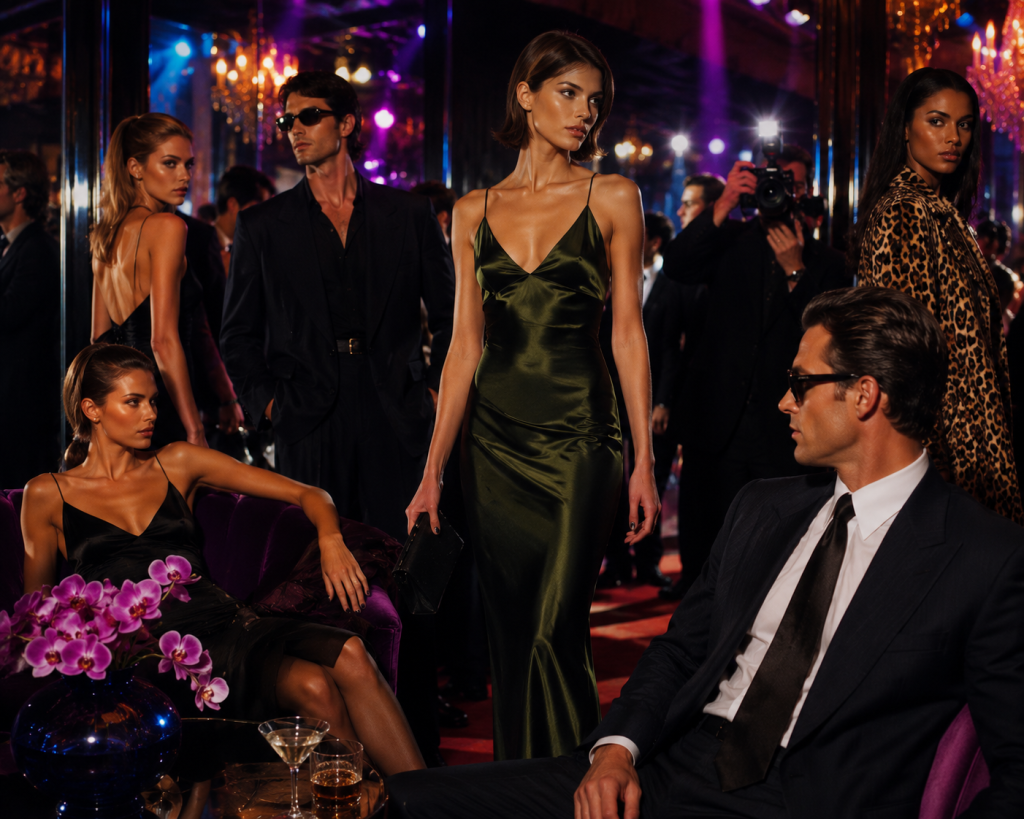
The 1990s opened with a murder and closed with an acquisition that changed luxury fashion forever. Between Gianni Versace’s assassination on the steps of Casa Casuarina and the formation of the Gucci Group conglomerate, fashion underwent a transformation as violent as the decade’s bookend event. Fashion in the 1990s replaced 1980s spectacle with minimalism. It replaced logo worship with anti-logo sophistication. Then a Texan named Tom Ford made logos desirable again by wrapping them in sex. The decade’s internal contradictions remain unresolved in 2026.
If the 1980s were about declaring your wealth, the 1990s were about declaring your taste. The distinction sounds trivial. It restructured a $100 billion industry and produced three of the most consequential creative director tenures in luxury history.
The Minimalism Revolution
Prada under Miuccia Prada set the decade’s intellectual agenda. Her “ugly chic” collections featured avocado greens, muddy browns, and 1970s secretarial prints. Each collection argued that fashion’s highest expression lay not in beauty but in intelligence. Carrying a Prada nylon bag in 1995 declared that you had transcended the logo wars. The idea mattered more than the insignia. Revenue grew from $200 million to over $1 billion during the decade. Prada proved that austerity, properly priced, ranked among luxury’s most expensive propositions.
The Minimalist Cohort
Calvin Klein, Jil Sander, Helmut Lang, and the Antwerp Six (Martin Margiela chief among them) all operated in the minimalist register. Their collective influence shaped atmosphere rather than revenue. They made the maximalism of the 1980s look crass. They gave consumers cultural permission to buy less visible luxury at higher prices. Klein’s stripped-back advertising (the Calvin Klein Obsession campaigns, the CK One fragrance launch) proved that provocation and minimalism could coexist profitably.
Helmut Lang pushed minimalism toward its conceptual edge. His bonded-fabric techniques, his elimination of decorative detail, and his decision to show collections in New York rather than Paris (a geographic provocation that challenged the French fashion establishment’s territorial authority) established him as the decade’s most uncompromising designer. Lang’s commercial ceiling remained lower than Prada’s or Klein’s. His influence, measured in the designers who cite him as a primary reference, exceeds both.
Armani, who had pioneered quiet luxury in the previous decade, found himself positioned as the establishment. Younger minimalists simultaneously honored his restraint and undermined his relevance. Armani adapted by expanding into Emporio Armani (younger, more accessible) and Armani Casa (home furnishings), proving that a lifestyle brand could age gracefully by segmenting rather than repositioning.
Tom Ford Saves Gucci
While minimalism dominated the critical conversation, the decade’s most consequential commercial event unfolded at Gucci. When Tom Ford arrived at the house in 1990 as a design director, Gucci existed as a family disaster. Revenue had cratered from overlicensing. Double-G logos appeared on everything from keychains to toilet seat covers. A brand name once synonymous with Florentine craftsmanship had diluted to meaninglessness.
The Fall 1995 Collection That Changed Everything
Tom Ford’s solution proved audacious. He stripped the brand back to its sexual core and rebuilt it as the label for people who looked good and knew it. His Fall 1995 collection defined the pivot. Velvet hip-huggers. Silk shirts unbuttoned to the navel. A satin evening dress cut so low it required double-sided tape. The fashion press went into overdrive. Revenue doubled within two years.
By 1999, Gucci generated over $1 billion annually. It had become the centerpiece of a new luxury conglomerate assembled by CEO Domenico De Sole and financed by Francois-Henri Pinault’s PPR (later renamed Kering). Ford’s commercial genius lay in understanding that sex sells at every price point. A $50 Gucci lipstick carried the same sexual energy as a $5,000 Gucci dress. That coherence across price tiers created a revenue engine that no competitor replicated until Alessandro Michele reinvented the brand entirely in 2015.
The Prada-Gucci Dialectic
Ford’s Gucci functioned as the counter-argument to Prada’s intellectualism. Both positions generated billions. The tension between “fashion as thought” (Prada) and “fashion as desire” (Gucci) became the defining creative dialectic of the decade. Among the Italian fashion houses, the Prada-Gucci opposition replaced the Armani-Versace opposition as the industry’s primary axis of creative competition. That new axis would persist through three subsequent decades of creative director appointments, departures, and reinventions.
July 15, 1997: The Murder That Ended an Era
When Gianni Versace was shot by Andrew Cunanan outside his Miami Beach mansion, the fashion industry lost its most charismatic showman. Gianni had continued producing spectacular, maximalist collections throughout the minimalist 1990s. He refused to modulate his aesthetic for critical approval. His death handed creative control to Donatella, who faced the impossible task of running a house built around a personality that no longer existed.
The Conglomeration Accelerant
Versace’s murder accelerated the conglomeration trend in ways nobody anticipated. Independent houses suddenly looked vulnerable. If a brand’s value depended entirely on its founder’s genius, a single bullet, a health crisis, or a retirement could destroy that value overnight. The conglomerate model offered corporate continuity that family ownership could not guarantee.
Bernard Arnault moved fastest. Within five years of Gianni’s death, LVMH acquired Fendi and consolidated its control over Dior. Arnault also bought stakes in Gucci itself, triggering the decade’s most dramatic corporate battle. The Gucci Group (later Kering) absorbed Bottega Veneta, Yves Saint Laurent, and Balenciaga. Arnault and Pinault fought a public bidding war for Gucci in 1999 that filled the financial pages of every European newspaper. Pinault won by offering Gucci a “white knight” deal that preserved management independence. He paid $3 billion for a house that had nearly died from overlicensing a decade earlier.
Prada attempted its own conglomerate play during the same period. Patrizio Bertelli acquired stakes in Jil Sander, Helmut Lang, Church’s shoes, and a minority position in Fendi. The strategy strained the balance sheet dangerously. Prada sold its Fendi stake to LVMH at a loss and divested the other acquisitions. The failed empire taught Bertelli a lesson he would not apply for twenty-two years, until acquiring Versace in 2025. The luxury industry entered the 21st century as a two-conglomerate duopoly. That structure persists today.
Lagerfeld’s Chanel Machine Hits Full Speed
Karl Lagerfeld’s Chanel hit full commercial velocity during the 1990s. Revenue grew from roughly $1 billion to over $3 billion as Lagerfeld perfected the formula he developed in the 1980s. Honor the codes (tweed, camellias, chains). Subvert the context (pair them with denim, crop tops, streetwear references). Stage every show as a spectacle worth photographing. The formula proved infinitely scalable because the codes never changed. Only the context rotated.
The Fendi Baguette and Multi-House Mastery
Lagerfeld’s Fendi collections ran simultaneously with his Chanel work. He produced eight to ten collections per year for each house while maintaining his own label. The Fendi Baguette bag, launched in 1997 by Silvia Venturini Fendi under Lagerfeld’s creative direction, became the decade’s most recognizable accessory. “Sex and the City” featured it in 1998. Revenue surged. LVMH’s acquisition of Fendi in 1999 paid a premium justified partly by Lagerfeld’s continued presence. His multi-house model proved that a single creative intelligence could sustain two major brands indefinitely.
Louis Vuitton Becomes a Fashion House
Louis Vuitton under Marc Jacobs (appointed in 1997) began the most consequential brand transformation in LVMH’s portfolio. Before Jacobs, Vuitton sold luggage and leather goods. After Jacobs, it sold everything. He introduced ready-to-wear for the first time in the house’s 143-year history. He hired Stephen Sprouse for the graffiti monogram collaboration that proved luxury heritage and street culture could coexist on the same product.
Jacobs positioned LV as the French fashion house most willing to engage with contemporary art and popular culture. His collaborations with Takashi Murakami (the multicolored monogram, 2003) and Richard Prince (the nurse paintings collection) generated waiting lists, secondary market premiums, and a template that every luxury house would eventually copy. That strategy prefigured the collaboration economy dominating the 2010s. Every Supreme x LV skateboard trunk and every Dior x Jordan sneaker traces its lineage to Jacobs’s decision to put graffiti on a monogram bag. Revenue at Louis Vuitton tripled during his sixteen-year tenure.
The Supermodel Peak and the Anti-Model Backlash
Supermodel culture peaked in the early 1990s and then faced a backlash that reshaped the industry’s entire visual language. Linda Evangelista, Naomi Campbell, Christy Turlington, Cindy Crawford, and Claudia Schiffer commanded unprecedented fees. Evangelista’s claim that she would not “wake up for less than $10,000 a day” reflected genuine market pricing: her face on a campaign generated measurable revenue increases. Versace built his entire marketing apparatus around these women. Chanel, Valentino, and Dior competed for their exclusive runway appearances. A supermodel’s schedule functioned as a stock ticker for brand relevance.
Grunge, Heroin Chic, and the Anti-Glamour Turn
Then grunge arrived. Marc Jacobs’s Spring 1993 collection for Perry Ellis (flannel shirts, combat boots, knit beanies on the runway at prices Perry Ellis customers found offensive) cost him his job and established grunge as fashion’s most commercially unsuccessful critical triumph. Jacobs proved that the street could dictate to the runway. The industry fired him for proving it.
“Heroin chic” followed grunge as the decade’s dominant photographic aesthetic. Corinne Day’s photographs of Kate Moss (pale, thin, shot in grim London apartments) replaced the bronzed glamour of 1980s supermodel photography. Moss became the anti-supermodel supermodel. She stood 5’7″ in an industry that required 5’10”. She weighed 105 pounds. Her appeal lay in looking like someone you might actually know, which represented a radical departure from the unattainable perfection that Crawford and Turlington embodied.
The shift reflected a broader cultural turn toward authenticity, rawness, and the rejection of aspirational perfection. Fashion photography stopped selling fantasy and started selling reality. Or at least a carefully constructed version of reality that felt more honest than what preceded it. President Clinton publicly criticized heroin chic imagery in 1997, calling it “destructive” and “not beautiful.” The industry quietly moved on to a different aesthetic. The damage to beauty standards, critics argued, had already compounded.
The American Expansion
Ralph Lauren consolidated his position as America’s defining luxury brand during the 1990s. He expanded into home furnishings, opened restaurants (the Polo Bar), and launched the flagship store in the Rhinelander Mansion on Madison Avenue. Lauren understood that American luxury worked differently from European luxury. A European customer bought a garment. An American customer bought a world. The house, the car, the table settings, the way afternoon light falls across a Nantucket porch. Revenue exceeded $5 billion by decade’s end.
Tory Burch had not yet launched (that would come in 2004). But the market she would eventually capture took shape during the 1990s. The American woman who wanted European aesthetic authority at accessible luxury prices, served with a lifestyle brand sensibility that European houses considered beneath them, existed as an underserved consumer. Burch would build a $1.5 billion brand serving her.
The Italian Middle Ground
Between the Prada-Gucci poles, other Italian houses found distinct positions. Dolce and Gabbana built a loyal following through Sicilian sensuality, corseted bodices, and relentless celebrity red carpet dressing. Madonna wore D&G throughout her “Girlie Show” tour. Celebrities discovered that Dolce and Gabbana’s clothes photographed better than almost anyone else’s, a commercial advantage worth billions in earned media. Valentino maintained his couture-level positioning through the decade, dressing every major Hollywood actress and political spouse who needed a gown that commanded a room.
Ferragamo expanded from footwear into full ready-to-wear and accessories under the Ferragamo family’s steady management, avoiding the corporate drama consuming the Gucci family. Zegna supplied the fabrics that Armani, Ford, and every other Italian menswear designer relied on, positioning itself as the invisible infrastructure behind Italian tailoring’s global dominance. Brunello Cucinelli began building his cashmere empire in the Umbrian hilltop village of Solomeo. His “humanistic capitalism” philosophy (paying artisans above-market wages, investing in community restoration, treating profit as a means rather than an end) would attract global attention two decades later when quiet luxury made understatement commercially explosive.
What Fashion in the 1990s Changed Forever
Fashion in the 1990s established the creative director as the most valuable asset in luxury. Before the decade, houses drew their identity from founders or heritage. After it, identity came from whoever held the creative director title. Ford at Gucci proved a designer could rebuild a dying brand. Lagerfeld at Chanel proved a designer could sustain a heritage brand indefinitely. Miuccia at Prada proved a designer could create an entirely new luxury category.
The Template for the 21st Century
The history of fashion after 1999 is essentially the history of creative director appointments, departures, and the billions of dollars riding on each transition. Kim Jones at three houses. Demna at two. Blazy moving from Bottega to Chanel. Lee moving from Bottega to Burberry. Every one of these moves traces back to the template the 1990s established: the designer matters more than the house, and the house that attracts the best designer wins.
For the Hamptons social circuit, the 1990s transformed the East End from a summer retreat for old money into a fashion showcase for new money. Dot-com fortunes and Wall Street bonuses brought a consumer who carried Prada nylon to beach dinners in Sagaponack and wore Gucci loafers to polo matches in Bridgehampton. The aesthetic tension of the decade (understated versus spectacular, intellectual versus sensual, old money versus new) still plays out every summer. Benefit galas, boutique openings, and private dinners from Southampton to Montauk continue the argument the 1990s started. Social Life Magazine was founded to document exactly this conversation. The brands worth partnering with are the ones still contributing to it.
Where The Conversation Continues
Connect With Social Life
Social Life Magazine has covered the intersection of luxury fashion, power, and the Hamptons for over two decades. Our five summer issues, distributed from Memorial Day through Labor Day across the East End, reach 25,000 readers who define the season’s cultural conversation. From Westhampton to Montauk, this is the publication that brands trust when the audience matters more than the impression count.
We deliver an additional 15,000 copies to Upper East Side doorman buildings during fall and winter. Our 82,000 email subscribers receive curated editorial that blends fashion authority with Hamptons insider access.
Polo Hamptons, our signature sporting and lifestyle event in Bridgehampton, brings together the brands and personalities that shape luxury culture. Christie Brinkley hosts. Getty and McMullan photograph.
Contact Cass Almendral, Head of Business Development, at [email protected] to discuss editorial features, event sponsorships, and brand activations for the 2026 season.
For Polo Hamptons corporate cabana inquiries, reach Justin Mitchell at [email protected].
Author

Written by
Recent Posts

The First Decision After a Collision Can Be the Most Important One
Two Weeks in Rome and Beyond: Turkish Airlines Itineraries from Boston, Chicago and Onward to India

Top 10 Hair Transplant Clinics in Turkey 2026
Artist Alley to Online Store: How Convention Artists Can Keep Selling After the Event
When an 18-Wheeler Crash Leaves Lasting Consequences
Categories
- Art
- Articles
- Business of Luxury
- Celebrities
- Culture
- Entertainment
- Events
- Faces of Summer 2026
- Fashion
- Fashion & Style
- Featured
- Finance
- Food, Spirits, Wine
- Hamptons
- Hamptons Celebrities
- Health
- Health & Beauty
- Lifestyle
- Luxury Lifestyle
- Press
- Profiles
- Real Estate
- Technology
- The Chronicles
- Travel
- Uncategorized
- Weddings