
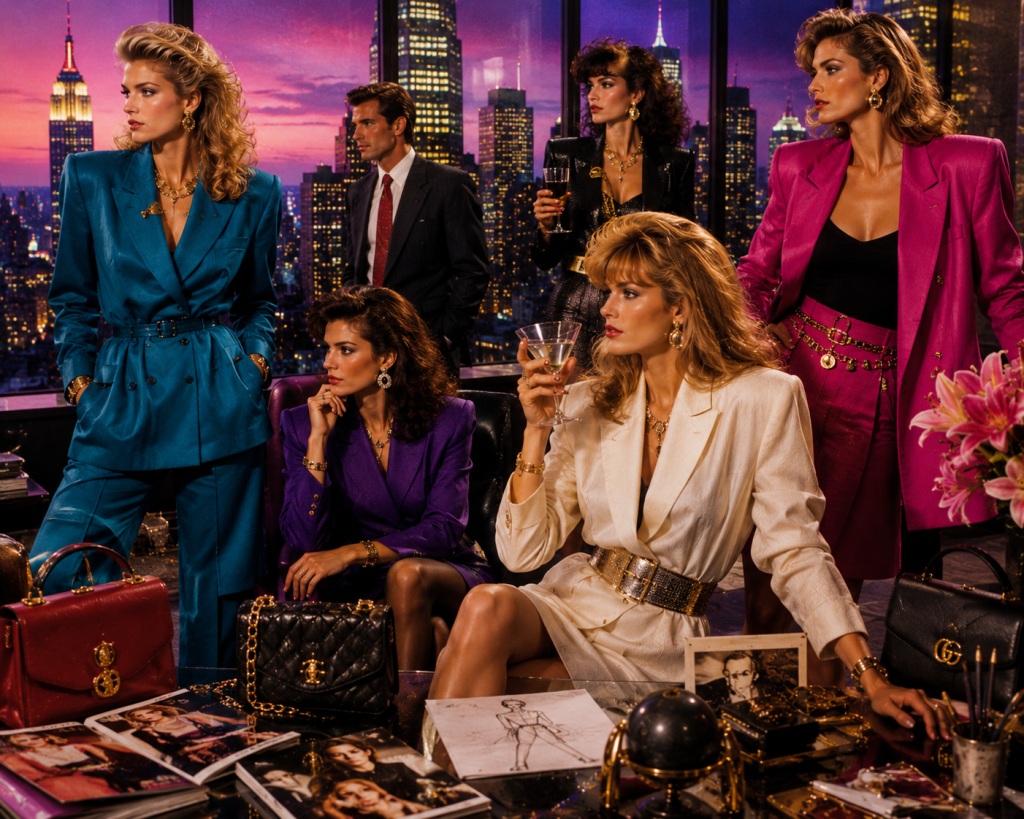
The 1980s did not invent luxury fashion. They invented luxury fashion as a mass spectacle. Before 1980, fashion served wealthy women through private appointments and discreet boutiques. By 1990, it had become a cultural force shaping how every human being on earth thought about status, identity, and the relationship between what you wear and who you are. Fashion in the 1980s turned designers into celebrities, logos into status symbols, and the red carpet into a runway generating more commercial value than the actual runways in Paris and Milan combined.
Three simultaneous forces drove the shift. The power suit emerged as the corporate uniform for a generation of women entering boardrooms for the first time. Designer logos exploded from discreet interior labels into billboard-scale identity markers. Fashion merged with entertainment through MTV, Hollywood, and supermodel culture. Each force amplified the others. Corporate women needed power dressing. Power dressing needed designer names. Designer names needed celebrity visibility. Celebrity visibility needed MTV. The feedback loop generated billions and transformed fashion from a craft industry into a media empire.
The Power Suit Revolution
Giorgio Armani did not invent the power suit. He made it feel inevitable. His unstructured blazer stripped away rigid canvas lining and heavy shoulder pads. Executives could look authoritative without looking uncomfortable. When Richard Gere wore Armani throughout “American Gigolo” in 1980, the film functioned as a 117-minute advertisement for Italian tailoring. No media buy could have replicated the impact. Revenue tripled between 1980 and 1985. Every menswear brand in Milan recalibrated toward softer construction.
Women Enter the Boardroom
For women, the power suit solved an existential wardrobe crisis. Female executives entered corporate boardrooms in unprecedented numbers throughout the decade. Traditional feminine dress signaled subordination. Traditional masculine suits signaled imitation. Armani found the third path: structured but fluid, authoritative but elegant, serious without severity. His womenswear became the unofficial uniform of Wall Street’s first generation of female managing directors. Washington’s female senators wore Armani to hearings. Entertainment lawyers negotiated deals in Beverly Hills wearing jackets that cost more than their first cars.
Donna Karan launched her “Seven Easy Pieces” collection in 1985, addressing the same professional woman Armani dressed but with a distinctly American approach. Her bodysuit-as-foundation system (body suit, skirt, jacket, pants, coat, evening piece, and the connecting accessories) gave working women a modular wardrobe that traveled from office to dinner without requiring a change of clothes. Karan understood that the American professional woman did not have time for outfit changes. She needed one system that worked across every context. Revenue at Donna Karan New York reached $115 million within three years of launch.
The Italian Explosion
The 1980s were the decade when Italian fashion overtook French fashion as the dominant commercial force in luxury. Paris retained its couture prestige. Milan generated the revenue. Armani, Versace, Valentino, Fendi, and Dolce and Gabbana (who debuted in 1985) collectively built a commercial infrastructure dominating global luxury for the next four decades. Lagerfeld continued his simultaneous Fendi tenure, now twenty years running, producing fur innovations and accessories that positioned the Roman house for the LVMH acquisition that would come in 1999.
Versace: The Anti-Armani
Gianni Versace represented the opposite pole from Armani. Where Armani whispered, Versace screamed. The Medusa head logo, the baroque prints, the chainmail dresses, the deliberate sexuality: Versace treated fashion as theatre and the customer as performer. His advertising campaigns featured supermodels shot by Richard Avedon and later by Bruce Weber. Each campaign provoked as aggressively as the clothes themselves.
The tension between Armani’s restraint and Versace’s excess defined Italian fashion’s dual identity throughout the decade. That tension continues structuring the market today. A woman choosing between Armani and Versace for a Southampton benefit gala in 1985 faced the same decision her granddaughter faces in 2026: do you want to command the room or ignite it? Both answers generate revenue. Both require conviction. Italian fashion’s genius lay in offering both options at the highest possible quality and letting the customer decide.
Prada, under Miuccia’s emerging leadership, introduced the nylon backpack in 1984 and quietly built a third position. Intellectual luxury rejected both Armani’s corporate polish and Versace’s Mediterranean spectacle. The nylon bag functioned as a thesis disguised as an accessory. It argued that the idea behind an object mattered more than its materials. That argument would not reach full commercial maturity until the 1990s. But the foundation took shape in the 1980s, and it proved more durable than either pole it positioned itself against.
The Logo Wars
If the 1970s belonged to discreet luxury, the 1980s belonged to conspicuous consumption. Designer logos migrated from garment interiors to exteriors, from subtle signifiers to billboard-scale declarations. Louis Vuitton’s monogram canvas, originally designed to prevent counterfeiting in the 19th century, became the most recognized luxury pattern on earth. Chanel’s interlocking Cs, revived by Karl Lagerfeld after he took creative control in 1983, appeared on earrings, belts, bags, and buttons with a frequency that Coco herself would have considered vulgar.
Lagerfeld Resurrects Chanel
Lagerfeld’s resurrection of Chanel ranks as the decade’s most consequential creative appointment. The house had drifted since Coco’s death in 1971. Revenue declined steadily. Tweed suits existed in museum vitrines but not in the cultural conversation. Younger women associated Chanel with their grandmothers. The Wertheimer family hired Lagerfeld as a Hail Mary.
Lagerfeld’s first move proved characteristically audacious. He shortened the skirts, exposed midriffs, added chain belts, and paired tweed with denim. He kept the camellias, the double-C logo, and the 2.55 bag. But he recontextualized every code for women who went to nightclubs, not garden parties. The strategy worked because it was simple in theory and almost impossible in execution: make the heritage feel modern without breaking it. Revenue began the trajectory from $500 million to the $17 billion empire it would become. Among the French fashion houses, Chanel’s 1980s revival remains the most commercially successful brand resurrection ever executed.
Ralph Lauren and the American Logo
Ralph Lauren built the American version of the logo wars. His Polo player emblem became the most widely worn luxury symbol in the United States. It appeared on polo shirts, Oxford shirts, blazers, and the preppy wardrobe dominating East Coast social life throughout the decade. Lauren understood that the American luxury consumer wanted heritage without history. Aristocratic signaling without aristocratic lineage. The Polo logo sold an identity: old money taste at new money prices.
His flagship store in the Rhinelander Mansion on Madison Avenue (opened in 1986) became luxury retail’s most ambitious theatrical production. An entire townhouse converted into a living fantasy of American aristocratic life. Mahogany paneling. Oriental rugs. Antique furniture. Customers did not walk into a store. They walked into the world Ralph Lauren had invented, and they left carrying pieces of it in shopping bags. Revenue exceeded $3 billion by decade’s end. No other American brand came close.
Supermodels and the Birth of Fashion Celebrity
The 1980s created the supermodel as a cultural category. Before the decade, models served as anonymous mannequins. By its end, Linda Evangelista, Christy Turlington, Naomi Campbell, Cindy Crawford, and Claudia Schiffer ranked as famous as the designers who hired them. Evangelista’s claim that she would not “wake up for less than $10,000 a day” reflected genuine market pricing. Her face on a campaign generated measurable revenue increases that justified the fee.
Versace’s Supermodel Machine
Versace served as the primary architect of supermodel culture. His runway shows featured the same five or six women season after season. That repetition built recognition transferring from catwalk to magazine covers to advertising campaigns. The exclusivity functioned as strategy: if Naomi walked for Versace and only Versace during Milan Fashion Week, every photograph of her in a Versace dress became a de facto endorsement worth millions in earned media.
The economics changed the industry permanently. Before the supermodel era, fashion houses spent marketing budgets on advertising pages in Vogue and Harper’s Bazaar. After the supermodels proved that a recognizable face generated more consumer response than any print advertisement, houses redirected budgets toward celebrity relationships. The celebrity endorsement economy that dominates luxury marketing in the 2020s traces directly to the supermodel economy Versace built in the late 1980s. Donatella inherited that infrastructure and maintained it through three decades of ownership changes.
MTV, Hollywood, and the Fashion-Entertainment Merger
MTV launched in 1981 and immediately created a new distribution channel for fashion. Music videos showed garments in motion, in context, attached to performers whose cultural influence exceeded any model’s reach. Madonna’s “Material Girl” video (1984) put Marilyn Monroe-era glamour back into the cultural conversation. Michael Jackson’s “Thriller” jacket became the decade’s most imitated garment. Run-DMC’s “My Adidas” (1986) created the first sneaker endorsement deal and foreshadowed the streetwear-luxury convergence that Virgil Abloh would complete three decades later.
Hollywood amplified the effect. “Dynasty” and “Dallas” dressed their characters in shoulder-padded power suits and sequined evening gowns that viewers replicated at every price point. Nolan Miller’s “Dynasty” costumes generated more consumer imitation than any Paris runway show of the same era. Fashion’s traditional hierarchy (couture creates, ready-to-wear adapts, the consumer follows) inverted. Television created desire. Designers scrambled to supply it. The power relationship between fashion creators and entertainment distributors shifted permanently during the 1980s. It has only tilted further toward entertainment in every subsequent decade.
The Business of Luxury Scales Up
The 1980s witnessed the beginning of luxury conglomeration. Bernard Arnault, a French real estate developer with no fashion background, acquired a controlling stake in LVMH in 1989 through a hostile takeover that the industry watched with horror and fascination. His consolidation of Dior, Givenchy, Celine, and eventually dozens of other brands created a corporate model that every competitor would eventually adopt or be consumed by.
The Fragrance and Licensing Gold Rush
Licensing revenue exploded during the decade. Designer fragrances (Obsession by Calvin Klein, Poison by Dior, Giorgio Beverly Hills) generated hundreds of millions in royalties for houses whose couture ateliers ran at a loss. The economics were irresistible. A $50 perfume bottle carrying a luxury house’s name cost $3 to manufacture and $10 to market. Margins exceeded 80%. Houses that had survived on custom orders from a few hundred wealthy clients suddenly accessed millions of aspirational consumers through department store fragrance counters.
The licensing model funded creative ambition. Couture shows that cost $500,000 to stage could be underwritten by fragrance royalties. Ready-to-wear collections that broke even at best could be subsidized by sunglasses and hosiery licensing deals. The arrangement worked until it didn’t. By the late 1990s, overlicensing had diluted brands like Gucci and Pierre Cardin so severely that recovery required total creative reinvention. The 1980s licensing gold rush created the revenue model the industry still uses. It also created the brand dilution problem the industry has never fully solved.
The Japanese Avant-Garde Arrives in Paris
Rei Kawakubo (Comme des Garcons) and Yohji Yamamoto showed their first Paris collections in 1981. The reaction from the French fashion establishment ranged from bewilderment to hostility. Kawakubo sent models down the runway in asymmetric black garments with holes, raw edges, and silhouettes that concealed rather than revealed the body. French critics called it “post-atomic fashion” and “Hiroshima chic.” Both labels missed the point entirely.
Kawakubo and Yamamoto introduced a design philosophy that treated fashion as intellectual inquiry rather than commercial decoration. Their influence would percolate through the industry for decades. Martin Margiela’s deconstructionism, Miuccia Prada’s “ugly chic,” and Demna’s Balenciaga provocations all trace conceptual lineage to the Japanese avant-garde’s 1981 Paris debut. Mainstream fashion ignored them in the 1980s. By the 2020s, the mainstream cannot imagine fashion without them.
The Gucci Family Wars
For independent houses like Gucci, the 1980s brought family warfare and brand dilution in equal measure. The Gucci family’s internal feuds (Aldo Gucci imprisoned for tax evasion in 1986, Maurizio Gucci seizing control through boardroom maneuvers, the overlicensing that put the double-G logo on 22,000 different products) damaged the brand so severely that it would take Tom Ford’s complete reinvention in the mid-1990s to recover. Ferragamo navigated the decade more successfully under Wanda Ferragamo’s steady family management. She expanded from footwear into ready-to-wear and accessories without the self-destructive drama consuming the Guccis. Zegna continued building its textile empire quietly, supplying the fabrics that Armani and every other Italian menswear designer relied on.
What Fashion in the 1980s Built
Fashion in the 1980s established every structural element defining the luxury industry today. Celebrity-designer relationships, logos as status symbols, conglomerate business models, the Italian-French rivalry as creative engine, supermodels as marketing assets, the power suit as professional credential, and the entertainment industry as fashion’s primary distribution channel. Every development in the history of fashion since 1990 represents either an extension of or a reaction against the systems the 1980s built.
The Hamptons in the Reagan Era
For the Hamptons social circuit, the 1980s established the East End as a luxury fashion showcase. The power couples who built estates in Southampton and Bridgehampton during the Reagan era brought their Armani suits, their Versace evening wear, their Chanel bags, and their Ralph Lauren polo shirts. They created the social ecosystem where fashion choices function as entrance exams. Brand recognition operates as a shared language spoken across every benefit gala, polo match, and private dinner from Memorial Day to Labor Day. That ecosystem survives intact four decades later. The brands have rotated. The language has evolved. Bottega replaced logo bags. Cucinelli replaced power suits. Off-White hoodies appear where Versace once monopolized attention. But the social function of fashion on the East End (signaling belonging, demonstrating taste, establishing hierarchy through garments) remains exactly what the 1980s invented. Every summer season from Memorial Day to Labor Day continues the conversation the Reagan era started. Social Life Magazine exists to document it.
Where The Conversation Continues
Connect With Social Life
Social Life Magazine has covered the intersection of luxury fashion, power, and the Hamptons for over two decades. Our five summer issues, distributed from Memorial Day through Labor Day across the East End, reach 25,000 readers who define the season’s cultural conversation. From Westhampton to Montauk, this is the publication that brands trust when the audience matters more than the impression count.
We deliver an additional 15,000 copies to Upper East Side doorman buildings during fall and winter, extending the Hamptons conversation into Manhattan’s most exclusive residential addresses. Our 82,000 email subscribers receive curated editorial that blends fashion authority with Hamptons insider access.
Polo Hamptons, our signature sporting and lifestyle event in Bridgehampton, brings together the brands and personalities that shape luxury culture. Christie Brinkley hosts. Getty and McMullan photograph.
Contact Cass Almendral, Head of Business Development, at [email protected] to discuss editorial features, event sponsorships, and brand activations for the 2026 season.
For Polo Hamptons corporate cabana inquiries, reach Justin Mitchell at [email protected].
Author

Written by
Recent Posts
The Skincare Habits That Make a Real Difference Over Time
Hamptons-Ready Beauty: Polished Makeup for Long Summer Days
Is Now a Good Time to Sell a Home in NJ?

The Hidden Work Behind a Seamless Hotel Weekend
Choosing Scratching Furniture for a British Shorthair
Categories
- Art
- Articles
- Business of Luxury
- Celebrities
- Culture
- Entertainment
- Events
- Faces of Summer 2026
- Fashion
- Fashion & Style
- Featured
- Finance
- Food, Spirits, Wine
- Hamptons
- Hamptons Celebrities
- Health
- Health & Beauty
- Lifestyle
- Luxury Lifestyle
- Press
- Profiles
- Real Estate
- Technology
- The Chronicles
- Travel
- Uncategorized
- Weddings